Free tool - no account, nothing uploaded
Free AI visibility checker for ChatGPT, Perplexity and Gemini
This free AI visibility checker does not hand you a score. It hands you the 25 questions worth asking and a sheet for recording what comes back. Enter a brand and the category a buyer would actually say, and the generator below writes the prompt set: five discovery prompts, five brand prompts, five comparison prompts, five problem-first prompts and five buying-intent prompts. Run them yourself, mark two booleans per answer, and you will understand your AI search visibility better than any 0-100 number can explain it.
Step 1 - describe the brand you are checking
Nothing leaves your browser. The prompts below rewrite as you type, and the page keeps no record of what you entered.
Leave this blank and group 4 falls back to your category, which is the easier test. Fill it in and you get the harder one: does the engine reach you from a symptom, without the category word?
25 prompts, 5 per group. The scoring sheet expands them to 75 rows - one per prompt per engine. Showing a worked example for Jincove until you enter your own brand and category above.
1. Category discovery
Nobody names you. This is the only group that tells you whether an engine surfaces you to a buyer who has never heard of you.
- 1What are the best GEO monitoring platforms for agencies?
- 2Top GEO monitoring platforms for agencies - which ones should I shortlist, and why?
- 3Who are the leading providers of GEO monitoring platforms for agencies right now?
- 4Recommend GEO monitoring platforms for agencies for a small team with a limited budget.
- 5Which GEO monitoring platforms for agencies do people actually recommend in 2026, and on what grounds?
2. Direct brand
The engine has been handed your name. Now you are checking whether it knows what you do and whether it gets the facts right.
- 6What is Jincove?
- 7Is Jincove any good? What do customers say about it?
- 8Who is Jincove built for, and who should not use it?
- 9Is Jincove a legitimate company? Summarize what you know and cite your sources.
- 10What are the main criticisms or downsides of Jincove?
3. Comparison
The highest-intent group. Somebody is down to a shortlist, and the engine is about to describe you in a competitor context.
- 11How does Jincove compare with the other leading GEO monitoring platforms for agencies?
- 12What are the best alternatives to Jincove?
- 13Which GEO monitoring platforms for agencies offer better value than Jincove?
- 14Compare Jincove with its two closest competitors on pricing and features.
- 15List the top alternatives to Jincove and explain how each one differs.
4. Problem-first
The buyer describes a symptom and never names the category. This is where most brands quietly disappear, because the engine picks the category for them.
- 16Our team is stuck choosing GEO monitoring platforms for agencies. What are my options?
- 17Our team is stuck choosing GEO monitoring platforms for agencies. Is there a tool that fixes this, or do I need to hire someone?
- 18How do other companies handle this: our team is stuck choosing GEO monitoring platforms for agencies?
- 19Our team is stuck choosing GEO monitoring platforms for agencies. What should I try first, and what is a waste of time?
- 20Who should I buy from or hire if our team is stuck choosing GEO monitoring platforms for agencies?
5. Buying intent
Money questions. Wrong pricing in an AI answer costs more than being absent, because the buyer acts on it without ever visiting your site.
- 21How much do GEO monitoring platforms for agencies usually cost?
- 22Jincove pricing - what are the plans, and what is included in each?
- 23Is Jincove worth the price compared with cheaper options?
- 24What is the cheapest reliable way to get GEO monitoring platforms for agencies?
- 25Do GEO monitoring platforms for agencies offer free trials or free plans? Which ones, and what are the limits?
What this AI visibility checker measures: mentioned, then cited
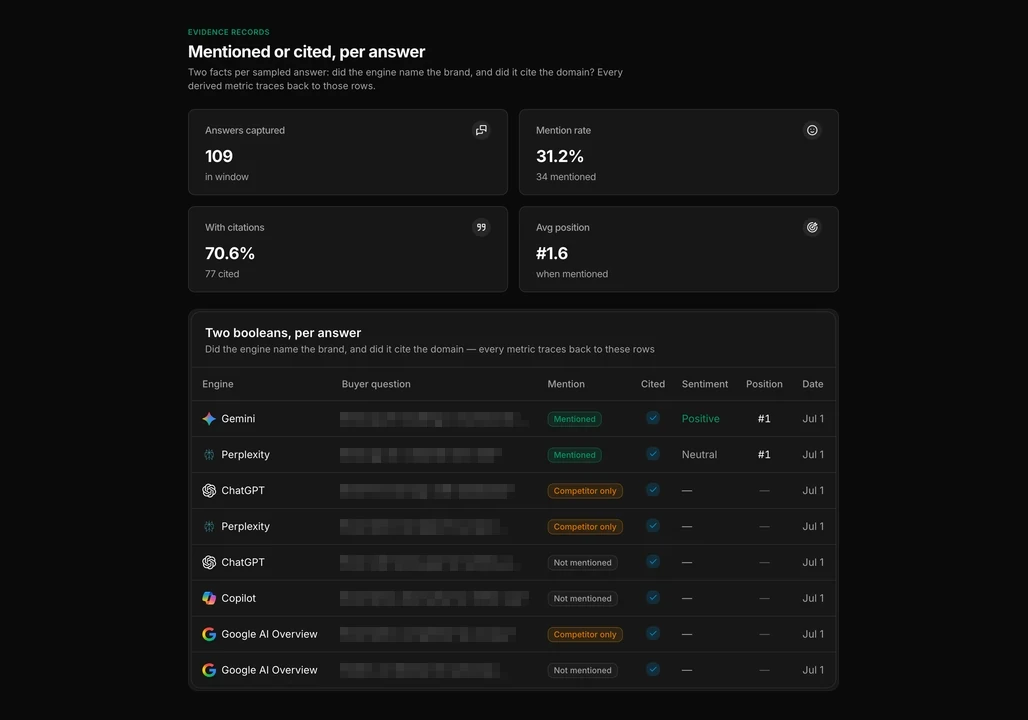
Every answer gets exactly two booleans. Mentioned means the engine wrote the brand name. Cited means a URL on the brand domain appears in the sources. Keeping them apart is the whole point, because the four combinations have four different causes and four different fixes.
- Mentioned N / Cited NInvisible
- The engine did not reach you at all. Concentrated in groups 1 and 4, this is a coverage problem, not a website problem.
- Mentioned N / Cited YConversion gap
- Your page was good enough to be the source, and the answer still credited someone else or nobody. The content works; the entity attribution does not.
- Mentioned Y / Cited NSource gap
- The engine knows your name from third-party coverage but does not read your own site. Fixes live in quotable, structured pages on your domain.
- Mentioned Y / Cited YVisible
- The only cell that counts. Track the ratio per group over time rather than a single blended total.
What you need before you start
The AI visibility checker above takes five inputs and only two of them are required. Getting the optional three right is what separates a useful run from a sheet full of noise.
- The brand name exactly as buyers write it. Include the legal suffix only if people really type it.
- One category phrase in buyer language, not internal language. If your team says output-side answer verification layer and buyers say AI visibility tools, use the buyer version.
- One real competitor you lose deals to. Optional, but it roughly doubles what group 3 tells you.
- One symptom sentence - the way a buyer describes the pain before they know your category exists.
- A spreadsheet and 90 minutes. 75 answers is roughly an hour and a half at a steady pace.
How to check your AI visibility of a website in six steps
- Step 1
Copy the sheet into a spreadsheet
Fill in the form, press Copy as scoring sheet, and paste into Google Sheets or Excel. Paste as plain text so the tabs split into six columns: prompt, group, engine, mentioned, cited, notes. You get 75 rows - 25 prompts across three engines.
- Step 2
Open one clean session per engine
Logged out where the engine allows it, personalization and chat history off, one region for all three. Write the date and the region at the top of the sheet. Without those two facts the run is not reproducible, and an unreproducible run cannot prove anything later.
- Step 3
Run prompt 1 on all three engines, then prompt 2
Batch by prompt, not by engine. Running all 25 on ChatGPT first lets one long conversation contaminate the later answers, and you end up measuring the session rather than the engine.
- Step 4
Mark mentioned: did it write the name?
Y only if the engine writes your brand name in the answer. Your category is not a mention. A paraphrase is not a mention. A link with no name in the prose is not a mention either - that is the next column.
- Step 5
Mark cited: is your domain in the sources?
Y only if the citation list, footnote or source panel contains a URL on your domain. Being described accurately with somebody else supplying the links is the single most common finding, and it scores N here.
- Step 6
Put anything surprising in notes
A wrong price, a feature you discontinued, a competitor called the market leader, a review site you have never heard of doing all the citing. The notes column is what a client reacts to, more than any count.
When this method does not work
A manual check is the honest starting point, not the finished answer. These are the conditions under which the sheet will mislead you, and you should know all six before you put the output of any AI visibility checker, manual or automated, in front of a client.
- One sample is an anecdote. The same prompt on the same engine can name you at 09:00 and skip you at 11:00. Treat a single pass as a snapshot, never as a measurement, and re-run before you act on anything.
- Answers drift with the session. Account history, memory, personalization, region and even the phrasing of the previous turn move the result. Two people running this sheet on the same day will not get identical rows, and that is the tool behaving normally.
- 25 prompts is a probe, not a census. Real demand is a long tail of thousands of phrasings. This set is built to cover the five shapes that matter, not to be exhaustive, so absence here does not prove absence everywhere.
- By hand, there is no time series. You cannot prove a fix worked without the same prompts, the same engines and the same settings before and after, and nobody keeps that discipline manually for six months.
- If the brand is new or has almost no third-party coverage, all 75 rows come back N and the sheet tells you only one thing: start with coverage, not with prompts.
- If the category phrase is internal jargon, group 1 tests a question no buyer asks. Get the category wording from sales calls or search data before you run anything.
How this differs from a one-click AI visibility checker
Most free tools that call themselves an AI visibility checker take a domain and return a number in seconds. That is a genuinely better experience, and it is worse evidence. Here is the trade honestly stated, including the parts where the one-click version wins.
| Typical score-based checker | This prompt set generator | |
|---|---|---|
| Input | A domain | Brand, category, competitor, pain |
| Output | One score | 25 prompts and a 75-row scoring sheet |
| Who picked the prompts | The vendor, usually unpublished | You, and you can edit every one |
| Can you audit a row | Rarely | Always - you read the answer |
| Time to a result | Seconds | About 90 minutes |
| Runs on a schedule | Often, on a paid plan | Not by hand - that is what monitoring is for |
If you want the reasoning behind the two booleans, read why AI cites your content but not your brand and the source gap and conversion gap audit framework. For the tooling comparison, see our honest shortlist of AI visibility tools for agencies and what the six-engine evidence pipeline records.
Want the three-engine version run for you?
Running 25 prompts across three engines takes one to two hours, and the result starts drifting the day after you finish. If you would rather not spend the afternoon, send one brand URL and we run a sample audit by hand across ChatGPT, Perplexity and Gemini and reply with a mini evidence report inside two business days. It is a human run, not an instant scan: no card, no account, and no score without the answer behind it. Scheduled re-runs across all six engines are the paid product, priced on usage-based credits.
AI visibility checker FAQ
- What is an AI visibility checker?
- An AI visibility checker is any tool that estimates whether AI answer engines - ChatGPT, Perplexity, Gemini, Google AI Overviews, AI Mode, Copilot - name a brand when someone asks a buying question. Most of them ask for a domain and return a score between 0 and 100. The number comes from a prompt set the vendor chose and a weighting the vendor decided, neither of which you usually get to see. This page takes the other route: it generates the prompt set in front of you, and you record the answers yourself. Slower, but every row is something you actually watched happen.
- Why does this AI visibility checker not give me an instant score?
- Because we would have to invent it. Jincove has no self-serve scoring product, and a score we cannot show you the evidence for is exactly the thing this page argues against. A single number also hides the finding that matters most: whether an engine names you, cites you, both, or neither. Those four states have four different fixes, and averaging them into one figure destroys the information. If you want a number for a client deck, build it from your own sheet - percentage of rows that are mentioned and cited, reported per group - so you can always open the answer behind it.
- Is this AI visibility checker really free?
- Yes, and there is no account, no email gate and no upload. The prompt set and the scoring sheet are generated in your browser with JavaScript; nothing you type is sent anywhere or stored. You can close the tab and the inputs are gone. What costs money is scale: running the same set across six engines every week, keeping the raw answers, and diffing them over time. That is what our paid monitoring does. The free human-run sample audit sits in between - we run three engines by hand for one brand and send back a mini evidence report.
- How do I check the AI visibility of my brand across ChatGPT, Perplexity and Gemini?
- Fill in the brand and category above, copy the 75-row sheet, then open one clean session per engine in the same region on the same day. Run prompt 1 on all three engines before moving to prompt 2, so no single long conversation skews the later answers. Score two booleans per answer: mentioned, meaning the engine wrote your name, and cited, meaning your domain appears in the sources. Note the date and region at the top. Budget roughly an hour and a half for a full pass, and repeat monthly if you are working on a fix.
- What is the difference between being mentioned and being cited?
- Mentioned means the answer contains your brand name. Cited means a URL on your domain appears in the source list. They come apart constantly, and the direction tells you what to fix. Cited but not mentioned is a conversion gap: your content earned the citation and the brand got no credit, usually because the page never states plainly who published it and what they do. Mentioned but not cited is a source gap: the engine learned your name from directories, reviews and press, and reads those instead of you. One is a content-attribution problem, the other is a coverage problem.
- How often should I re-run the check?
- Monthly is the useful floor for an active brand, and weekly during a push. Anything less frequent and you cannot separate a real change from the ordinary noise between two runs of the same prompt. The rule that matters more than frequency is consistency: identical prompts, identical engines, identical region and session settings, recorded every time. A messy weekly run tells you less than a disciplined monthly one. This is also the point where manual checking stops scaling, which is why scheduled re-runs exist as a paid product rather than a browser tool.
An AI visibility checker is only as good as the prompts behind it and the evidence you can open afterwards. Generate the set, run it once by hand, and keep the sheet - the first honest baseline is worth more than a score you cannot explain, and it is the thing every later measurement gets compared against.
Start with the free audit
Send us one brand. We’ll run it through the engines and send back the answers, citations, and sources — so the first report your client sees is already backed by evidence.
Free audit: ChatGPT, Perplexity and Gemini, run by hand. Paid work covers all six engines.