Source Gap vs Conversion Gap: A 2x2 Framework for AI Visibility Audits
Score every prompt on two booleans - brand named, own domain cited - and every AI answer lands in one of four quadrants: stronghold, conversion gap, source gap, or whitespace. Each quadrant has one fixed move.
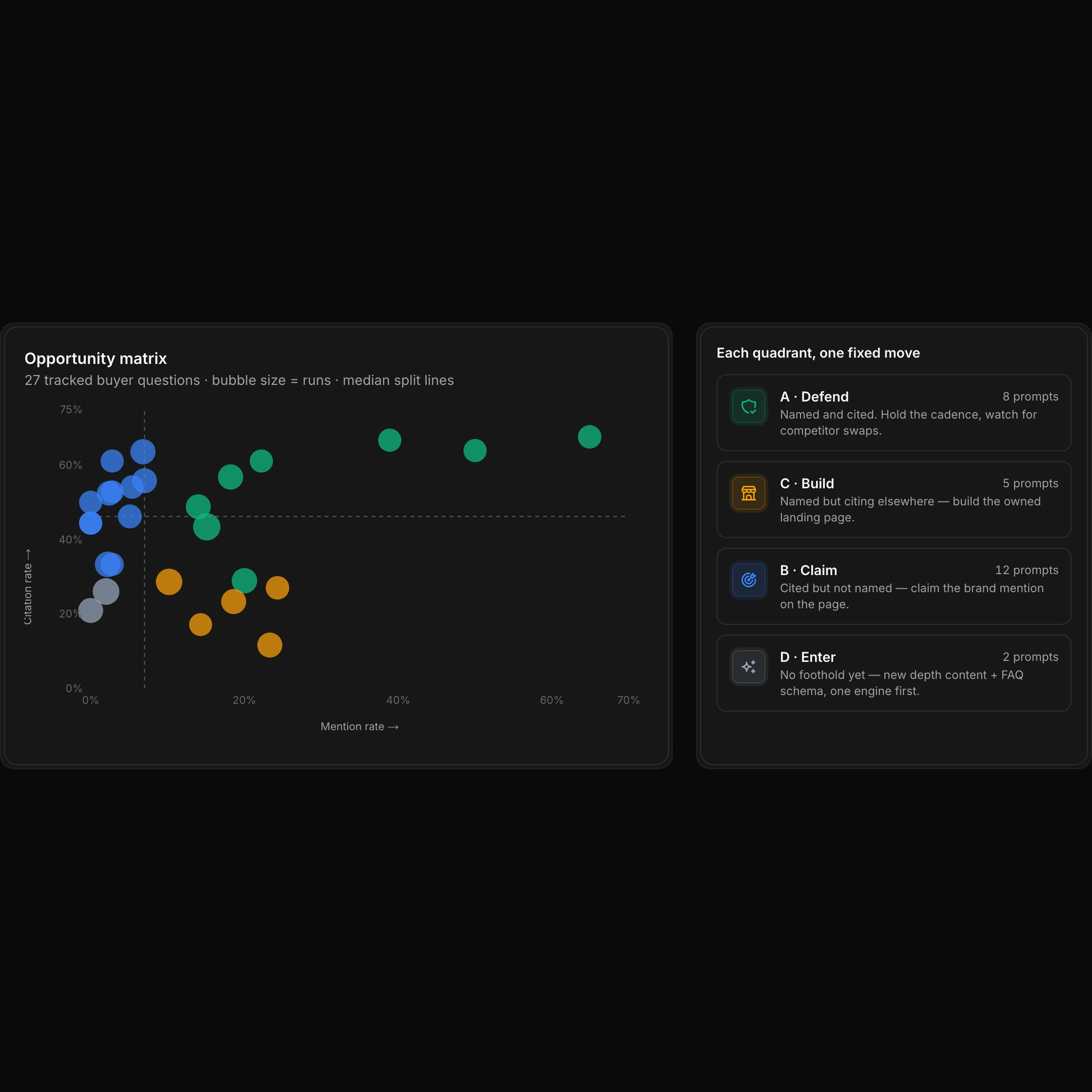
TL;DR: Score every prompt on two independent booleans - did the AI name your brand (mention) and did it cite your own domain (citation). You get four quadrants: Stronghold (named and cited), Conversion gap (cited, not named), Source gap (named, but the citation points elsewhere), and Whitespace (neither). Each quadrant has one fixed move.
Most AI visibility audits collapse into a single number. Someone runs a few prompts through ChatGPT, eyeballs the answers, and reports back: "you're at 40% visibility." Nobody can act on that. Forty percent of what? Named, or cited, or both, blurred together?
This framework refuses the blur. It keeps the two signals separate, because they fail for different reasons and get fixed with different work.
The two booleans (and why they never merge)
Every answer-engine run gives you three things you can open and read: the exact answer text, the cited sources, and the provider metadata (which model, which country, web search on or off). From the answer text and the source list, you extract two independent facts:
- Mention - is your brand named in the answer the reader sees? A boolean. Yes or no.
- Citation - is your own domain listed as one of the sources under that answer? Also a boolean. Yes or no.
These are not two views of one thing. The AI can name you without linking you - it "knows" the brand but pulls its facts from a review site. It can cite your page without ever saying your name - your content answered the question and the brand got dropped. Merge them into one visibility score and you delete exactly the signal you need to act on. Keep them apart and every prompt lands in one of four boxes. For the scoring rules on their own - what counts as a mention, what counts as a citation, and how to score an edge case the same way twice - use the mention vs citation glossary entry. For the deeper case on why the two signals stay separate, read mention vs citation: why AI cites your content but never names your brand.
The 2x2
Run a batch of prompts across your answer engines. For each prompt, mark mention (Y/N) and citation (Y/N). Every answer lands in a quadrant:
| Your domain cited | Someone else's domain cited | |
|---|---|---|
| Brand named | Stronghold - named and cited | Source gap - named, but the answer leans on another site |
| Brand not named | Conversion gap - your content is cited, your brand vanished | Whitespace - neither named nor cited |
Two axes, four quadrants, and a fixed move for each. The baseline is always your own history - you diff each prompt against your own past runs, not against an absolute target someone invented.
Quadrant 1 - Stronghold (named and cited)
The AI says your name and links your domain. The reader sees the brand and can click through to you. This is the outcome the whole audit is chasing.
The fixed move: defend and monitor. Strongholds decay silently - a model update, a fresh competitor page, a re-crawl, and a prompt that named you last month names someone else this month. Put these prompts on a schedule (weekly down to every 15 minutes if the query is high-stakes) and diff against your own history. A change gets flagged only when it moves beyond sampling noise, and every flag traces back to a stored answer you can reopen.
Quadrant 2 - Conversion gap (cited, not named)
Your page is in the source list. Your brand is nowhere in the answer. The reader absorbs your content, credits the AI, and never learns you exist. You did the work; the answer took the credit. The full definition, with a worked example and the one misreading that wastes a month, is on the conversion gap glossary page.
The fixed move: brandable content. The citation proves the content earned its place. The missing mention says the content doesn't carry the brand inside the quotable sentence - the part the model lifts into the answer. Rewrite so the brand name travels with the claim, not just the byline. You are not trying to make the AI "say something nice" - that is not a lever anyone controls, and no audit can promise it. You are making the brand harder to strip out of the sentence the model already wants to quote.
Quadrant 3 - Source gap (named, citing someone else)
The AI names you - then cites a review site, a competitor, a directory, a forum thread. The reader hears your name and gets pointed at somebody else's domain to learn more. That other domain owns the click, the context, and the next brand it recommends. The source gap glossary entry sets out how to measure it and how it differs from the quadrant above.
The fixed move: reclaim the source. Find the exact URL the answer cited in your place. Is it a comparison page you could out-publish? A stat you could host with fresher, first-party numbers? A question your docs answer better? The stored answer names the domain that beat you, so this is not guesswork - you are competing against a specific page, on the record.
Quadrant 4 - Whitespace (neither)
You are absent. Not named, not cited. For some prompts that is fine - genuinely off-topic. For others it is the biggest untapped surface you have: high-intent questions where you simply do not appear yet.
The fixed move: triage, then enter. Sort whitespace prompts by intent. The high-intent ones become a content roadmap: what would need to exist for a model to name or cite you here? Re-audit after you publish and watch which prompts migrate out of whitespace - and into which quadrant.
The output side of the ontology conversation
Teams building AI-native content pour effort into the input side - ontologies, knowledge graphs, retrieval, grounding - shaping what a model could know about them. That is real work, and it is someone else's job. We do not build any of it.
This framework is the output side. It reads what the answer engines actually said and reduces each answer to two booleans that trace back to one stored record you can open. When a prompt sits in the source gap, you can pull the exact answer, see the exact competing URL, and check the method yourself. Evidence, not a score. For the full split between shaping input and auditing output, read input-side grounding vs output-side verification.
That is the difference between "your AI visibility is 40%" and "these high-intent prompts name you but cite a third-party review directory - here is each URL." One is a number to nod at. The other is a work order.
The GEO audit checklist
Run this on any brand. Note what it is not: a static scan of your site or a simulated score of your schema. A GEO audit in this method runs the questions buyers actually ask through the engines themselves and reads what came back:
- Pick 20-50 real prompts people actually ask in your category - question-shaped queries, not brand-name lookups.
- Run each across your engines, capturing exact answer text and cited sources.
- Mark two booleans per run: brand named (Y/N), own domain cited (Y/N).
- Drop each prompt into its quadrant.
- Assign the fixed move per quadrant: defend, brandable content, reclaim the source, or triage-and-enter.
- Set a schedule, then diff against your own history over a defined sampling window.
Two booleans. Four boxes. Four moves. That is the whole audit, and every cell traces back to an answer you can read. For the step-by-step operations version - scoping prompts with the client, running it the same way every time, and turning it into a retainer - follow the GEO audit checklist for agencies. If you run this across a client book, see how agencies package AI visibility monitoring.
Start with the free audit
Want to see your own 2x2 before you spend a dollar? Request the free, human-run audit: send a URL and an email, and we hand-run ChatGPT, Perplexity, and Gemini, then reply with the exact answers and sources. No card, no account. The paid Evidence Sprint extends the same method to around 20 buyer questions across all six engines, sorted into these quadrants with a prioritized fix list.
Related blogs
Related Post
Expand your knowledge with these hand-picked posts.
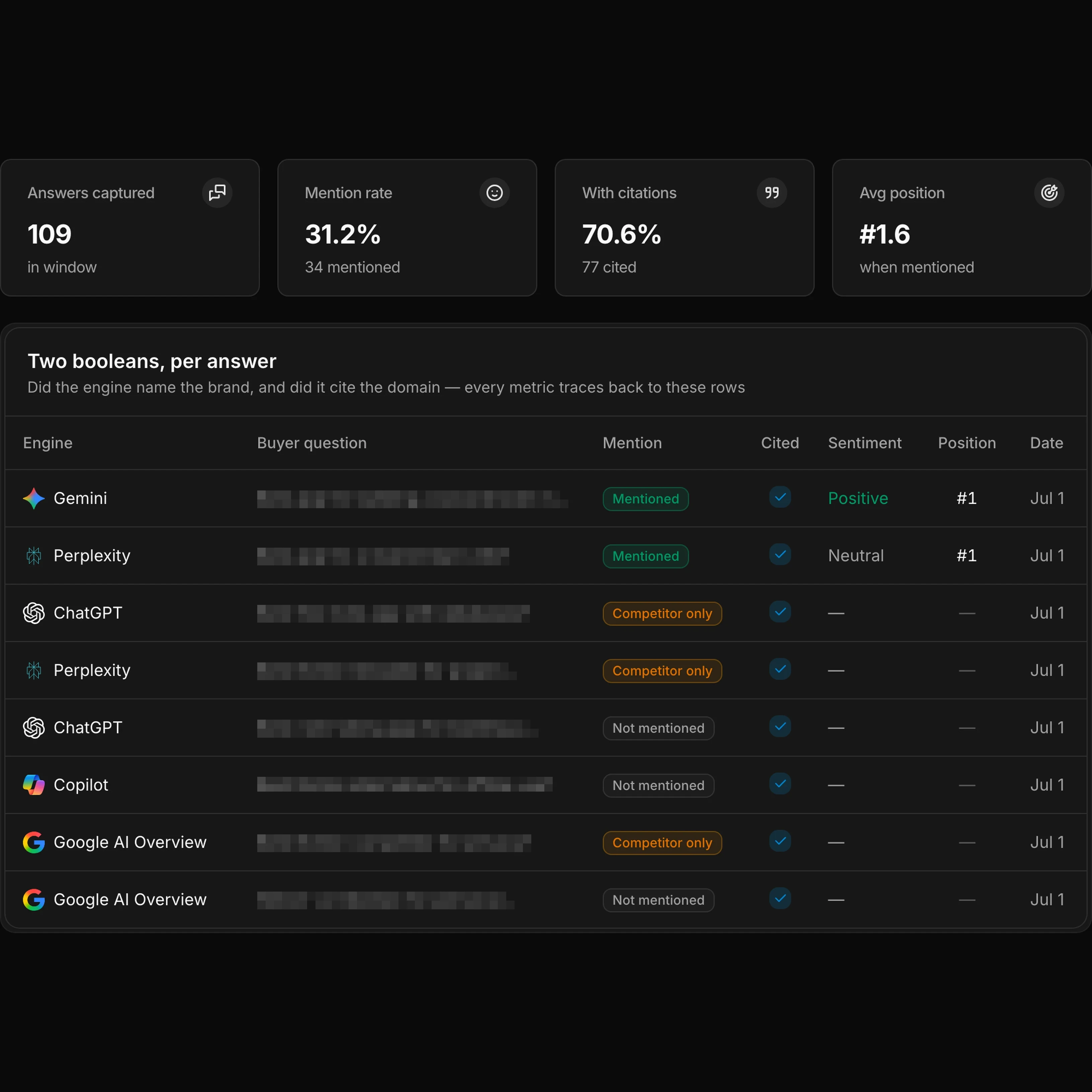
Mention vs Citation: Why AI Cites Your Content but Never Names Your Brand
When an AI answer links your page but never says your name, that is a conversion gap. What the mention and citation booleans mean, why the gap happens, the attribution lever you can pull, and how to monitor brand mentions in ChatGPT without a black-box score.
Gan Liu
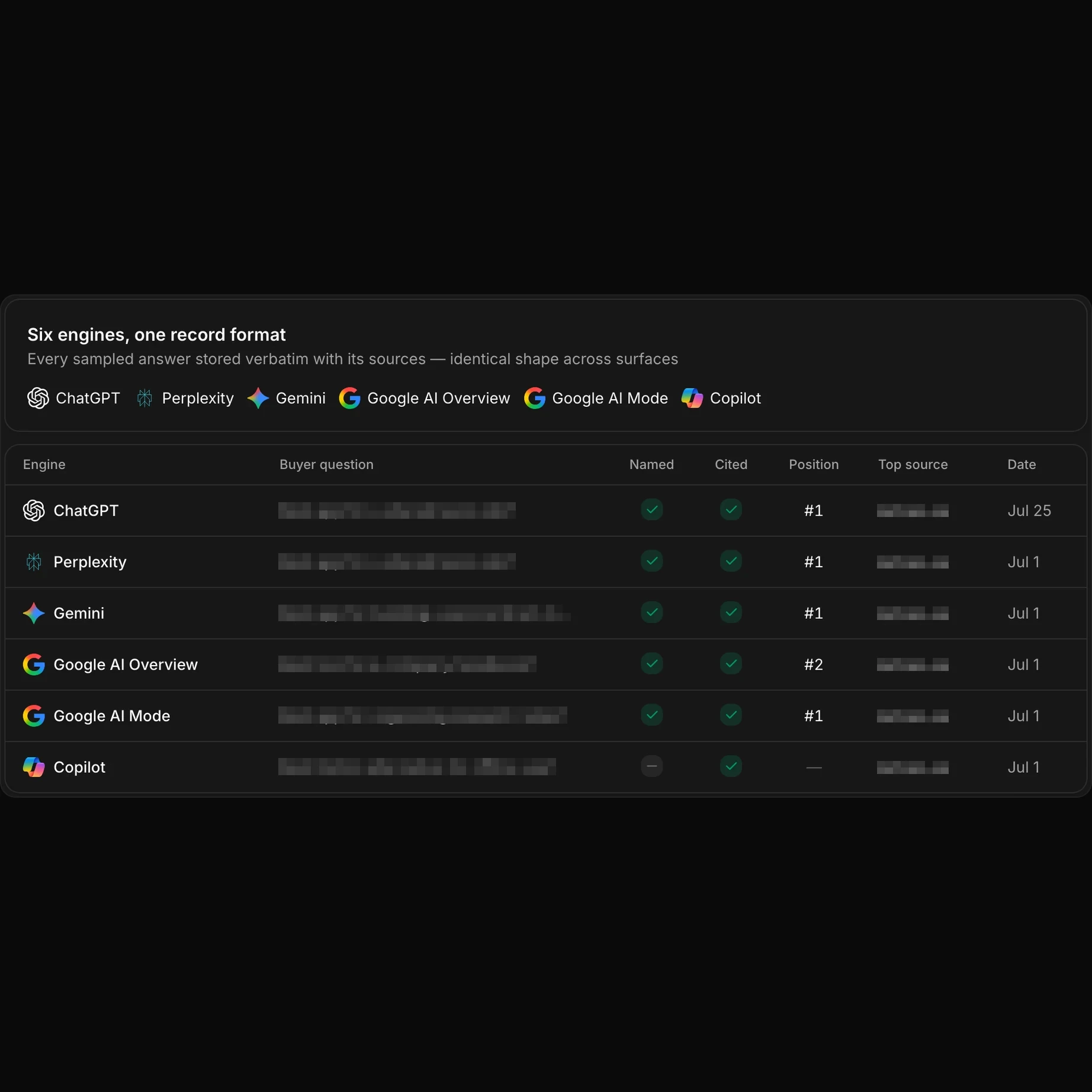
Input-Side Grounding vs Output-Side Verification: Where GEO Fits in the Ontology and RAG Stack
Ontology, RAG, and grounding feed your own AI so it understands your business. GEO verification is the mirror image: checking whether external answer engines named your brand and cited your domain.
Gan Liu
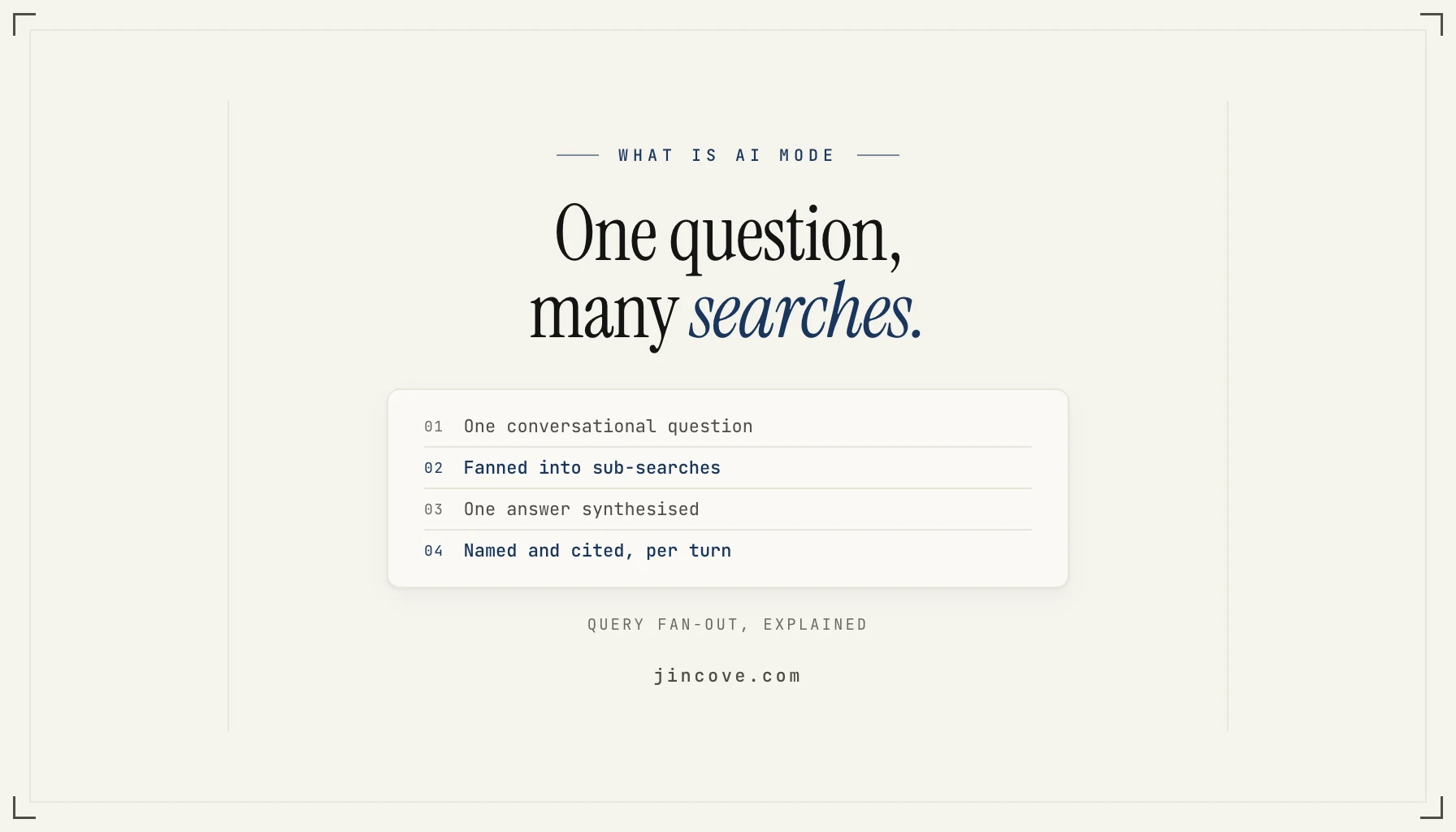
What Is Google AI Mode, and How Does It Work?
Google AI Mode is a conversational search surface that fans one question into several sub-searches and answers in prose. How it works, and what it changes.
Gan Liu
Start with the free audit
Send us one brand. We’ll run it through the engines and send back the answers, citations, and sources — so the first report your client sees is already backed by evidence.
Free audit: ChatGPT, Perplexity and Gemini, run by hand. Paid work covers all six engines.