Mention vs Citation: Why AI Cites Your Content but Never Names Your Brand
When an AI answer links your page but never says your name, that is a conversion gap. What the mention and citation booleans mean, why the gap happens, the attribution lever you can pull, and how to monitor brand mentions in ChatGPT without a black-box score.
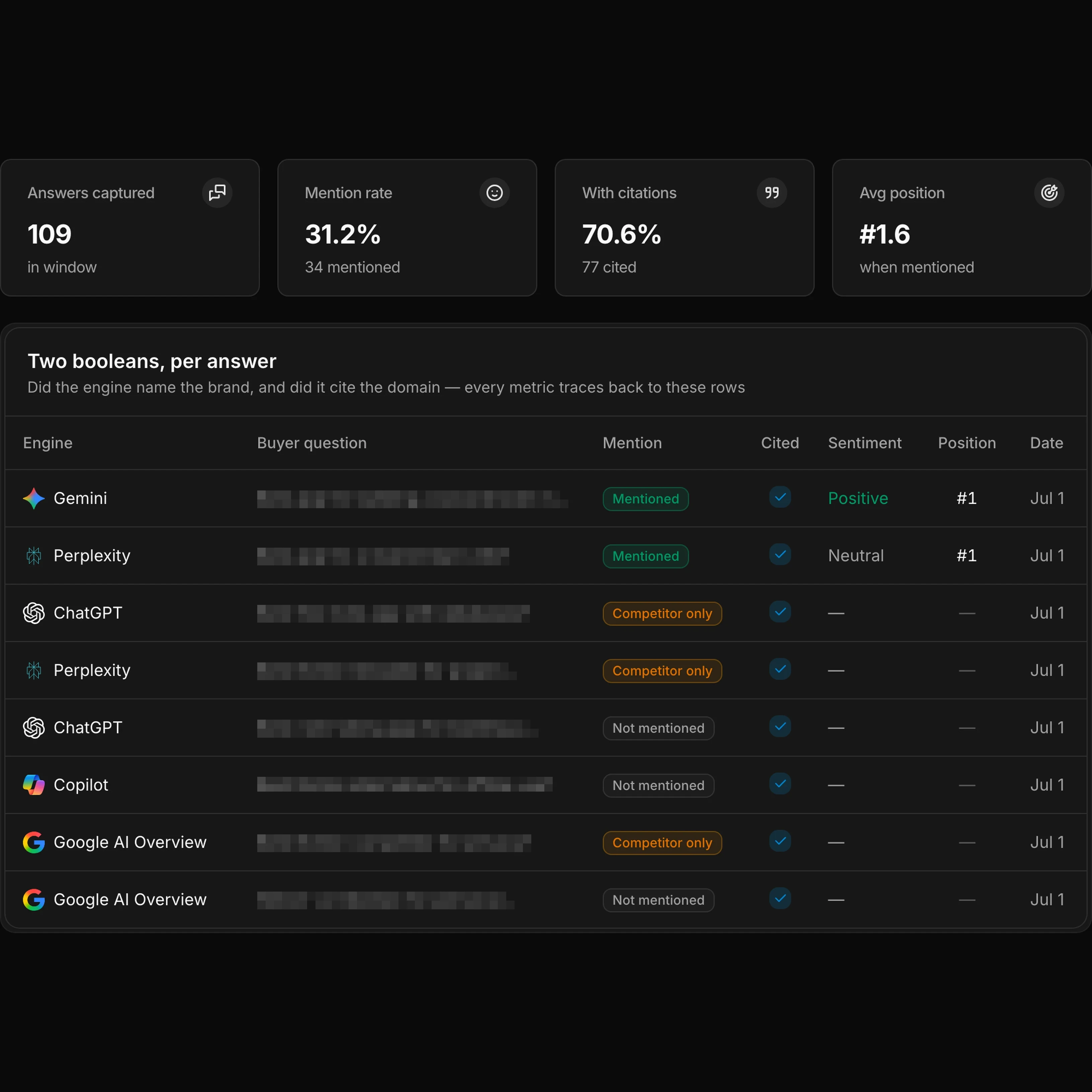
TL;DR: Mention (your brand named in the answer) and citation (your domain linked as a source) are two independent booleans. When an AI answer cites your page but never names you, that is a conversion gap - the reader trusts your content and leaves without your brand. Your strongest lever is attribution: put the brand name next to the claims an engine is likely to lift, then re-measure to see whether it moved.
You open an AI answer. Your paragraph is right there - paraphrased, sometimes quoted. The little source chip at the bottom links to your domain. And nowhere in the answer does your brand name appear. The reader gets your expertise and never learns who gave it to them.
That is not a bug in the model, and it is not a failure of your content. It is a specific, nameable pattern - and once you can name it, you can measure it.
Two signals, not one score
Most "AI visibility" talk collapses everything into a single number. That number hides the exact thing you need to see. There are two separate signals, and they answer different questions.
- Mention - a boolean. Is your brand named in the answer text? "Try Acme for this" is a mention. "One tool does X" is not, even if that tool is you.
- Citation - a boolean. Is your own domain listed as a source the answer drew from? A link to acme.com in the sources is a citation. A link to a competitor's roundup that quotes you is not.
These are independent. Any combination can happen - the mention vs citation glossary entry states the scoring rules for both booleans in one place:
| Cited (your domain is a source) | Not cited | |
|---|---|---|
Mentioned (brand named) | Named and sourced | Named, no link back |
| Not mentioned | Conversion gap - your content, someone else's takeaway | Invisible on this prompt |
The dangerous cell is cited-but-not-named. Your content did the work of answering the question. The reader believes the answer. Your brand is absent from the sentence they remember. That is the conversion gap.
Merge mention and citation into one score and this cell disappears - a healthy-looking number hiding wins that credit no one. That is why we keep the booleans apart and never roll them into a black-box visibility score; any derived number in our reports opens back to the raw answer it came from.
Why the conversion gap happens
AI answers are written to sound like one confident voice, not a bibliography. The model pulls facts, structure, and phrasing from sources, then rewrites them into clean prose. Sources drop to a chip or footnote. Brand names tend to survive that rewrite only when they sit right next to the fact itself.
Three common patterns you can see in the stored answer:
- Your brand lives below the fold. The model lifted the answer from a section three scrolls down. Your name sat in the header and the footer, far from the sentence that got quoted.
- The fact and the name are separated. Your page says "The recommended retention window is 30 days." It does not say "Acme recommends a 30-day retention window." The model keeps the fact and drops the unattached name.
- The page reads as a generic resource, not a branded point of view. If nothing in the extractable text signals whose opinion this is, the model has little to attribute.
Notice what is not on this list: content quality. You got cited - that bar is cleared. The gap is attribution, not substance, and attribution is cheaper to fix than a rewrite.
The lever: anchor the name to the claim
You control your page, not the engine. You cannot force any AI to name you, and no honest vendor should promise that. What you can do is make attribution travel with the facts an engine is likely to lift, then re-run the prompt and see whether it moved.
A reusable checklist for closing the conversion gap:
- Put the brand name in the first sentence of the section that answers the query, not just the H1 or nav.
- Attach the name to the claim: "Acme's benchmark shows..." beats "The benchmark shows...".
- Name the product where the product is the answer: "Use Acme Retention to set the window" beats "set the window."
- Add one above-the-fold sentence that states who you are and what you do, in plain nouns.
- Use consistent entity naming - the same brand string everywhere, so the model treats it as one thing.
- Keep the key claim and the name in the same paragraph an engine is likely to quote.
None of this is keyword stuffing. You are making the sentence self-attributing, so the name travels with the quote more often. It is a lever, not a guarantee - which is exactly why you measure before and after instead of assuming the edit landed. This edit-then-verify loop is what our gap remediation work does end to end: we make the changes, re-run the prompts, and show you whether the answer moved. We never promise the AI changes its answer. We verify whether it did.
How to monitor brand mentions in ChatGPT - without a black-box score
Here is where honesty matters. When we monitor brand mentions in ChatGPT - and in Perplexity, Gemini, and the other engines - we track the two booleans and nothing softer. For the step-by-step version you can run yourself, see how to track brand mentions in ChatGPT.
For every prompt-and-engine run, our toolchain captures the exact answer text, the cited sources, and the provider metadata - the model, the country, whether web search was on. It runs no models of its own; it routes each request through a managed AI-scraper provider and normalizes the record. From that record, two facts are read: was the brand named (mention), and was your domain a source (citation). Both are traceable to the stored answer you can open and read yourself.
What we do not do, and no honest vendor should claim:
- We do not judge whether the AI described your brand correctly. Mention is a yes or no on your name appearing, not a fact-check of the sentence around it.
- We do not roll the two booleans into one black-box visibility score you have to trust; any derived number opens back to the raw answer. The whole point is to keep them apart so the conversion gap stays visible.
- We cannot make an AI say good things about you or start naming you. We measure the output of external engines; we do not steer them. The lever you pull is your own page.
Each run diffs against your own past runs, over a defined sampling window, and we flag a change only when it moves beyond sampling noise - with the stored answer and the method open for you to check.
Read the pattern before you act
Before you touch a page, look at the run. Open the exact answer. Confirm the citation points at your domain. Confirm your brand name is genuinely absent from the prose - not just from the source chip. Only then is it a real conversion gap worth a fix. Perplexity is where this pattern shows up most, because it prints numbered sources under nearly every answer - see Perplexity visibility tracking for the engine-specific method.
The opposite pattern also exists and needs the opposite response: named, but the citation points at someone else's domain - the source gap. There the reader hears your name and clicks through to a competitor's page. Same two booleans, different failure, different fix. Both patterns, plus the two healthy quadrants, are mapped in the source gap vs conversion gap framework. For where all of this sits in the wider ontology and RAG conversation, read input-side grounding vs output-side verification.
You cannot fix a gap you cannot see, and you cannot see it through a score. Start by reading one real answer.
Want the two booleans on your own domain, read by a person, no card? Request the free audit: send a URL and an email, and we hand-run ChatGPT, Perplexity, and Gemini, then reply with the exact answers, the cited sources, and every place your content is used but your brand is missing.
Related blogs
Related Post
Expand your knowledge with these hand-picked posts.
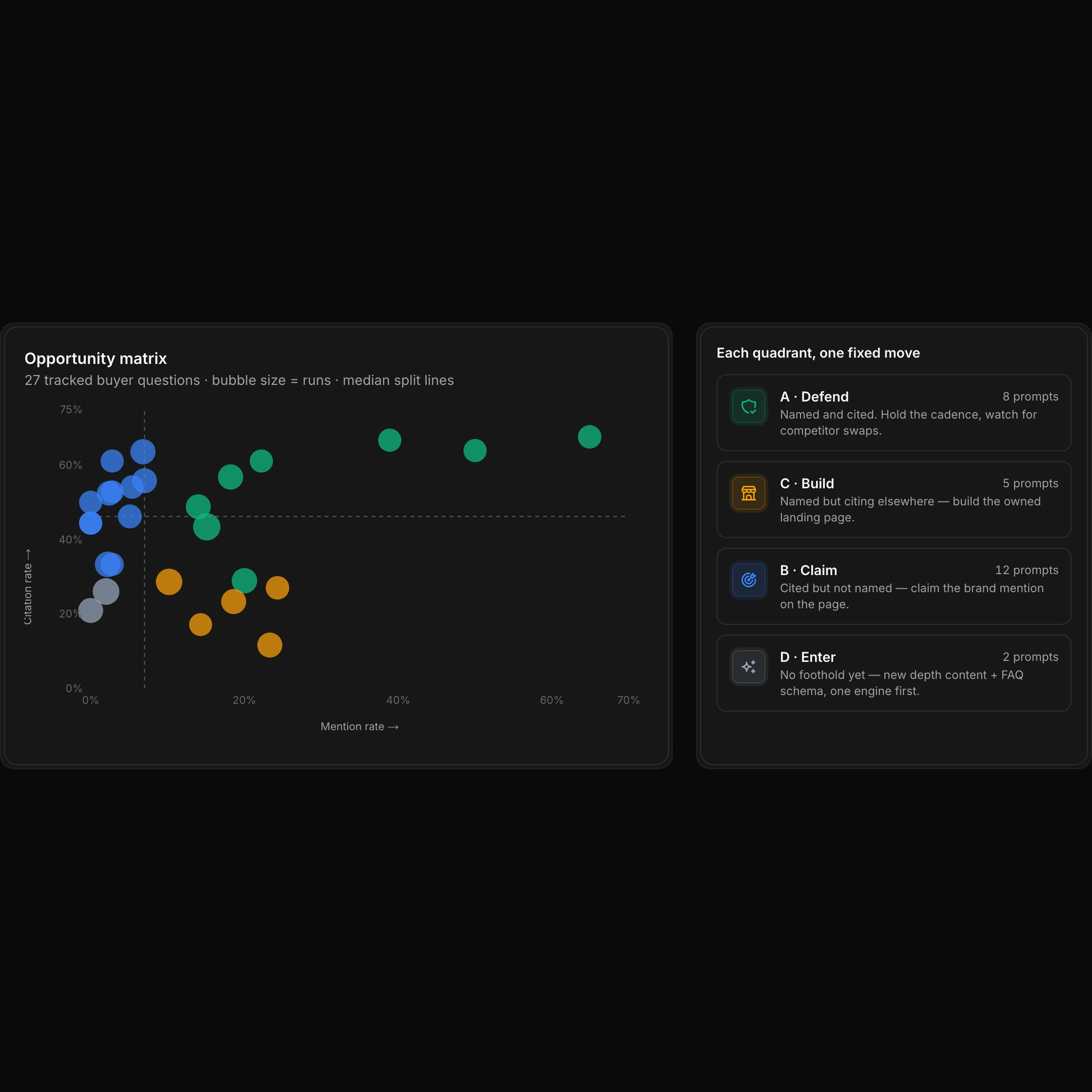
Source Gap vs Conversion Gap: A 2x2 Framework for AI Visibility Audits
Score every prompt on two booleans - brand named, own domain cited - and every AI answer lands in one of four quadrants: stronghold, conversion gap, source gap, or whitespace. Each quadrant has one fixed move.
Gan Liu
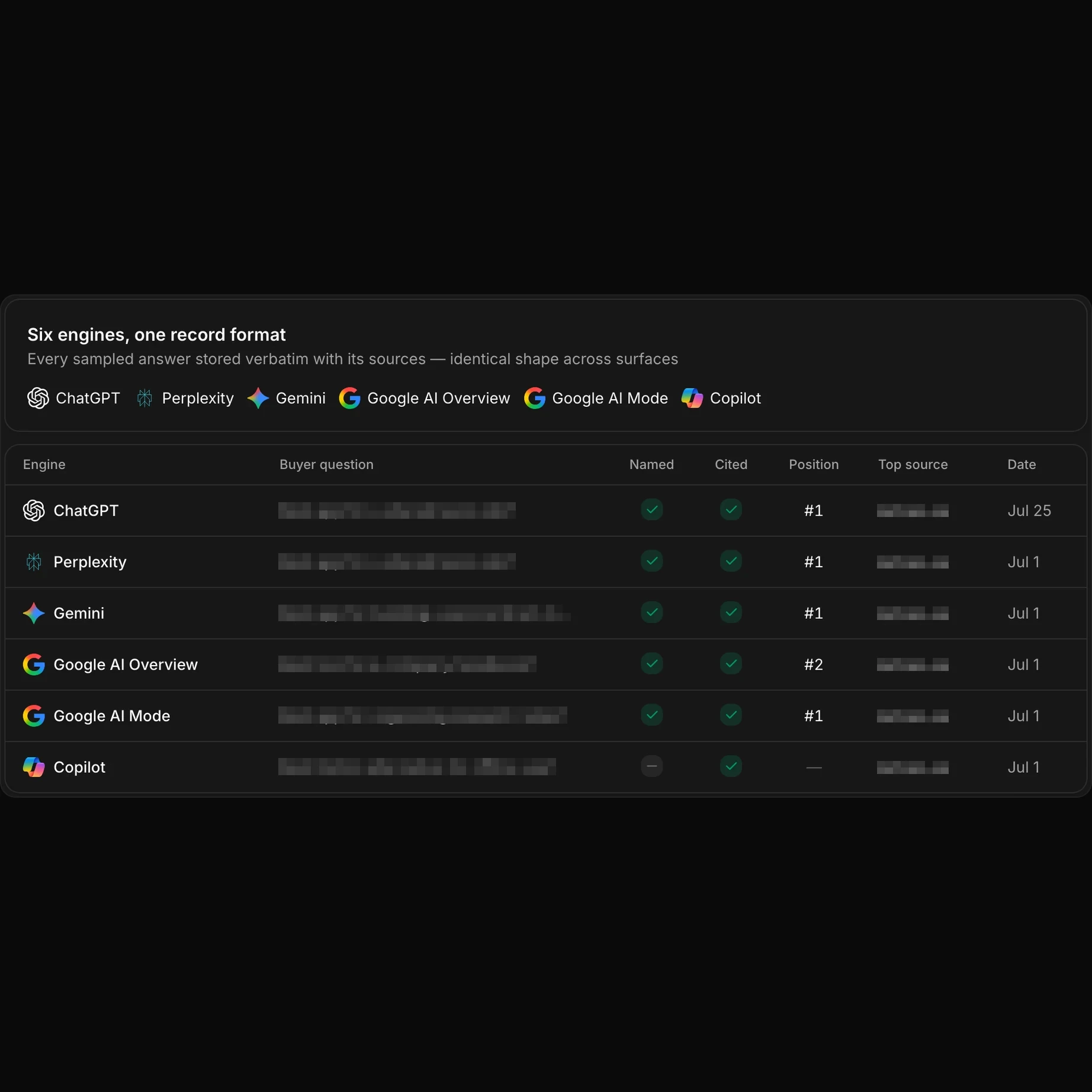
Input-Side Grounding vs Output-Side Verification: Where GEO Fits in the Ontology and RAG Stack
Ontology, RAG, and grounding feed your own AI so it understands your business. GEO verification is the mirror image: checking whether external answer engines named your brand and cited your domain.
Gan Liu
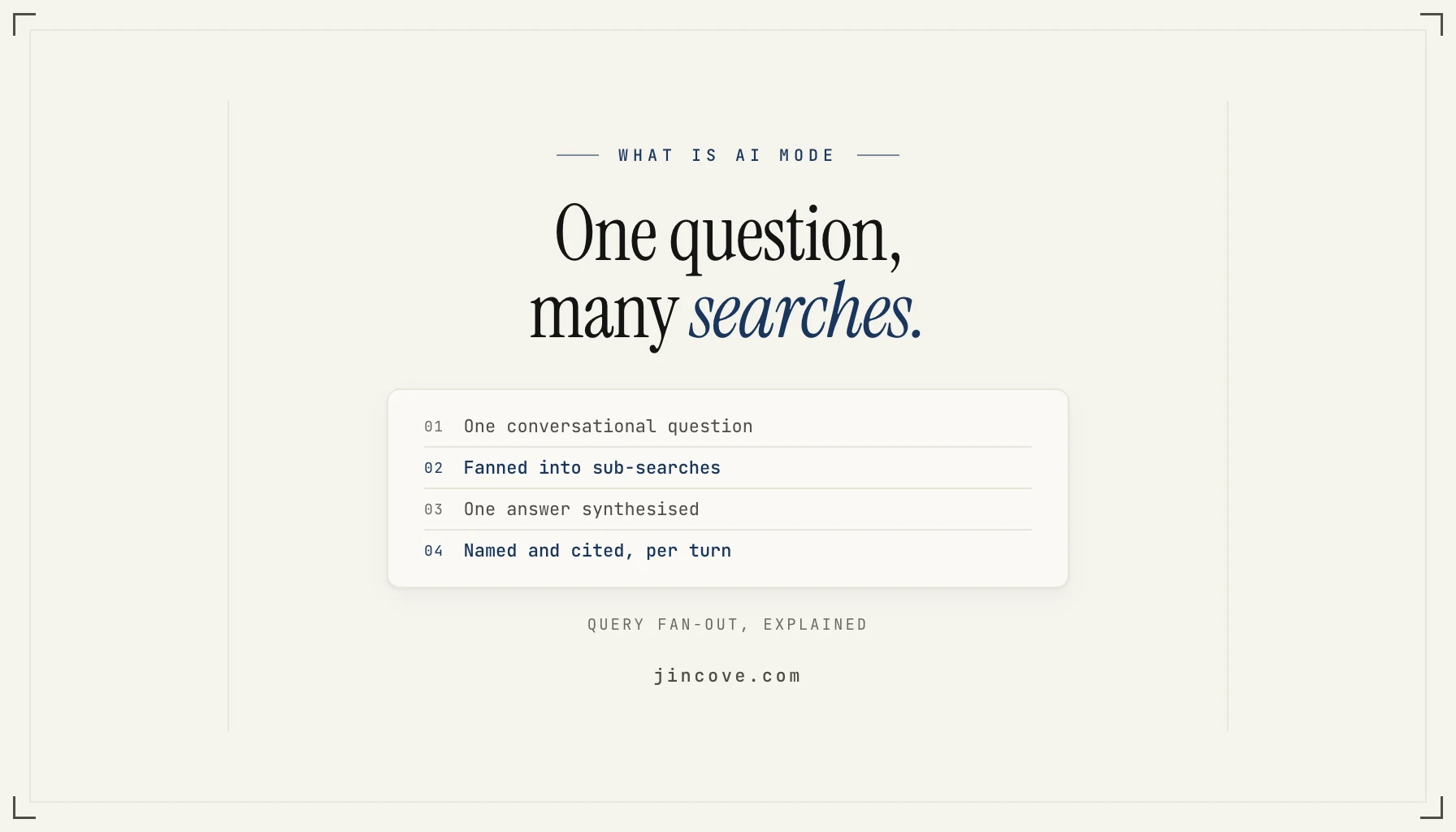
What Is Google AI Mode, and How Does It Work?
Google AI Mode is a conversational search surface that fans one question into several sub-searches and answers in prose. How it works, and what it changes.
Gan Liu
Start with the free audit
Send us one brand. We’ll run it through the engines and send back the answers, citations, and sources — so the first report your client sees is already backed by evidence.
Free audit: ChatGPT, Perplexity and Gemini, run by hand. Paid work covers all six engines.