Best AI Visibility Tools for Agencies in 2026: An Honest Shortlist
Most "best GEO tool" roundups rank on engine count. Agencies buy on a different axis - client roster, white-label, and evidence you can hand a client. Here is the honest shortlist, what each tool is actually best at, and the three questions that decide it.

TL;DR: The GEO tool market splits by buyer, not by feature list. Profound and Scrunch are built for enterprises with governance needs. Peec AI fits mid-market teams tracking many brands. Otterly is the lightweight baseline. If you are an agency, the deciding axis is not "how many engines" - it is whether the tool is built for a client roster and whether every number opens back to evidence you can put in front of a client. That is the gap this shortlist is written around.
Search "best GEO tools 2026" and every roundup ranks the same way: engines covered, prompt volume, price. That ranking answers a brand's question - "which tool watches my one name?" It does not answer an agency's question, which is different: "which tool lets me run this across twenty clients, keep each one isolated, and hand back a report a client can check?"
What "for agencies" actually changes
A brand buys a GEO tool to watch itself. An agency buys one to run a service line. Three things move to the front:
- Roster economics. You are not tracking one brand, you are tracking a book of them. Per-seat or per-brand pricing that made sense for one company becomes the whole margin of the service line when you multiply it by your client count.
- Isolation and white-label. Client A's prompts, answers, and history can never bleed into Client B's. And the report needs to look like your work, not the vendor's - here is the structure a white-label GEO report should follow.
- Evidence over score. When a client pushes back - "why am I paying for this, nothing changed" - a dashboard number does not survive the meeting. The stored answer the engine actually gave does. This is the difference between a score and a work order.
How we scored these AI visibility tools for agencies
We are not neutral and we are not pretending to be - Jincove is on this list. So here is the rubric up front, and you can re-run it yourself against any tool we left out.
- Roster economics. What does the bill look like at one client versus ten? We modelled every published plan at a ten-client roster, because that is where per-brand pricing stops being a rounding error and starts being the whole margin of the service line.
- Isolation. Can each client live in its own workspace, with its own prompt set and history, without one client's data turning up in another client's export?
- Evidence depth. Can a number in the dashboard be opened back to the verbatim answer the engine gave, with its sources? A chart you cannot drill into is a chart you cannot defend in a meeting.
- Engine coverage in the base plan. Not the marketing page's engine count - the count included at the price you would actually pay.
- Deliverability. Is the output something you can put in front of a client, or something you have to re-key into a slide deck first?
Prices below are what each vendor publicly listed as of 2026-09. Several list nothing at all and quote on request, which we say plainly rather than guessing.
This page ranks the field. Once you have a shortlist, the next step is interrogating it - the 12 questions to ask an AI visibility provider is the buying script that separates vendors on method and billing rather than on features.
The shortlist
| Tool | Best for | Pricing signal | Agency fit |
|---|---|---|---|
| Profound | Enterprises with governance, SSO, many engines | From ~$99/mo, scales up fast | Deep, but priced and shaped for in-house enterprise teams |
| Scrunch AI | Enterprises needing the widest engine coverage | ~$300/mo and up | Broad coverage; enterprise-first |
| Peec AI | Mid-market teams tracking multiple brands | ~EUR 89-199/mo | Good multi-brand depth for the price |
| Otterly.AI | Small teams wanting a lightweight baseline | From ~$29/mo | Cheap entry; a monitoring baseline, not a client deliverable |
| Jincove | Agencies running GEO across a client roster | Usage-based credits; shared pool from $249/mo | Built for a roster - isolated workspaces, line-verifiable evidence |
Every tool here is real and does what it says. The point is not that one wins on paper - it is that the right pick depends on who is signing off on the report. If your question is narrower and you only need to watch one engine, we compared the ChatGPT brand monitoring tools separately, including the two incumbents that publish nothing we could verify.
Profound: the enterprise analytics standard
In one line: the most polished AI-search analytics dashboard on the market, built for large in-house brand teams.
Who it fits. A brand team with an analytics function, an SSO requirement, and a single name to watch. The reporting depth is real and the product is not a thin wrapper over an API.
Who it does not fit. Agencies. As of 2026-09 the publicly listed entry tier is around $99/mo for ChatGPT only, with the first plan most teams actually use listed near $399/mo for three engines; multi-client work moves you into a quoted Enterprise contract. That is a procurement cycle, not a line item you can attach to a client retainer next week.
Verdict: best-in-class if you are the brand. Structurally awkward if you are billing on someone else's behalf. The long version is in Jincove vs Profound.
Scrunch AI: enterprise coverage, enterprise procurement
In one line: wide engine coverage plus AI-crawler analytics, acquired by Sitecore in mid-2026 and sold the way enterprise software is sold.
Who it fits. Mid-market and enterprise in-house teams that want brand monitoring plus AI-crawler analytics and site audits, with names like Lenovo and Penn State already on the customer list.
Who it does not fit. Anyone who needs to scope a single client engagement this month. As of 2026-09 Scrunch publishes self-serve tiers - Starter at $300/mo and Growth at $500/mo, each capping custom prompts and seats - but the Data API, SSO and real scale sit behind a custom Enterprise quote, and agency terms run through a partner program whose pricing is not published. For an agency that means you cannot cost a client proposal without first running a sales cycle of your own.
Verdict: a credible product with the wrong purchasing shape for a service line. The detailed comparison is in Jincove vs Scrunch AI.
Peec AI: the mid-market multi-brand tracker
In one line: a clean prompt-tracking dashboard with a real agency tier, popular with European teams.
Who it fits. Mid-market teams and smaller agencies tracking several brands who want tracking charts more than they want raw artefacts. Unlimited seats on the agency plans is a genuine advantage when every account manager needs a login.
Who it does not fit. Teams whose deliverable is the evidence itself. As of 2026-09 Peec publicly lists brand plans in the roughly $95 to $495/mo range and agency plans in the roughly $245 to $795/mo range, credit-based and capped by project count, with three engines in the base and further engines as paid add-ons. No white-label is publicly documented.
Verdict: the best value on this list if charts are the deliverable and three engines are enough. See Jincove vs Peec AI.
Otterly.AI: the cheapest way to start watching
In one line: a low-cost brand-mention tracker for solo marketers and small teams.
Who it fits. Anyone who wants to stop guessing this week for less than the price of a team lunch. As of 2026-09 Otterly publicly lists tiers at $29, $189 and $489/mo, separated mainly by tracked prompt count - roughly 15, 100 and 400 prompts.
Who it does not fit. Agencies past their second client. A flat prompt quota does not partition across a roster, agency terms run through a partner program with no public price, and the output is a monitoring signal rather than something you hand a client with your logo on it.
Verdict: an excellent personal early-warning system, a weak client deliverable. Long version: Jincove vs Otterly.
Jincove: the roster-first pick, and who should skip it
In one line: a usage-based GEO platform whose unit is the client roster, with the raw answer stored behind every number.
Who it fits. Agencies running GEO as a billable service line across several clients, who need per-client isolation and evidence a client can check line by line.
Who it does not fit. A single brand watching only itself will pay for roster machinery it never uses - Otterly or Peec will cost less and do that job. Teams that want one headline visibility number will find our reports deliberately uncomfortable, because we do not produce one. And our white-label reporting is still coming soon rather than shipped, so if rebranded client PDFs are a hard requirement this quarter, take that at face value.
Verdict: buy it for the roster, not for the dashboard. Pricing is publicly listed - Studio $249/mo and Agency $749/mo as of 2026-09, usage-based on top.
What we could not test
This shortlist is built from public pricing pages, vendor documentation, and third-party reviews read in September 2026 - not from buying every product and running a controlled bake-off. That distinction matters, so here is what it means in practice.
We did not push identical prompt sets through each dashboard and compare outputs, so we make no claim about relative data accuracy between these tools. We did not verify enterprise pricing, because the vendors who quote on request do not publish it and second-hand figures circulating in review sites are not evidence. We did not test white-label output quality anywhere, including our own, since ours has not shipped. And we could not test support responsiveness or contract flexibility, which is often what actually decides whether a renewal happens.
Every price and every feature claim here has a shelf life. This category re-prices roughly every quarter and ships new engines faster than that. If you are reading this more than a few months after 2026-09, treat the pricing column as the starting point for your own check, not as a fact.
How to run the shortlist yourself in 30 minutes
You do not have to take our word for any of it. The evaluation that matters is the one run on your own client list, and it is short.
- Pick one real client, not a hypothetical. Take the account where a GEO retainer is most likely to sell. Everything downstream gets more honest.
- Write ten buyer questions in that client's category - the shapes prospects actually use, like "best X for Y" or "alternatives to Z". Not brand-name lookups. Our AI visibility checker will generate a starting set and a scorecard if you would rather not face a blank page.
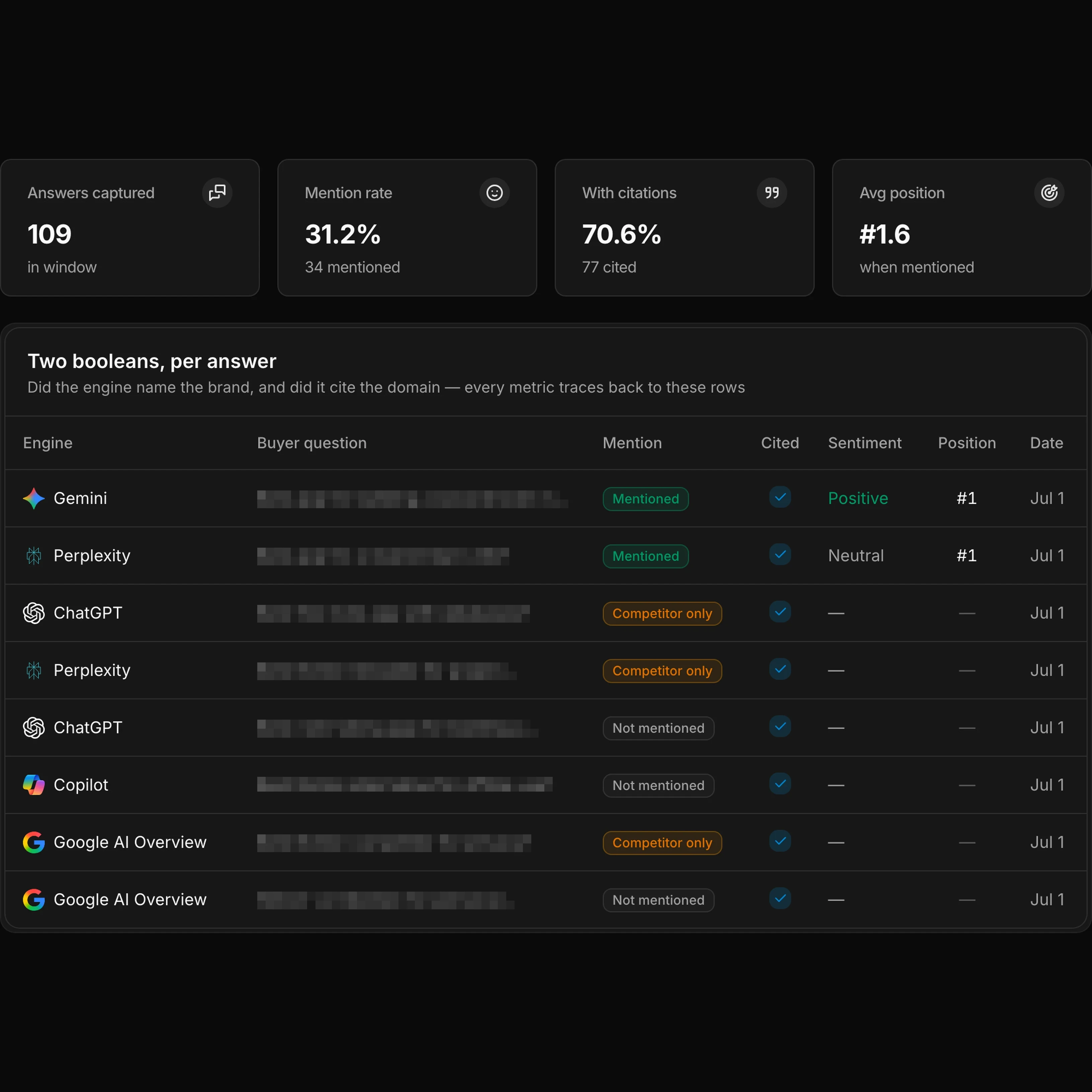
- Run all ten by hand in ChatGPT before you open a single vendor demo. Record two booleans per answer - named, and own domain cited. Fifteen minutes, and now you hold ground truth that no sales call can talk you out of.
- Open each tool's trial or demo and ask one question: can I get back to the answer behind this number? If the honest reply is no, the tool is a dashboard, not evidence.
- Model the bill at ten clients. Multiply, do not estimate. Per-brand pricing and pooled pricing diverge sharply somewhere between client three and client ten, and the direction is not obvious from the pricing page.
- Ask about white-label in writing. Shipped, on the roadmap, or partner-program-only are three very different answers, and vendors will tell you plainly if you ask plainly.
If a vendor's number and your hand-run booleans disagree, believe your hand-run booleans. And if a term in a dashboard is doing work you cannot define - visibility score, share of voice, presence rate - check it against our GEO glossary before it goes anywhere near a client report.
The three questions that decide it
- Who reads the output - you, or your client? If it is your client, you need evidence that opens, not a proprietary score you cannot defend. Ask any tool: can I click a number and see the exact answer the engine gave, with its sources?
- What happens as you add clients? Model the cost at ten clients, not one. A shared credit pool where unit cost drops as the roster grows behaves very differently from per-brand seats.
- Whose brand is on the report? If the deliverable carries the vendor's name, you are reselling their product. If it carries yours, you are running a service line.
Run the three questions against real numbers
The questions above only bite when you put figures behind them. Take a mid-size agency with ten clients, twenty prompts each, monitored weekly across six engines. That is a fixed, countable workload before anyone quotes a price:
10 clients x 20 prompts x 6 engines x 4 runs/month = 4,800 records/month
Now the three questions stop being abstract:
- Per-brand seats vs a shared pool. A tool priced per brand multiplies that $X by ten - and often gates engines or prompt volume per seat on top. A shared usage pool spreads one budget across the roster, so the eleventh client is cheaper to add than the first. Model the bill at ten clients, never at one.
- Score vs openable evidence. At 4,800 records a month, the question is not "is there a dashboard" but "when a client challenges one row in a QBR, can I open the exact answer the engine gave, with its sources?" If the number is a sealed calculation, you inherit the argument.
- Their brand vs yours on the deliverable. Reselling a vendor's dashboard caps you at their margin and their logo. A report that carries your name - and, where offered, full white-label - is a service line you own.
The market maps cleanly onto that math. Profound and Scrunch AI are built for a single well-funded in-house team, not a roster; Peec AI gives mid-market teams solid multi-brand depth; Otterly is a cheap baseline that was never meant to be a client deliverable. The agency question - "what happens to cost and evidence at ten clients?" - is the one the roundups skip. For the underlying scoring the evidence has to support, see source gap vs conversion gap, and for the operations layer, the GEO audit checklist for agencies.
Where Jincove fits
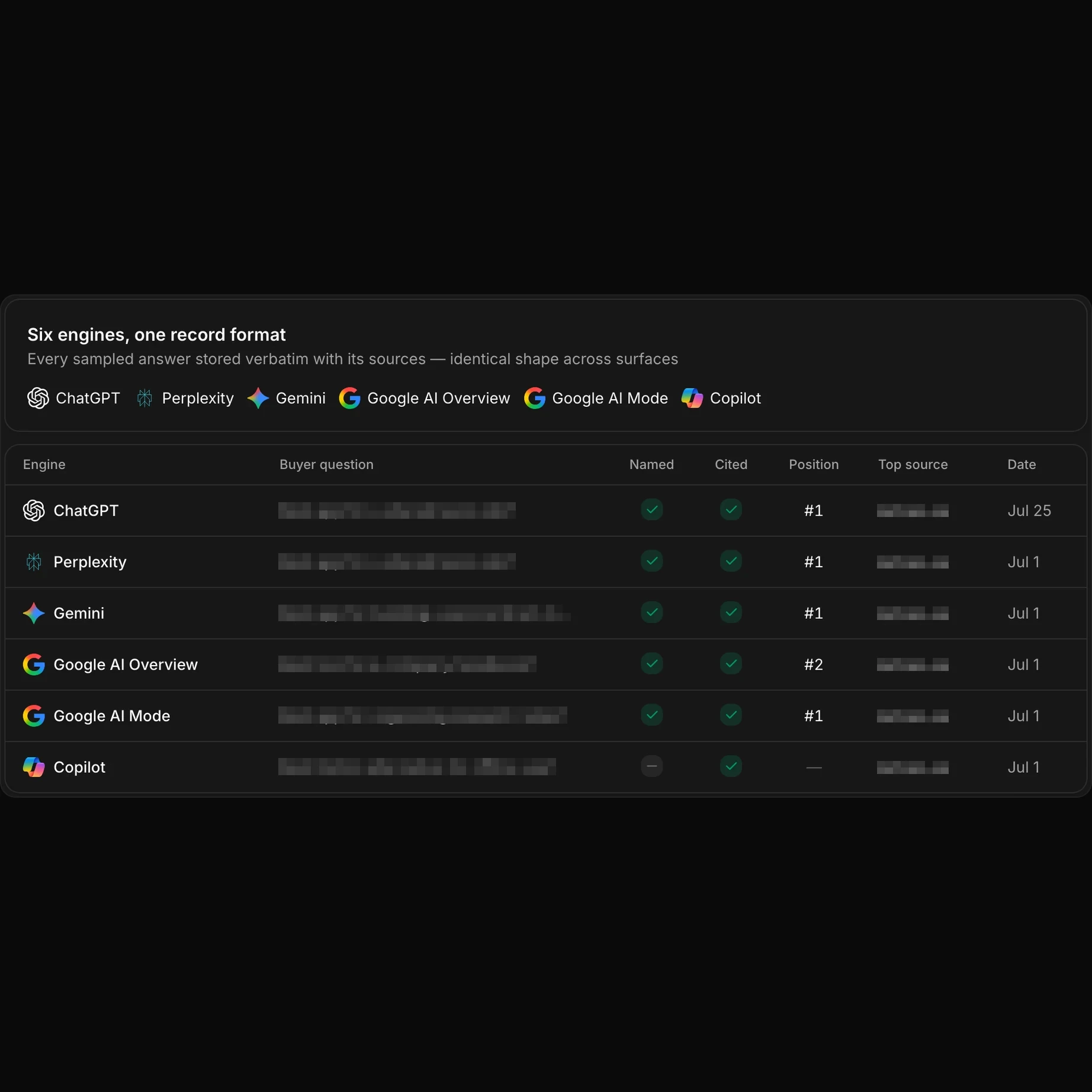
We built Jincove for the third column of that table. It audits and monitors the same six engines - ChatGPT, Perplexity, Gemini, Google AI Overviews, Google AI Mode, Copilot - but the unit of the product is the client roster, not the single brand. Each client gets an isolated workspace, credits come from a shared pool so unit cost drops as you grow, and every number opens back to the verbatim stored answer. We report evidence, not a promise - we prove what the engines said and what moved after a fix, we do not claim to make an AI say something nice.
Comparing head to head? We wrote the honest versions: Jincove vs Profound, Jincove vs Peec AI, Jincove vs Otterly and Jincove vs Scrunch AI. All four run the same seven-row table and sit together on the Jincove comparison index, so you can read them side by side rather than one at a time.
Questions agencies ask before they pick
Do I need a paid tool at all to start a GEO service line?
No, and pretending otherwise would just be selling. The method is a prompt set, a browser, and a spreadsheet with two boolean columns. Your first audit for one client can be run by hand in an afternoon, and it is often a better pitch artefact than a dashboard screenshot, because the client can read the actual answers rather than trust a bar. Tooling starts to pay when you cross roughly three clients or a weekly cadence - the point where manual runs stop scaling and a missed re-run costs you the retainer rather than an afternoon.
Why is engine count a weak way to rank AI visibility tools for agencies?
Because engine count is a marketing-page number, and the one that bills you is the count included at the price you actually pay. Several tools on this list advertise broad coverage while gating engines behind add-ons or an enterprise tier. The more useful question is which surfaces your client's buyers actually use, which is usually three or four rather than nine. A tool that covers four engines deeply, with the raw answers stored and openable, beats one that samples nine shallowly and rolls the result into a score you cannot audit.
Start with evidence, not a subscription
Before you commit to any tool on this list, see the output on one of your own clients. Request a free, human-run audit: send one client URL and an email, and we hand-run ChatGPT, Perplexity, and Gemini and reply with the exact answers and sources - no card, no account. If the evidence is useful, the Evidence Sprint extends the same method across all six engines and around twenty buyer questions.
Related blogs
Related Post
Expand your knowledge with these hand-picked posts.

How to Track Brand Mentions in ChatGPT in 2026: The Agency Method
ChatGPT has no Search Console - no impressions, no analytics, no export. Here is the method agencies use to track brand mentions across ChatGPT and the other answer engines without trusting a black-box score, and why "citations" and "mentions" are two different numbers.
Gan Liu
How to Track Brand Mentions in Perplexity in 2026: The Agency Method
Perplexity shows numbered citations and a Sources list under every answer. The agency method for reading brand mention vs citation off it - no black-box score.
Gan Liu
How to Track Brand Mentions in Gemini in 2026: The Agency Method
Gemini sometimes grounds on Google Search and shows sources, sometimes answers from the model alone. Here is the agency method for tracking brand mentions in Gemini with two booleans and stored evidence.
Gan Liu
Start with the free audit
Send us one brand. We’ll run it through the engines and send back the answers, citations, and sources — so the first report your client sees is already backed by evidence.
Free audit: ChatGPT, Perplexity and Gemini, run by hand. Paid work covers all six engines.