GEO vs AEO vs SEO: What They Are and How They're Measured (2026)
GEO vs AEO vs SEO explained: SEO optimizes for a ranked link, AEO and GEO optimize for the synthesized answer, measured by whether your brand is named and cited.
TL;DR: SEO, AEO, and GEO are not three rival disciplines - they are two jobs. SEO optimizes for a position in a list of links. AEO (Answer Engine Optimization) and GEO (Generative Engine Optimization) describe the same output-side job: getting a brand into the synthesized answer, measured by whether it was named and whether its domain was cited. Use AEO and GEO interchangeably. SEO is the classic-links craft they build on, not a thing they replace.
Three acronyms, endless confusion. Vendors sell "AEO audits" and "GEO platforms" as if they were different products, and half the market thinks GEO is just SEO with a new coat of paint. It is simpler than the marketing makes it. There are two places a buyer can find you - a ranked list of links, or a machine-written answer - and each place is optimized and measured differently. That is the whole map.
SEO: optimize for a position in a list
Search engine optimization is the discipline you already know. A user types a query, the engine returns a ranked list of ten blue links, and your job is to earn a high position on that list. Success is a ranking. You measure it with rank trackers, impressions, and click-through rate, and Google hands you a Search Console full of the data. The user sees a page of links and chooses one.
SEO is mature, it has real tooling, and it is not going anywhere. When an answer engine grounds on the open web, the pages it retrieves are the pages that ranked. Classic SEO is the supply of raw material the answer is built from. That is exactly why GEO builds on it rather than replacing it.
AEO and GEO: optimize for the synthesized answer
Now the surface changes. A buyer opens ChatGPT, Perplexity, or Google's AI Overview and asks a question. There is no list of ten links to climb. The engine writes one answer, names a few brands inside the prose, and shows a handful of cited sources underneath. Your job is no longer "rank third" - it is "be the brand the answer names, backed by a citation to your own domain."
That job has two names. Answer Engine Optimization frames it around the surface: the answer engine. Generative Engine Optimization frames it around the mechanism: a generative model synthesizing the response. They point at the same output-side work and the same measurement. We use them interchangeably, and you should too - anyone insisting on a hard technical line between them is selling a distinction, not a discipline. See the glossary on generative engine optimization and answer engine optimization for the plain definitions.
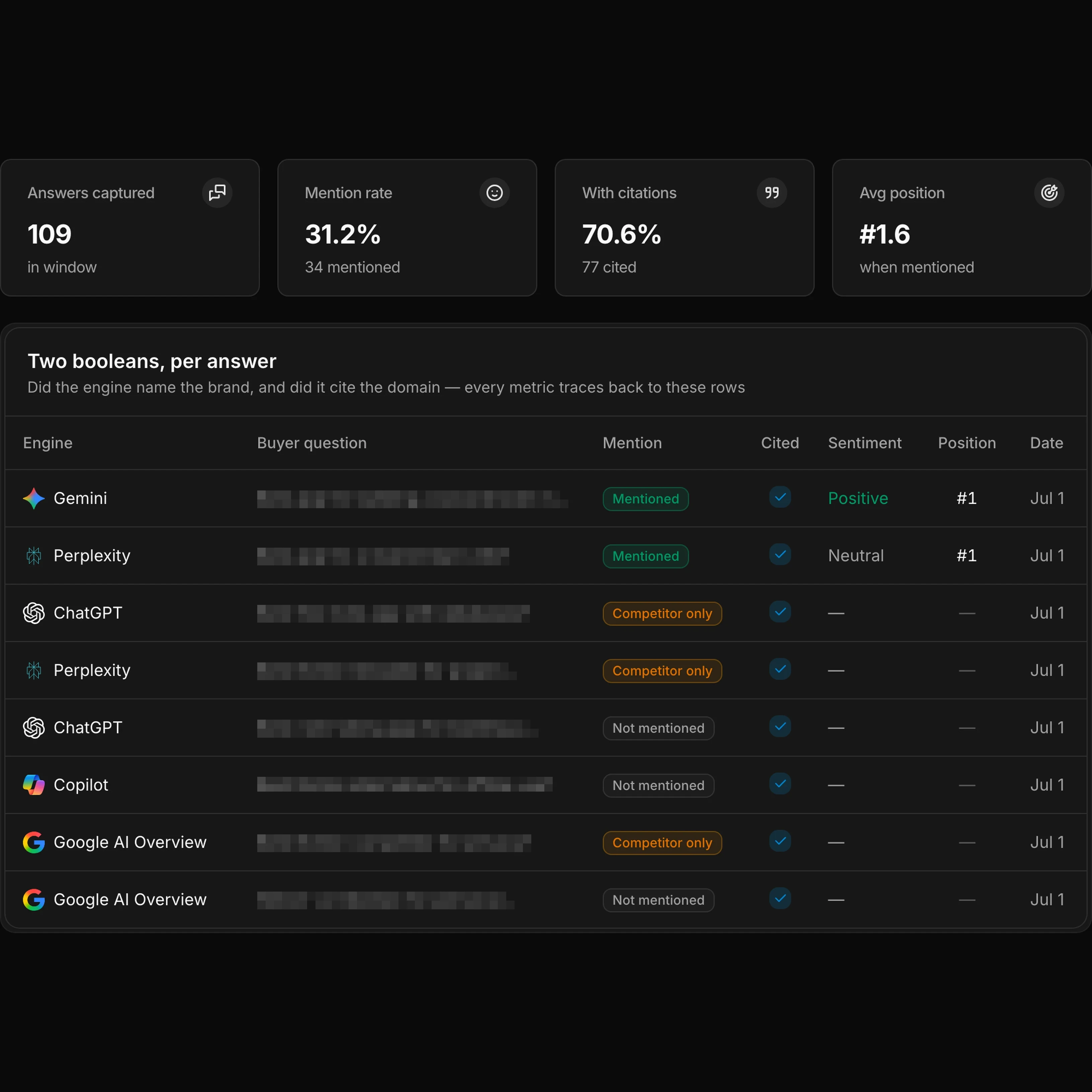
The measurement is what makes GEO/AEO a real discipline rather than a vibe. You reduce every answer to two independent booleans:
- Mention - was the brand named in the answer text the reader sees? Yes or no.
- Citation - was the brand's own domain in the cited sources? Yes or no.
These never merge into one score, because they fail for different reasons. The engine can name you while citing a review site (a source gap), or cite your page without ever saying your name (a conversion gap). One black-box "visibility %" deletes exactly the signal you would act on. Two booleans keep it. The full case for keeping them apart is in mention vs citation.
The comparison, one table
| SEO | AEO / GEO | |
|---|---|---|
| Unit of success | A ranked position in a list of links | Being named and cited inside one synthesized answer |
| What you optimize | A page, for keywords, links, and crawlability | The quotable, brandable claims a model lifts into its answer |
| How it's measured | Rank, impressions, CTR - from Search Console | Two booleans per answer: mention (named) and citation (own domain cited) |
| Where the user sees it | A page of ten blue links they choose from | One answer with a few named brands and source chips |
| Failure mode | You rank on page two - nobody clicks | Answer names a competitor, or cites you without saying your name |
Read it top to bottom and the through-line is clear: SEO is about a place in a list, GEO/AEO is about a place in a sentence. Same brand, two different games, and the second one is not measured with the first one's tools.
An AEO/GEO audit measures what the engines said - not your site
An AEO audit is not a static scan of your schema or a simulated score of your content. It runs the questions buyers actually ask through the engines themselves and reads what came back. The method is the same one covered in how to track brand mentions in ChatGPT, extended across every engine:
- Build a set of 20-50 real, question-shaped buyer prompts - not brand-name lookups.
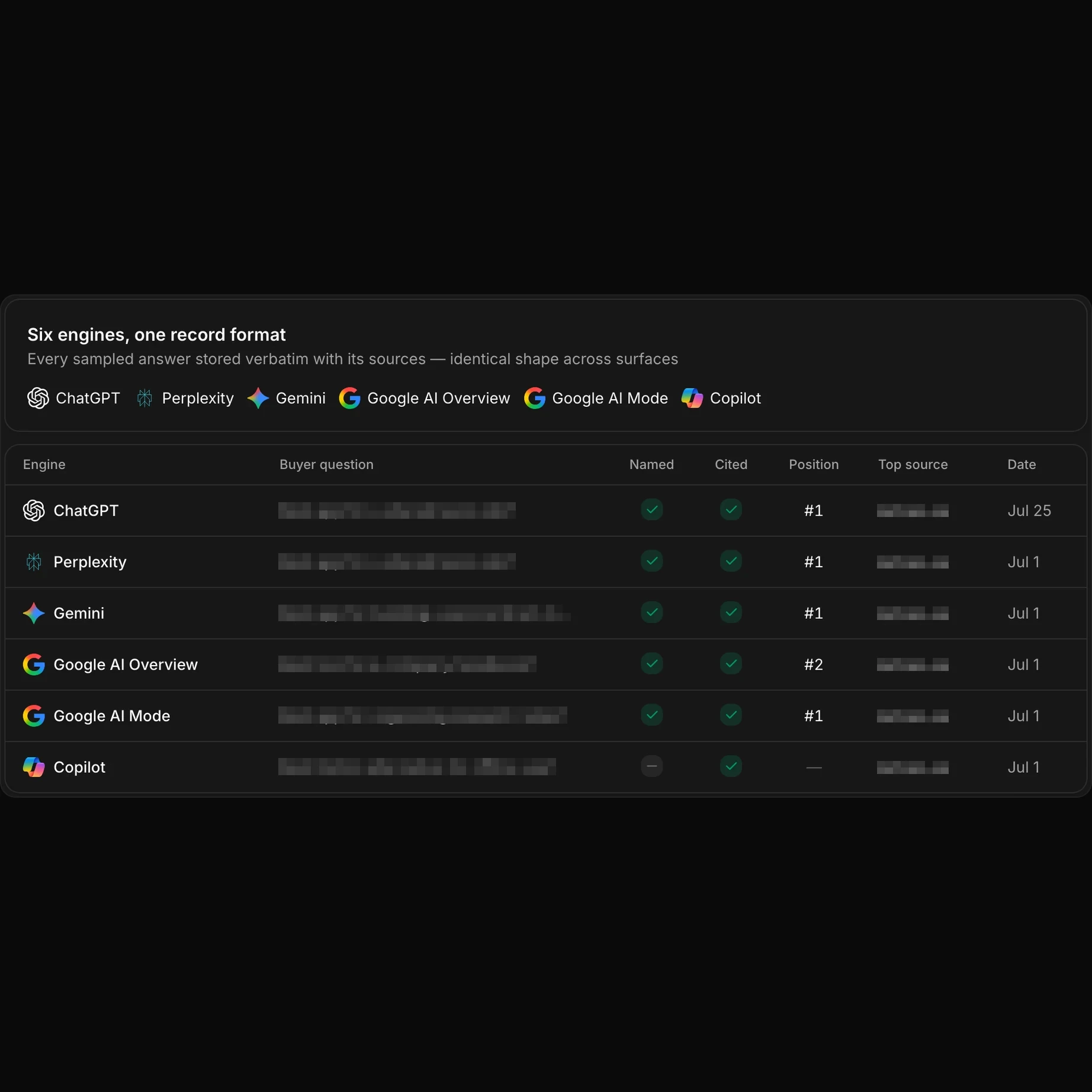
- Run each across the six engines: ChatGPT, Perplexity, Gemini, Google AI Overviews, Google AI Mode, and Copilot.
- Capture the verbatim answer, every cited URL, and the metadata (model, country, web search on/off).
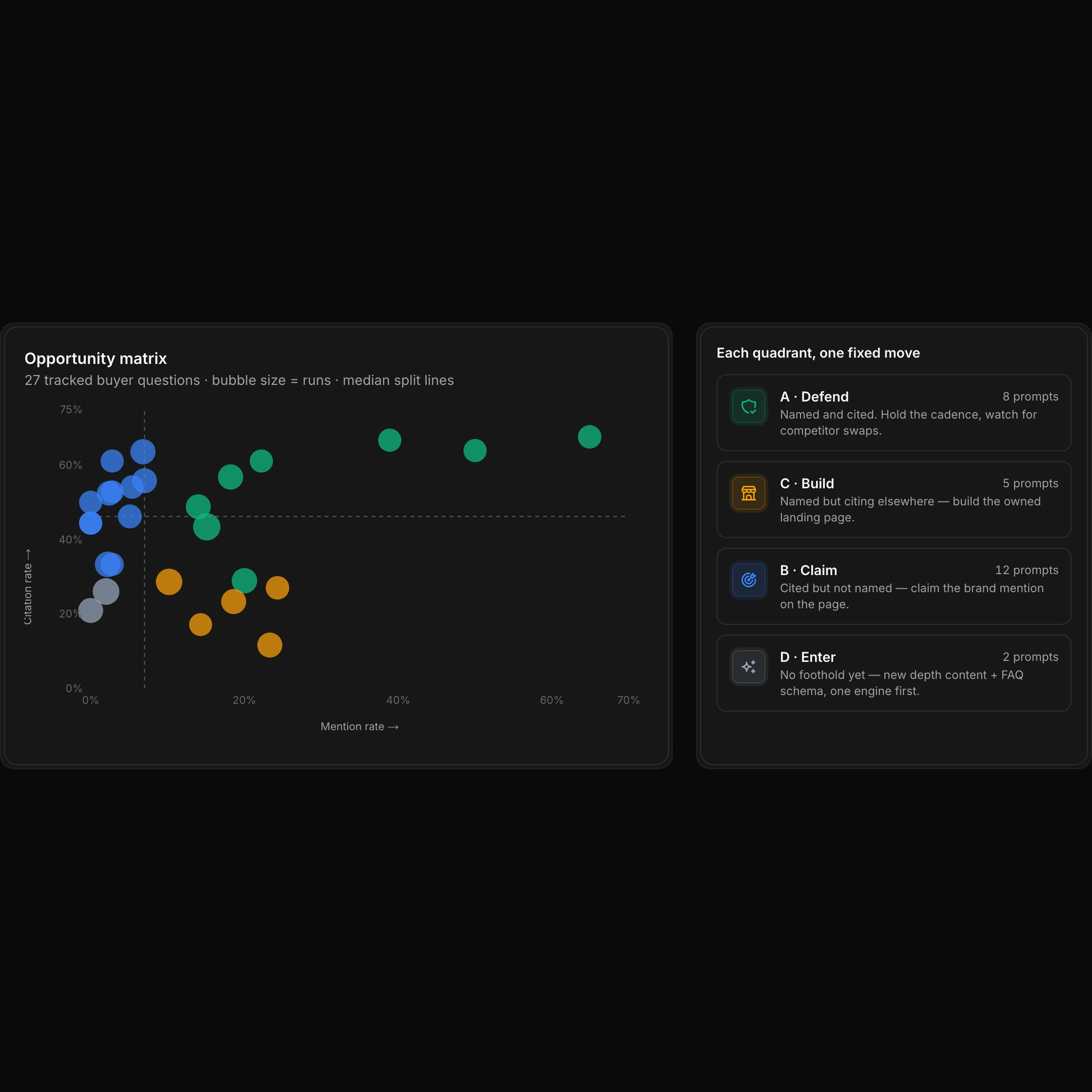
- Mark the two booleans per answer, and sort each into a quadrant.
- Diff against the brand's own history over a sampling window - flag only changes beyond run-to-run noise.
Those quadrants - stronghold, conversion gap, source gap, whitespace - and the one fixed move each demands are laid out in the source gap vs conversion gap framework. That is where a pile of raw answers becomes a work order.
One honesty boundary, because it separates a real audit from a promise nobody can keep: nobody controls what the engines say. A GEO audit proves what an engine said and what moved after you shipped a fix. It does not make an engine name you, and it does not fact-check the model's prose. It reads the output; it does not bend it.
Quick answers
Is GEO the same as AEO? For practical purposes, yes. Both name the output-side job of getting a brand into synthesized answers, measured by mention and citation. GEO leans on "generative," AEO on "answer engine." Use them interchangeably.
Does GEO replace SEO? No. SEO earns the rankings that answer engines retrieve from. GEO/AEO measures and optimizes what the engine then synthesizes. You need the classic-links work; GEO sits on top of it.
How do you run an AEO audit? Run a set of real buyer prompts through the answer engines, capture each verbatim answer and its cited sources, and score two booleans per answer - named and cited. Store the raw answer behind every number so each result can be reopened and checked.
What does a GEO audit measure? Two independent booleans per answer - mention and citation - and the gaps derived from them. Never a single black-box visibility score. Every number opens back to a stored raw answer with its sources and metadata.
See both sides on your own brand
If you already do SEO, you own half the picture - the rankings. The other half is what the engines say when they turn those rankings into an answer. Jincove reads that output side across all six engines with evidence behind every number, and you can see exactly what it captures per run. Start with a free, human-run GEO audit: send one URL and an email, and we hand-run the engines and reply with the exact answers, the cited sources, and whether each named or only cited your brand - no card, no account.
Related blogs
Related Post
Expand your knowledge with these hand-picked posts.
Mention vs Citation: Why AI Cites Your Content but Never Names Your Brand
When an AI answer links your page but never says your name, that is a conversion gap. What the mention and citation booleans mean, why the gap happens, the attribution lever you can pull, and how to monitor brand mentions in ChatGPT without a black-box score.
Gan Liu
Source Gap vs Conversion Gap: A 2x2 Framework for AI Visibility Audits
Score every prompt on two booleans - brand named, own domain cited - and every AI answer lands in one of four quadrants: stronghold, conversion gap, source gap, or whitespace. Each quadrant has one fixed move.
Gan Liu
Input-Side Grounding vs Output-Side Verification: Where GEO Fits in the Ontology and RAG Stack
Ontology, RAG, and grounding feed your own AI so it understands your business. GEO verification is the mirror image: checking whether external answer engines named your brand and cited your domain.
Gan Liu
Start with the free audit
Send us one brand. We’ll run it through the engines and send back the answers, citations, and sources — so the first report your client sees is already backed by evidence.
Free audit: ChatGPT, Perplexity and Gemini, run by hand. Paid work covers all six engines.