ChatGPT Brand Monitoring Tools: 7 Compared (2026)
Seven ChatGPT brand monitoring tools compared on engine coverage, stored evidence, multi-client support and 2026-09 pricing - plus the limits none of them fix.
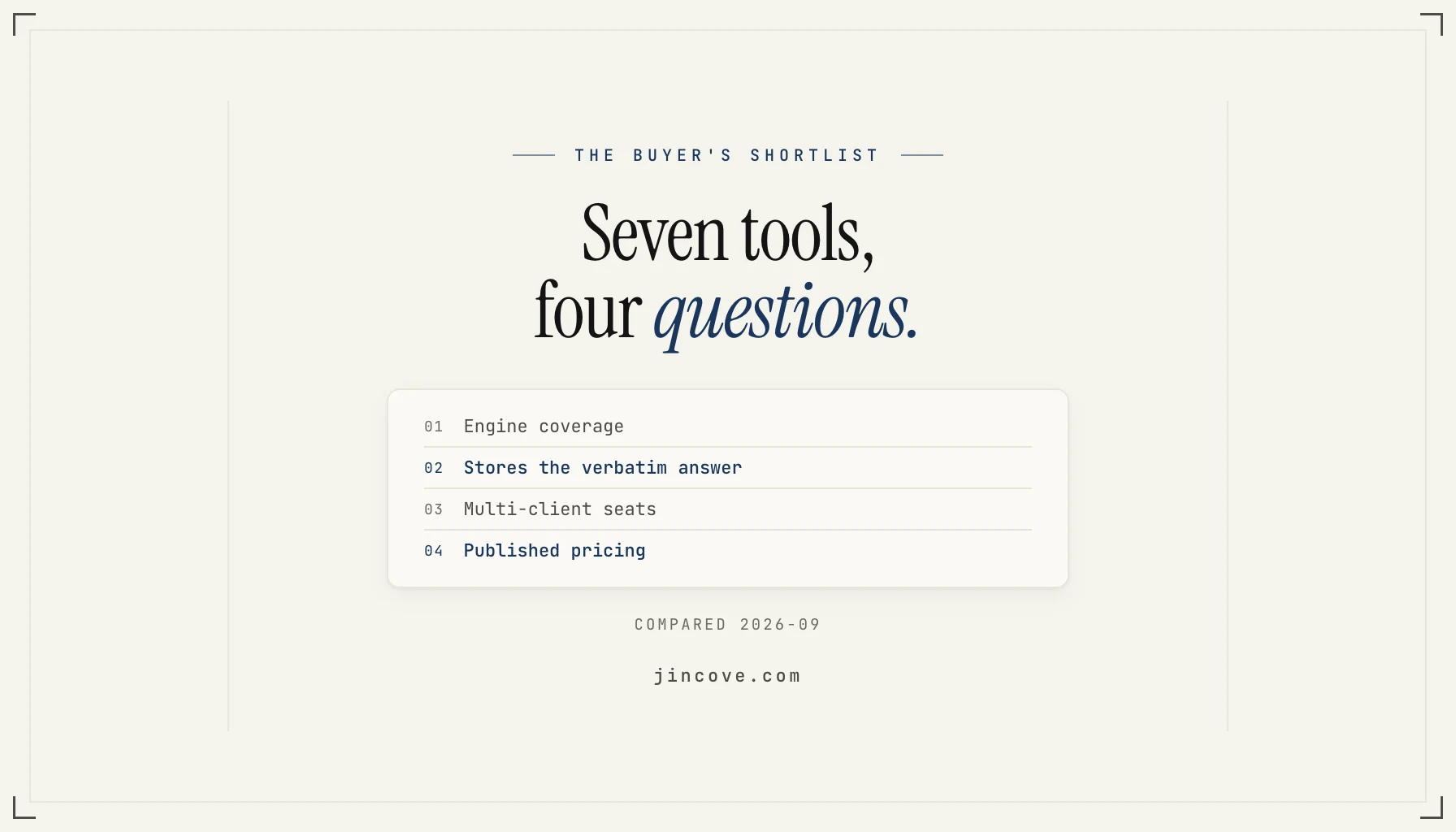
TL;DR: If you only need to know whether ChatGPT names your brand this week, Otterly.AI is the cheapest honest start - $29/mo at entry as of 2026-09. If you have to defend the number in a client meeting, the deciding feature is whether the tool stores the verbatim answer behind every chart, and that narrows the field fast. Two incumbents on this query, Siftly and Livesov, publish so little that we list them as unverified rather than rank them.
This page is narrow on purpose: tools that watch one engine, and what separates them past the marketing pages. For the method rather than the software, read how to track brand mentions in ChatGPT - the manual version you can run this afternoon with a browser and a spreadsheet. For the whole category rather than one engine, read the wider AI visibility tool shortlist for agencies. Three different jobs, linked rather than repeated. And once you have a shortlist from any of them, run the 12 questions to ask an AI visibility provider against it before you sign.
One framing note. "Monitoring ChatGPT mentions" is two measurements wearing one name, and most tools collapse them. A brand can be named in an answer with no link, or cited as a source with no name in the text. Those failures have different causes and different fixes, so we score them separately - see mention vs citation.
How we picked, and where we are biased
Jincove is our own product. It is on this list, at the bottom, with a paragraph on who should not buy it. Read the rubric first and re-run it against anything we left out.
- Does it store the raw answer. Can you click a number and read the exact text ChatGPT produced, with its sources? If not, the tool is a dashboard, and a dashboard does not survive a client asking "how do you know".
- Does it separate named from cited. One merged visibility score hides the only two facts you would act on.
- What does it cost at ten brands, not one. Flat prompt quotas and per-brand seats behave very differently once you multiply.
- Is ChatGPT the only surface, or one column of a matrix. A ChatGPT-only number is not wrong, it is partial.
- Can the output leave the tool. Something a client can read, or something you re-key into slides first.
Every figure below is what the vendor publicly listed when we checked, marked (2026-09). Where a vendor publishes nothing, the cell says "not publicly listed" rather than a number inferred from a review site. We ran no controlled bake-off, so nothing here claims relative data accuracy.
The seven tools compared
| Tool | Engines | Raw answer stored | Multi-client | Pricing signal (2026-09) | Best for |
|---|---|---|---|---|---|
| Otterly.AI | ChatGPT plus a small set of other surfaces; some gated by tier | Not documented as a client-facing evidence record | Flat prompt quota, no per-client partition | $29 / $189 / $489 per month by tracked prompts | Solo marketers wanting a cheap early-warning signal |
| Peec AI | 3 in the base plan; more as paid add-ons | Tracking charts are the primary output | Agency plans capped by project count | Brand plans about $95-495; agency about $245-795 | Mid-market teams tracking several brands on charts |
| Profound | 1 at entry, 3 at the real entry tier, more on Enterprise | Dashboards and aggregate metrics | Enterprise contract only | $99 ChatGPT-only; $399 for 3 engines; Enterprise quoted | Large in-house brand teams with an analytics function |
| Scrunch AI | ~7 LLM surfaces; Copilot not listed | Tracked responses and share-of-AI metrics; screenshots not documented | Multi-client workspace; agency pricing via an unpublished partner program | Published: Starter $300 and Growth $500 per month; Enterprise quoted | Mid-market and enterprise brand teams |
| Siftly | Not publicly listed | Not publicly listed | Not publicly listed | Not publicly listed | Unverified - trial it yourself before shortlisting |
| Livesov | Not publicly listed | Not publicly listed | Not publicly listed | Not publicly listed | Unverified - trial it yourself before shortlisting |
| Jincove | All 6, every plan | Verbatim answer, sources and screenshot behind every number | Per-client workspaces on one shared credit pool | Studio $249 and Agency $749 per month, usage-based on top | Agencies billing GEO across a client roster |
Otterly.AI
In one line: the cheapest way to stop guessing whether ChatGPT names you.
Who it fits. A founder or solo marketer with one brand and a handful of prompts. As of 2026-09 Otterly publicly lists $29, $189 and $489 per month, separated mainly by tracked prompt count at roughly 15, 100 and 400 prompts. At the bottom tier that is genuinely cheap for a weekly signal.
Who it does not fit. Anyone past their second client. A flat prompt quota does not partition across a roster, agency terms run through a partner program with no public price, and the output is a signal rather than an artefact you hand a client with your logo on it.
Pricing signal (2026-09). Published, three tiers, prompt-count based, with add-ons for extra prompts and some surfaces.
Verdict: a personal smoke alarm, not a deliverable. Long version: Jincove vs Otterly, or the whole set of head-to-heads on the Jincove comparison index.
Peec AI
In one line: a clean prompt-tracking dashboard with a real agency tier.
Who it fits. Mid-market teams and small agencies tracking several brands who want trend charts more than raw artefacts. Unlimited seats on the agency plans matters when every account manager needs a login.
Who it does not fit. Teams whose deliverable is the evidence itself. As of 2026-09 Peec lists brand plans in roughly the $95 to $495 per month range and agency plans in roughly $245 to $795, credit-based and capped by project count, with three engines in the base and more as paid add-ons. No white-label is publicly documented.
Pricing signal (2026-09). Published ranges, capped by project count, engines added separately.
Verdict: the best value here if charts are the deliverable and three engines are enough.
Profound
In one line: the most polished AI-search analytics dashboard, built for large in-house brand teams.
Who it fits. A brand team with an analytics function, an SSO requirement and one name to watch. The reporting depth is real.
Who it does not fit. Agencies. As of 2026-09 the listed entry tier is around $99 per month for ChatGPT only, with the plan most teams actually use near $399 for three engines and about 100 prompts. Multi-client work moves you into a quoted Enterprise contract - a procurement cycle, not a line item you attach to a retainer next week.
Pricing signal (2026-09). Published at the low tiers, quoted above them.
Verdict: best-in-class if you are the brand, awkward if you bill on someone else's behalf.
Scrunch AI
In one line: an AI-search visibility platform for mid-market and enterprise brand teams, acquired by Sitecore in mid-2026.
Who it fits. In-house teams that want brand monitoring plus AI-crawler analytics and site audits, across roughly seven LLM surfaces. As of 2026-09 Scrunch publishes self-serve tiers - Starter at $300 per month and Growth at $500, each capping custom prompts and seats - with the Data API, SSO and real scale behind a custom Enterprise quote.
Who it does not fit. Agencies costing a per-client engagement: agency terms run through a partner program whose pricing is not published, and the self-serve prompt and seat caps do not partition across a roster. Reporting runs through client Guest access and Looker Studio rather than fully white-labeled exports.
Pricing signal (2026-09). Published for self-serve: Starter $300 and Growth $500 per month; Enterprise and agency partner pricing quoted.
Verdict: a credible enterprise product; confirm the agency price before proposing it on a retainer. Long version: Jincove vs Scrunch AI.
Siftly
In one line: a ChatGPT-mention tracker that ranks for this query and publishes very little we could verify.
Who it fits. Unknown from public material. It appears consistently in results for ChatGPT brand monitoring, so it is a real product with real users, and a free trial is the only honest way to evaluate it.
Who it does not fit. Anyone writing a procurement case this week. If pricing, engine list and data-retention behaviour are not on a public page, you reconstruct them from a sales call.
Pricing signal (2026-09). Not publicly listed at the time of writing. We are not going to invent one.
Verdict: trial it directly before it enters a shortlist. We will update this entry when there is a public page to cite.
Livesov
In one line: another incumbent on this query with no public detail we could confirm.
Who it fits. Unknown from the outside. Treat its presence in results as evidence the category is crowded, not as a recommendation.
Who it does not fit. Buyers who need a comparable spec sheet. You cannot compare against an unlisted price.
Pricing signal (2026-09). Not publicly listed at the time of writing.
Verdict: unverified. Judge it on whether the trial hands back the answer text.
Jincove, and who should skip it
In one line: a usage-based GEO platform whose unit is the client roster, with the raw answer stored behind every number.
Who it fits. Agencies running GEO as a billable service line across several clients, needing per-client isolation and evidence a client can check line by line. All six engines are in every plan, credits come from a shared pool so unit cost drops as the roster grows, and every number opens back to the verbatim stored answer with its sources and a screenshot.
Who it does not fit. A single brand watching only itself pays for roster machinery it never uses - Otterly or Peec cost less and do that job. Teams wanting one headline visibility number will find our reports deliberately uncomfortable, because we do not produce one. White-label reporting is coming soon rather than shipped, so if rebranded client PDFs are a hard requirement this quarter, take that at face value.
Pricing signal (2026-09). Published: Studio $249 and Agency $749 per month, usage-based credits on top. See pricing.
Verdict: buy it for the roster and the evidence trail, not for the dashboard.
Is monitoring ChatGPT on its own enough
Sometimes - decide deliberately rather than by default.
ChatGPT is the largest single assistant surface, so a ChatGPT-only number is not noise. But it is one column of a matrix. The buyer who asks ChatGPT for a shortlist also sees Google AI Overviews without asking, opens Google AI Mode for the comparison questions, and leans on Perplexity because it shows sources. A brand can be well represented in one and absent from another, and a single-engine tool cannot tell you which.
There is a subtler problem. "ChatGPT coverage" is not one thing. An answer generated with web search enabled is a different artefact from one generated without it, and both differ again from the same prompt sent through the API with no browsing. Vendors rarely state which they run. That is the most useful question to ask on a demo call, and the answer changes how you read every chart in the product.
The practical rule: single-engine monitoring is fine as an internal early-warning signal and thin as a client deliverable. If the report carries someone else's logo, cover at least the surfaces that client's buyers actually use, usually three or four rather than nine.
What none of these tools can do
Every tool here, ours included, works the same way underneath: it sends prompts to an engine, reads what comes back, records it. That method has four limits no dashboard polish removes, and stating them up front is what makes the rest of the report credible.
It is sampling, not a census. There is no impression log for ChatGPT. Nobody knows how many real people asked anything, so every number is an estimate from a prompt set someone chose. Change the prompt set and the number changes, legitimately.
Answers drift for reasons you cannot see. Model updates, index refreshes, region, time of day and whether web search fired all move the result. A drop between two weekly runs may reflect a silent model change rather than anything about the brand, and a single sample can reverse on the next run with nothing having changed.
Personalization and memory contaminate results. A logged-in account that has discussed a brand carries that forward. Clean sessions and disabled memory reduce it, nothing eliminates it, and no method reproduces exactly what a stranger in another country sees.
None of it proves causation. A tool can show a mention appeared after you published something. None can show the publishing caused it. Reports implying otherwise are selling.
If any of these is load-bearing for a claim you make to a client, put the limit in the report. A method that states its error bars persuades better than one pretending it has none.
Questions buyers ask
What is the cheapest way to monitor ChatGPT brand mentions?
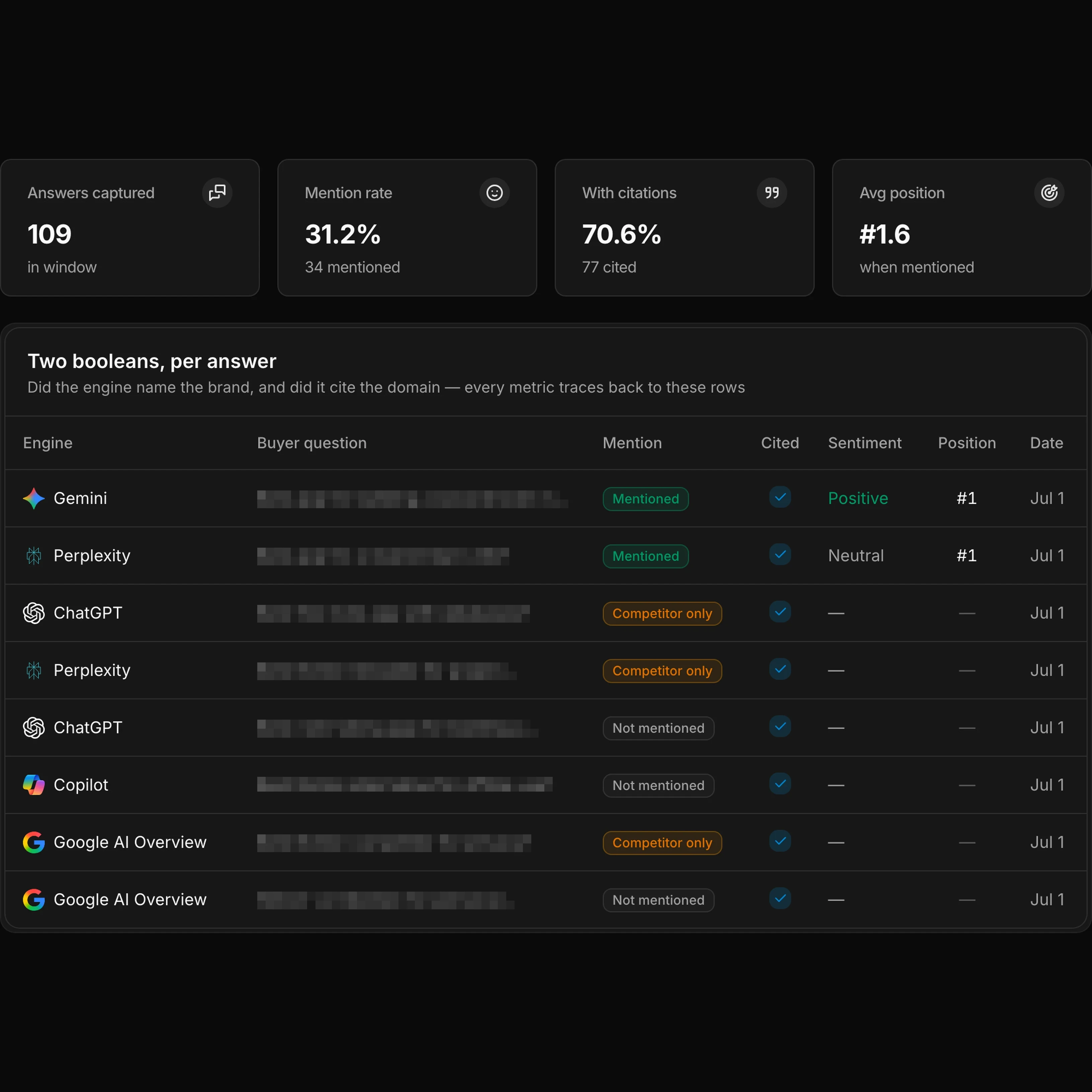
Free, by hand, before you buy anything. Write ten buyer questions in the brand's category, run them in a logged-out ChatGPT session, and record two booleans per answer - was the brand named, and was its own domain cited. Fifteen minutes, and you hold ground truth no sales call can talk you out of. Our AI visibility checker generates a starting prompt set and a scoring sheet free in the browser. Paid tooling starts paying for itself at roughly three clients or a weekly cadence, the point where a missed re-run costs a retainer rather than an afternoon.
Why do two ChatGPT monitoring tools report different numbers for the same brand?
Because they are not measuring the same thing. Differences come from the prompt set, whether the run happens in a browser session or through the API, whether web search fired, region and account state, and how the tool defines a mention - some count any occurrence of the brand string, some only recommendations. None of that is cheating. It does mean vendor numbers are not comparable across tools, so never mix two vendors' figures into one client chart. Pick one method, document it, compare only against your own history.
Do I need a tool that stores the raw answer?
If the output stays inside your team, no. If it goes to a client, yes, and it is the feature that matters most. The predictable moment is month three of a retainer, when someone asks why they pay for a line that moved from 22 percent to 26 percent. A stored answer with its sources ends that conversation in ten seconds. A score you cannot open does not, and you spend the meeting defending a vendor's methodology rather than your work.
How often should ChatGPT monitoring run?
Weekly is the default that works. Daily runs mostly buy noise, because day-to-day variation in generative answers exceeds most real movement. Monthly is too slow to attribute anything: by the time you see a change you have shipped four other things. Cadence matters more than frequency - an unbroken weekly line is a trend, a line with two gaps is an anecdote.
See the evidence on one of your own clients
Before subscribing to anything on this page, look at the output. Request a free, human-run audit: send one client URL and an email, and we hand-run ChatGPT, Perplexity and Gemini and reply with the exact answers, the sources, and whether each named or only cited the brand - two business days, no card, no account. If the evidence is useful, the same method runs on a schedule across all six engines.
Related blogs
Related Post
Expand your knowledge with these hand-picked posts.

How to Track Brand Mentions in ChatGPT in 2026: The Agency Method
ChatGPT has no Search Console - no impressions, no analytics, no export. Here is the method agencies use to track brand mentions across ChatGPT and the other answer engines without trusting a black-box score, and why "citations" and "mentions" are two different numbers.
Gan Liu

Best AI Visibility Tools for Agencies in 2026: An Honest Shortlist
Most "best GEO tool" roundups rank on engine count. Agencies buy on a different axis - client roster, white-label, and evidence you can hand a client. Here is the honest shortlist, what each tool is actually best at, and the three questions that decide it.
Gan Liu
How to Track Brand Mentions in Perplexity in 2026: The Agency Method
Perplexity shows numbered citations and a Sources list under every answer. The agency method for reading brand mention vs citation off it - no black-box score.
Gan Liu
Start with the free audit
Send us one brand. We’ll run it through the engines and send back the answers, citations, and sources — so the first report your client sees is already backed by evidence.
Free audit: ChatGPT, Perplexity and Gemini, run by hand. Paid work covers all six engines.