Input-Side Grounding vs Output-Side Verification: Where GEO Fits in the Ontology and RAG Stack
Ontology, RAG, and grounding feed your own AI so it understands your business. GEO verification is the mirror image: checking whether external answer engines named your brand and cited your domain.
TL;DR: Ontology, RAG, and grounding are input-side work - you feed your own AI so it understands your business. GEO verification is the mirror image, output-side work - after external engines ground on the open web, you check whether they named your brand and cited your domain. Jincove does the second job.
There are two AI projects on your roadmap, and they get confused constantly because they both live under "AI."
The first is inward-facing. You build an ontology, wire up retrieval, ground a model on your own docs, so your agent stops hallucinating your SKUs and starts answering support tickets with the right policy. That is a real, hard, valuable project. It is also entirely about the input - the data you feed into a model you control.
The second is outward-facing and has nothing to do with the first. Someone opens ChatGPT and asks "what's the best tool for X." A model you do not control, grounded on the open web you do not curate, writes an answer. Did it name you? Did it cite your domain, or a competitor's? That is the output - and no amount of ontology work tells you the answer.
Most "AI visibility" content smears these two together. This post keeps them apart, because the distinction is the whole point.
The clean split: input side vs output side
| Input side (grounding) | Output side (verification) | |
|---|---|---|
| Whose AI | Yours - the agent you build or configure | Everyone else's - ChatGPT, Perplexity, Gemini, Google AI Overview, Google AI Mode, Copilot |
| What you do | Feed it: ontology, knowledge graph, RAG, grounding on your docs | Read it: capture the exact answer, the cited sources, the metadata |
| Goal | Make it understand your business | Find out what it said about you - named or not, cited or not |
| Who owns it | Your data or ML team, or an ontology and RAG vendor | You, the brand - and Jincove does the reading |
| Failure looks like | Your agent gives a wrong answer about your own product | An external answer recommends a competitor and never mentions you |
Read the table left to right and the confusion dissolves. Grounding is something you do to a model. Verification is something you observe coming out of a model. They are not two steps of one pipeline - they are opposite ends of two different pipelines.
Why grounding your own agent tells you nothing about the output side
Say you finish a beautiful ontology. Every entity in your business is modeled, every relationship is typed, your internal agent answers flawlessly. Congratulations - and it changes nothing about what ChatGPT says to a stranger tomorrow.
ChatGPT was not trained on your ontology. Perplexity does not query your knowledge graph. When Google's AI Overview writes three sentences and picks two source links, it grounds on whatever it retrieved from the open web in that moment - pages, forum threads, competitor comparisons, your own content if it happened to surface. Your internal grounding project lives on your side of the wall. The external engine lives on the other side, and the only interface between them is the public web.
So the output-side questions are genuinely separate, and no input-side work answers them:
- When people ask about your category, is your brand named in the answer?
- When an engine cites sources, is your own domain one of them?
Those are two independent facts. You cannot infer either one from how well-grounded your own agent is.
What output-side verification actually measures
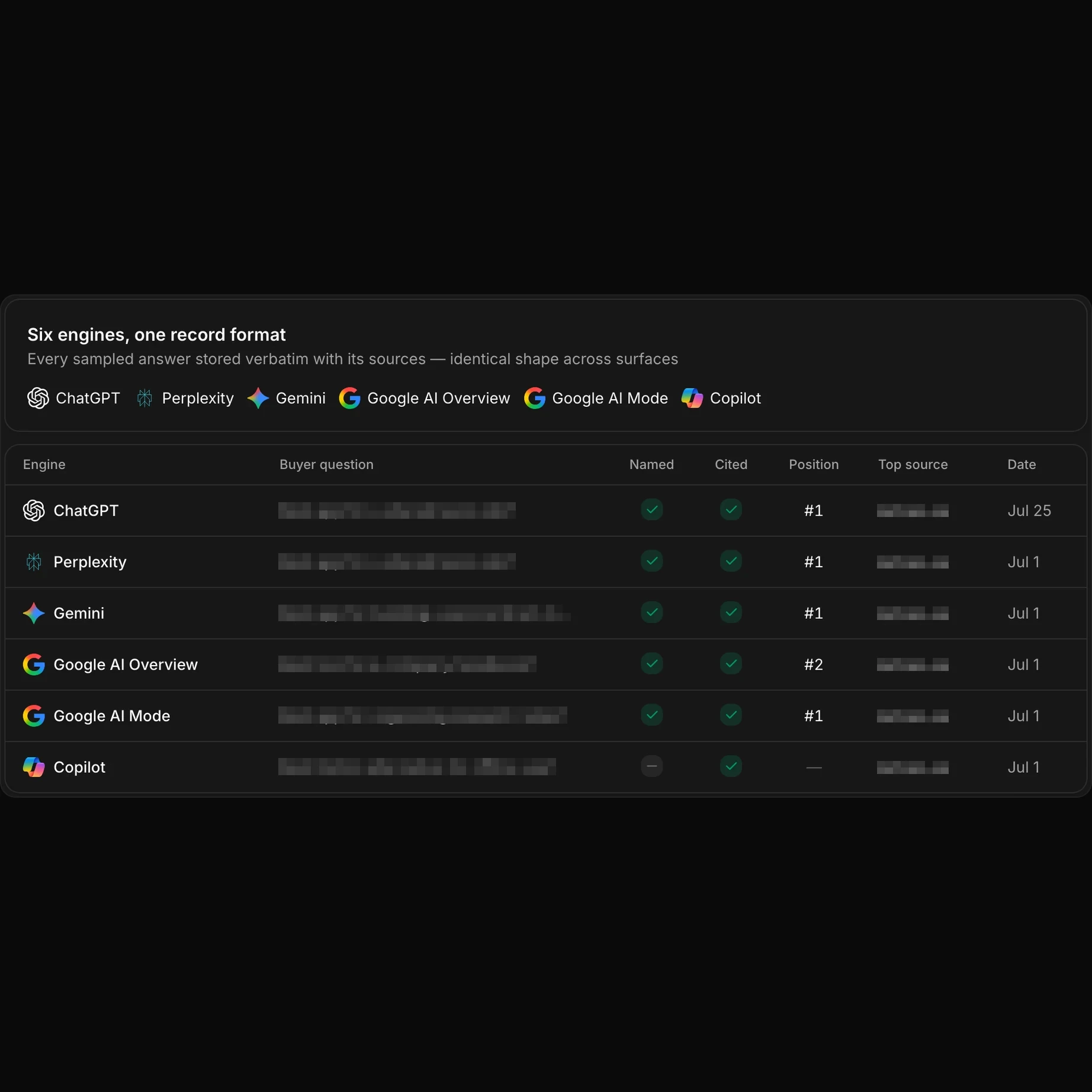
This is the job we built Jincove around. Our toolchain sits entirely on the output side and runs no models of its own. For a prompt and an engine, it routes the request through a managed AI-scraper provider - we are a downstream consumer of that real-time data - then normalizes the reply into one record: the exact answer text, the cited sources, and the provider metadata (which model, which country, whether web search was on). Nothing gets flattened into a black-box score you have to trust. Any derived number opens back to the raw answer.
From that record we read two booleans - and only two:
- Mention - was your brand named in the answer?
- Citation - was your own domain listed as a source?
They stay separate on purpose. The most useful information lives in the gap between them:
- Conversion gap - cited but not named. The engine pulled from your content and never said your name. A reader met your words and never met your brand.
- Source gap - named, but the citation points at someone else's domain. The answer credits your brand to a competitor's or a third party's URL.
For paid monitoring we run the same prompts on a schedule - weekly down to every fifteen minutes - across all six engines in the table, and keep every run in history. You diff against your own past runs, and we flag a change only when it moves beyond sampling noise. Every flag traces back to a stored answer, inside a defined sampling window, with the methodology open to inspection. Evidence, not a score.
Two honest boundaries this split forces
The input/output frame is only useful if you respect what each side can and cannot do.
We do not build ontologies, knowledge graphs, RAG, or grounding. That is input-side work, and it belongs to your team or a specialist vendor. If someone offers to "optimize your grounding," that is a different job on a different side of the wall.
We do not change what any AI says, and we do not fact-check it. We cannot make ChatGPT say good things about you - we measure whether ChatGPT named you. We do not judge whether the AI described you correctly - only whether your brand was mentioned and your domain was cited. Measurement, not influence. Evidence, not a verdict.
Anyone promising to make an engine "say the right thing" is selling something we deliberately refuse to sell.
How the two sides work together in practice
They are separate, but they inform each other in one direction. Output-side verification shows you where the external web currently fails you, and that points your input-side and content work at real gaps:
- Ground your own agent (input side) so your product, docs, and support answers are correct and consistent. Your team or vendor owns this.
- Verify the external output (output side) so you know, per engine and per prompt, whether your brand gets named and your domain cited where buyers actually ask. We own this.
- Read the gaps. A source gap means an engine credits your idea to someone else's URL - a content and positioning problem. A conversion gap means your content lands but your name doesn't stick.
- Re-run on a schedule and diff. Did last quarter's work move the mention or the citation? The stored history answers with the exact text, not a hunch.
The ontology hype is real and the work is worth doing. Just don't mistake a well-grounded internal agent for proof that the outside world's AI is on your side. Those are two different questions, and only one of them is answered by reading what the engines actually wrote.
Where to go from here
If you want the full method for turning the two booleans into a repeatable GEO audit, read the source gap vs conversion gap framework. If mention versus citation is still fuzzy, this breakdown walks through it with examples. And if you run this for clients, see how agencies package output-side monitoring - or, if you are weighing which platform to run it on, the honest shortlist of AI visibility tools for agencies.
You do not need to commit to anything to see the output side for yourself. Send us a URL and an email and we hand-run three engines - ChatGPT, Perplexity, and Gemini - then reply with a mini report: the exact answers and the cited sources. No card, no account. Paid work extends the same method across all six engines. Read your own output before you decide the input side was enough.
Related blogs
Related Post
Expand your knowledge with these hand-picked posts.
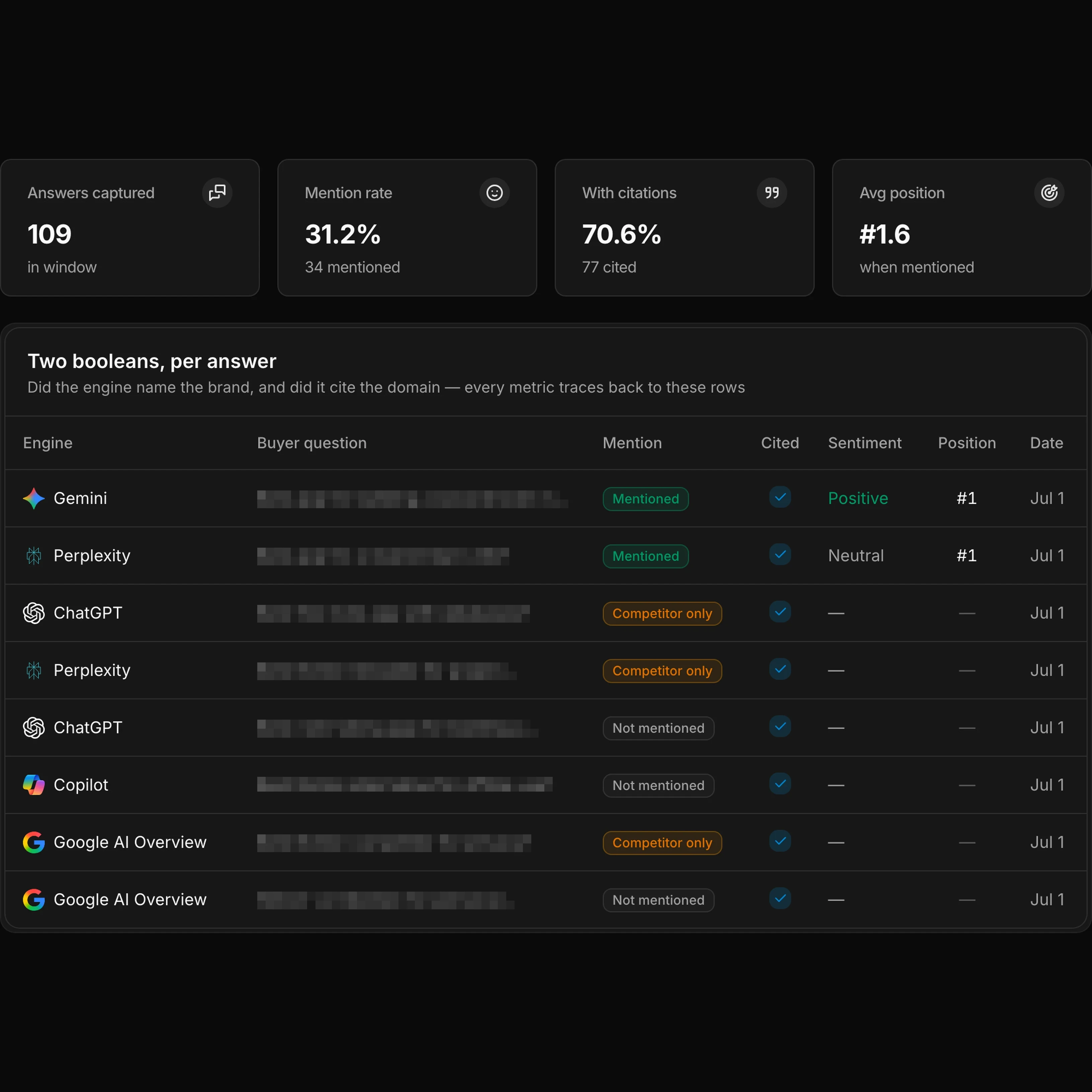
Mention vs Citation: Why AI Cites Your Content but Never Names Your Brand
When an AI answer links your page but never says your name, that is a conversion gap. What the mention and citation booleans mean, why the gap happens, the attribution lever you can pull, and how to monitor brand mentions in ChatGPT without a black-box score.
Gan Liu
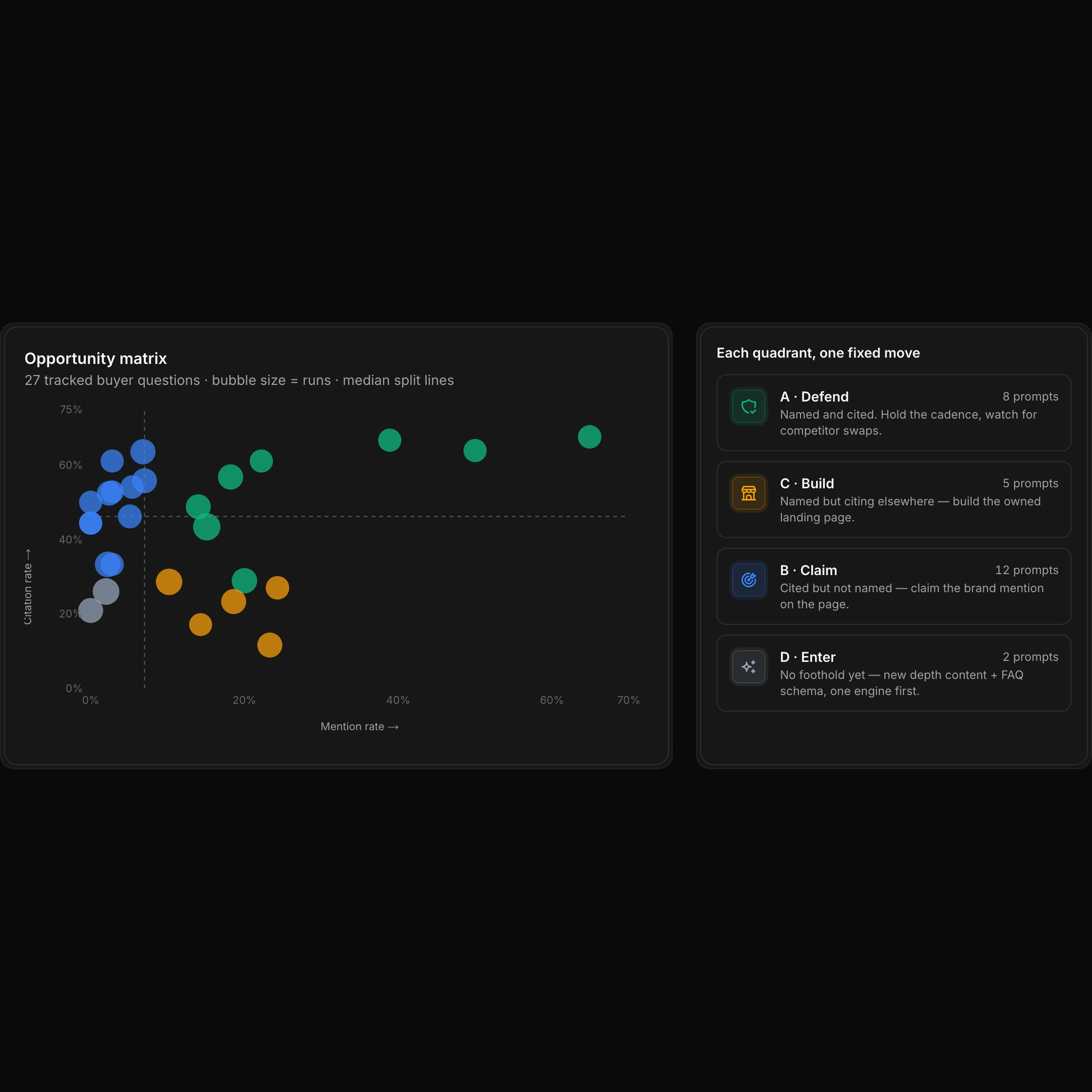
Source Gap vs Conversion Gap: A 2x2 Framework for AI Visibility Audits
Score every prompt on two booleans - brand named, own domain cited - and every AI answer lands in one of four quadrants: stronghold, conversion gap, source gap, or whitespace. Each quadrant has one fixed move.
Gan Liu
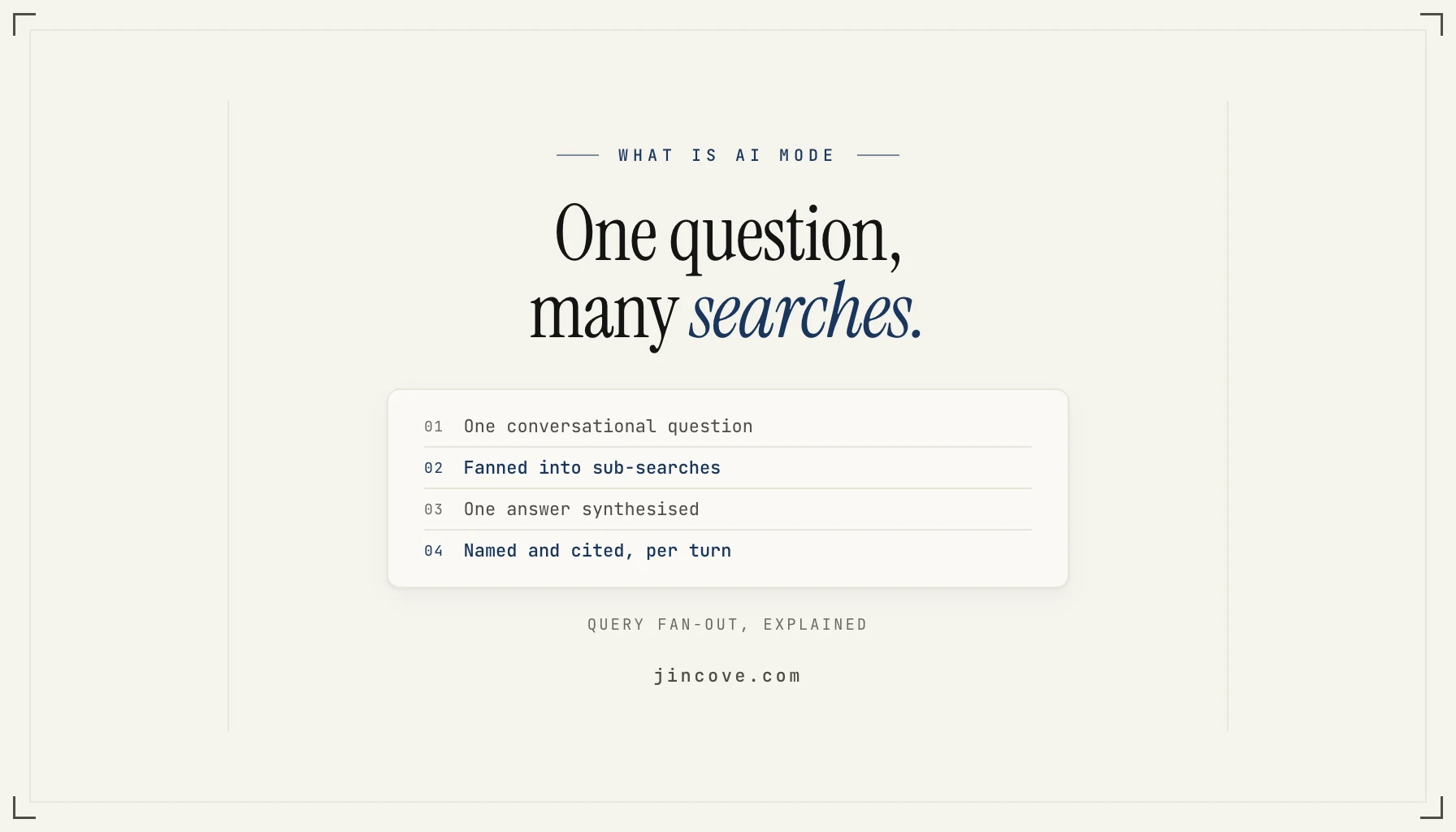
What Is Google AI Mode, and How Does It Work?
Google AI Mode is a conversational search surface that fans one question into several sub-searches and answers in prose. How it works, and what it changes.
Gan Liu
Start with the free audit
Send us one brand. We’ll run it through the engines and send back the answers, citations, and sources — so the first report your client sees is already backed by evidence.
Free audit: ChatGPT, Perplexity and Gemini, run by hand. Paid work covers all six engines.