What Is Google AI Mode, and How Does It Work?
Google AI Mode is a conversational search surface that fans one question into several sub-searches and answers in prose. How it works, and what it changes.
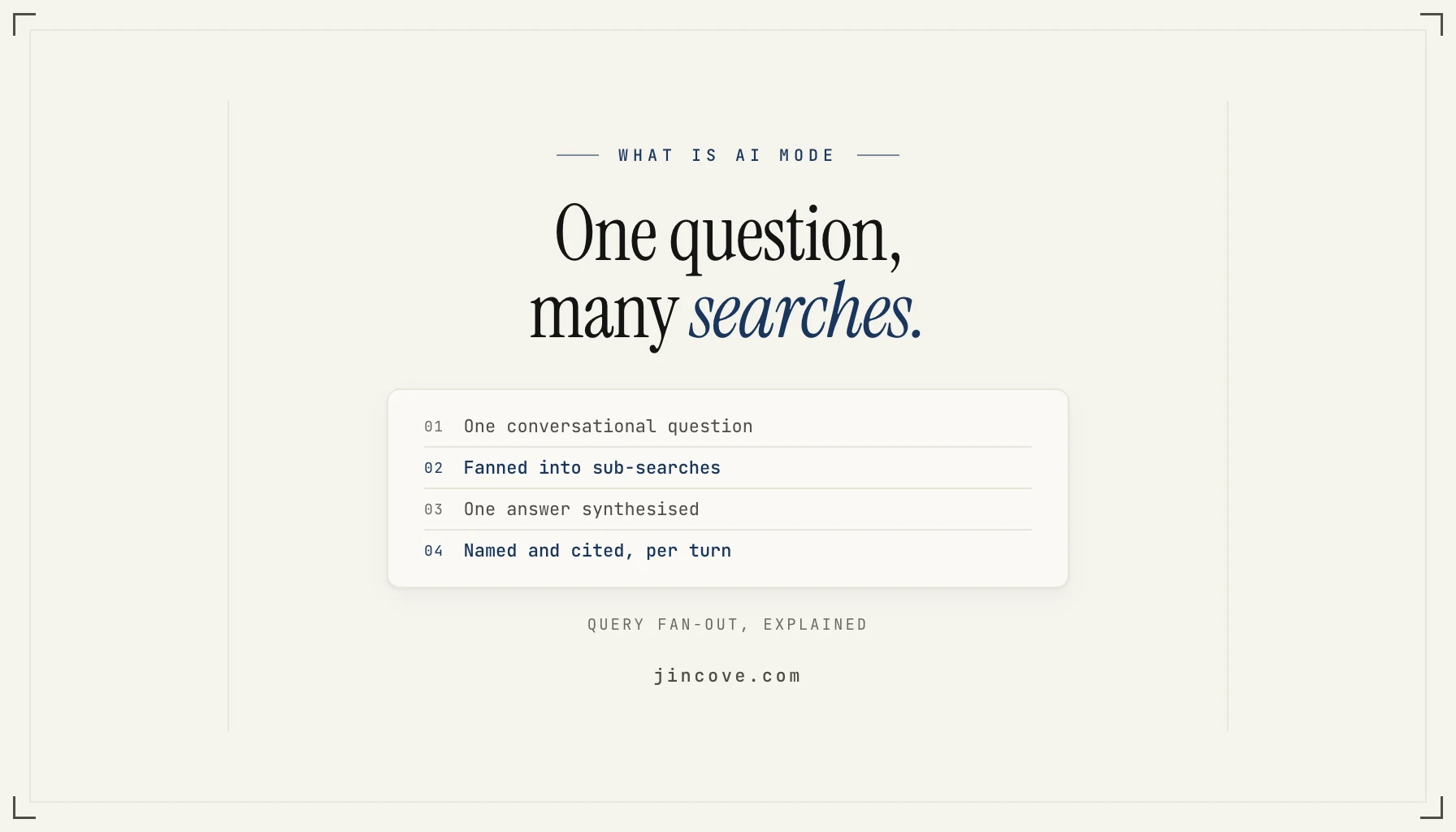
TL;DR: Google AI Mode is a conversational mode inside Google Search, entered deliberately rather than shown automatically, that answers a question in prose with linked sources instead of returning a ranked list of pages. It runs on a Gemini build tuned for search grounding, uses query fan-out to break one question into several simultaneous sub-searches, and supports follow-up turns in a single session. It is not AI Overviews and it is not the Gemini app. Practically, it removes the concept of rank, so the measurable facts about your brand become whether an answer named it and whether an answer cited its domain.
Three Google surfaces are routinely confused with each other, and the confusion is expensive because it leads teams to measure one thing and report another. This page defines AI Mode precisely, separates it from its two neighbours, and explains what it does to the numbers you put in front of a client.
The short definition
Google AI Mode is a conversational search experience inside Google Search where a user asks a question in natural language and receives a synthesised prose answer with linked sources, then continues the conversation with follow-up questions in the same session, instead of scanning a ranked list of results.
Three parts of that sentence carry the weight. Inside Google Search - it is a mode of the search product, not a separate assistant app. Synthesised prose with linked sources - the answer is written, not retrieved, and its links are citations rather than results. Continues the conversation - the session, not the query, is the unit.
How Google AI Mode works
A custom Gemini build. AI Mode runs on a Gemini model configured for search: grounded in retrieval, tuned to produce citations, and pointed at Google's index rather than at open-ended conversation. It is not the same configuration as the model in the standalone Gemini app, which is why the same question can produce noticeably different answers in the two places.
Query fan-out. This is the part with the most consequence and the least public understanding. When you ask Google AI Mode a question, it does not run one search. It decomposes the question into a set of related sub-queries, issues them concurrently across subtopics and sources, and then writes one answer over the combined material. Ask "which project management tool is best for a five-person design studio" and the system may separately investigate small-team project tools, design-agency workflows, pricing at that seat count and recent user sentiment, then merge what it found.
Two things follow. Your page can influence an answer without matching the phrasing the user typed, because it may have matched one of the sub-queries instead. And there is no single query whose results you can inspect to explain why the answer said what it said.
Multi-turn sessions. AI Mode is built for follow-ups. The first answer is usually broad; the narrowing happens on turn two and three, where the user adds budget, region, team size or an objection. In commercial categories that is where the shortlist actually forms - which matters enormously for measurement, because almost everything that samples AI Mode samples turn one.
Google AI Mode is not AI Overviews, and neither is the Gemini app
| AI Overviews | AI Mode | Gemini app | |
|---|---|---|---|
| Where it lives | Above classic results on a normal search | A mode inside Google Search you open | A separate assistant product |
| How you get it | Pushed to you, unrequested | Chosen deliberately | Chosen deliberately |
| Unit of use | One keyword | One conversation | One conversation |
| Classic results present | Yes, directly underneath | No, the answer replaces the list | No |
| Retrieval | Summarises results for that query | Query fan-out across sub-queries | Varies by mode and model |
| How to measure it | Trigger rate, citation, brand named | Brand named, domain cited, on which turn | Brand named, domain cited |
The line between the first two has been getting softer rather than sharper. Google has wired the surfaces together in the interface, so a reader can expand an AI Overview or ask a follow-up and be carried into an AI Mode conversation. That is good for users and awkward for reporting: the two surfaces now share traffic paths, and Search Console reports them in a single generative bucket rather than separately.
What Google AI Mode changes for visibility
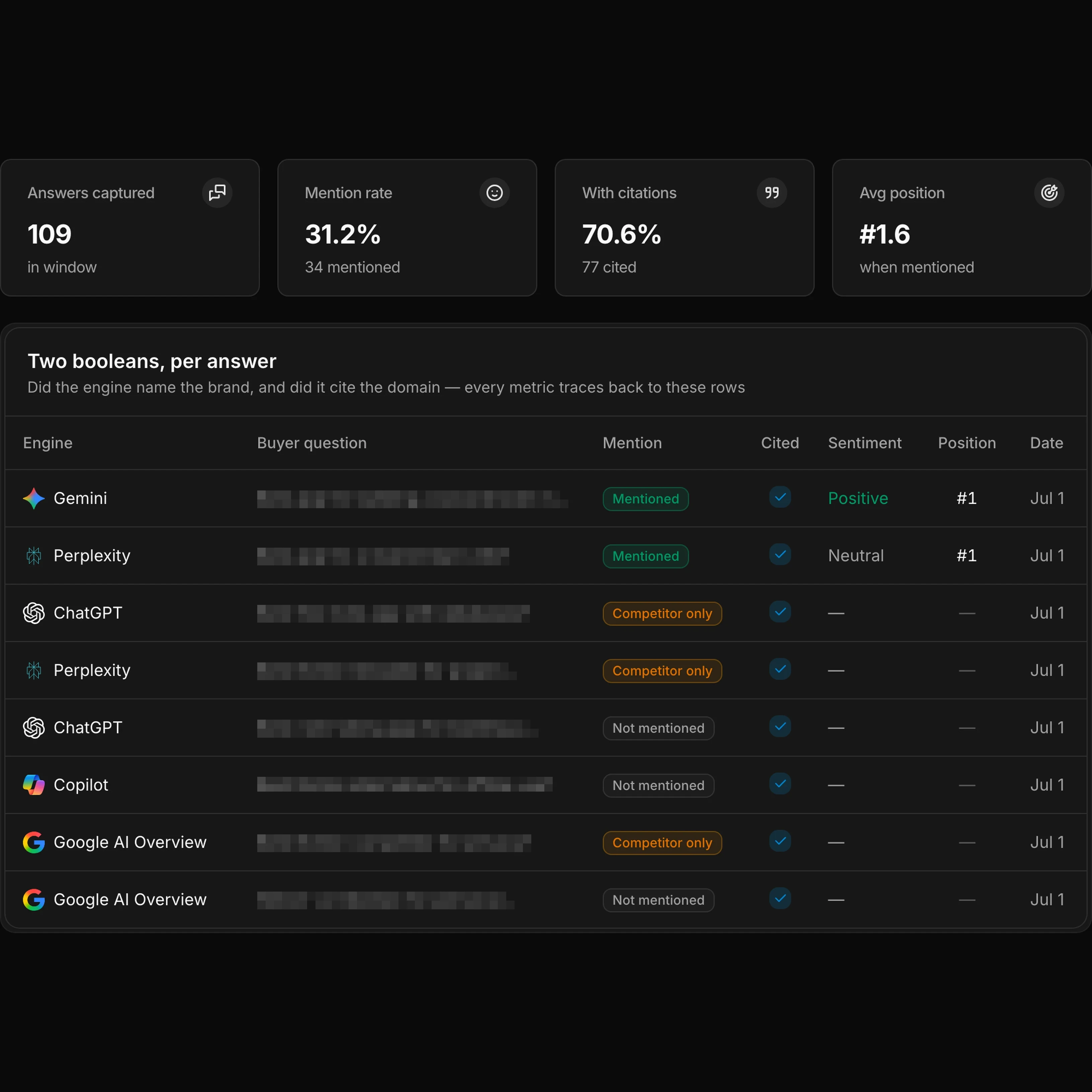
Rank stops being a coherent question. A ranked list has positions; a written paragraph does not. You can be the third citation, the only brand named, both, or neither, and none of those is a position. Any tool selling you an AI Mode rank is either reporting the classic results behind the query or has invented an internal score - both can be useful, neither is a rank. This is the core reason we score two independent booleans instead: was the brand named, was its domain cited. Those two fail for different reasons and get fixed by different work, which is the argument in mention vs citation.
Being cited and being named come apart more often. A synthesised answer built from several sub-searches has more source material than sentences. Google can lift a fact from your page, cite the URL in the source list, and describe the category generically without ever writing your brand name. The reader takes the fact and remembers Google. That failure has a name - a conversion gap - and it is more common on fan-out surfaces than on keyword-attached ones.
Attribution gets harder, not easier. Fewer, longer sessions replace many short ones. A user may resolve a question in three turns without clicking anything, then arrive on your site a day later through a branded search. The AI Mode session caused the visit and no analytics tool will say so. Report the surface as exposure, not as a channel, and say so in the report before a client works it out for themselves - the way to structure that is a separate problem worth solving deliberately.
Does Google AI Mode reduce clicks to your site
Probably, for some query types, and anyone giving you a single percentage is guessing. The structural argument is sound and the measurement is not available, so here is the honest version of each.
Structurally, AI Mode removes the ranked list from the screen. A user who would have scanned ten titles now reads one answer with a smaller set of links, and the answer is written to be sufficient. For questions with a short factual resolution - a definition, a comparison of two specs, an opening hours lookup - the click was already fragile and AI Mode finishes it off. For questions that end in a purchase, a signup or a document the user needs to read in full, the click still has to happen somewhere, and AI Mode's links are where it happens.
What you cannot do is size that shift for your own site. Search Console counts a click on an external link in generative AI features, but reports AI Mode and AI Overviews together, so a decline you observe cannot be assigned to one surface. Year-over-year organic comparisons are also contaminated by everything else that changed in the same window.
The workable posture: stop treating the surface as a traffic channel and start treating it as an exposure surface with its own two facts - named and cited. Report clicks where clicks are measurable, report exposure where only exposure is measurable, and never let one stand in for the other.
Where it is available
Google has expanded the surface aggressively. As of 2026 Google AI Mode is available in close to 200 countries and territories and in the order of a hundred languages, with a small number of markets still arriving later than the rest. Treat any specific country list as perishable - this has changed several times in a year, and the current answer belongs on Google's own announcement pages rather than in a blog post.
For anyone tracking a brand, the practical implication is that region is now part of your method statement. An answer sampled from the United States is not evidence about the United Kingdom, and a report that does not state where its runs were issued from is not reproducible.
How to check whether Google AI Mode names your brand
Fifteen minutes, no tooling, and the result is ground truth you can hold against any vendor's dashboard.
- Write ten questions a buyer would actually ask, phrased conversationally. Favour comparison and reasoning questions, because those are what people open AI Mode for.
- Open AI Mode in a clean, logged-out browser profile, from the region that matters. Account history and personalisation move results and nothing removes that fully.
- For each answer, record two booleans: was the brand named in the text, was the brand's domain in the cited sources. Two columns, never averaged.
- Ask one follow-up per question - the narrowing move a real buyer would make - and record the same two booleans for turn two.
- Paste the answer text into the sheet. In month three the text is what settles an argument; a chart is not.
- Re-run the same set weekly and note the date if you ever change the set, because changing it starts a new series.
Our AI visibility checker generates a starting prompt set and a scoring sheet in the browser, free, with nothing leaving the page. When one brand becomes several, the tracking tools worth comparing are here, and the keyword-attached surface has its own separate shortlist.
What nobody can tell you about AI Mode
Stating these first is what makes the rest of a report credible.
There is no impression log. Nobody outside Google knows how many people asked anything in AI Mode, so every third-party number is an estimate from a prompt set someone chose. Change the prompt set and the number changes, legitimately.
You cannot isolate its traffic. Search Console reports impressions in generative AI features and counts clicks on external links there, but it does not separate AI Mode from AI Overviews. Anyone quoting you an AI Mode traffic figure is modelling.
Answers move for invisible reasons. Model updates, index refreshes, region, time of day and session state all shift the result. A drop between two weekly runs may reflect a silent model change rather than anything about the brand.
Nothing here proves causation. A tool can show that a mention appeared after you published something. None can show that publishing caused it. Reports implying otherwise are selling.
See what Google AI Mode says about one of your clients
Request a free, human-run audit: send one client URL and an email, and we hand-run the answer engines and reply with the exact answers, the sources, and whether each named the brand or only cited it - two business days, no card, no account. If the evidence is useful, the same method runs on a schedule across all six engines, and pricing is published rather than quoted.
Related blogs
Related Post
Expand your knowledge with these hand-picked posts.
Mention vs Citation: Why AI Cites Your Content but Never Names Your Brand
When an AI answer links your page but never says your name, that is a conversion gap. What the mention and citation booleans mean, why the gap happens, the attribution lever you can pull, and how to monitor brand mentions in ChatGPT without a black-box score.
Gan Liu
Source Gap vs Conversion Gap: A 2x2 Framework for AI Visibility Audits
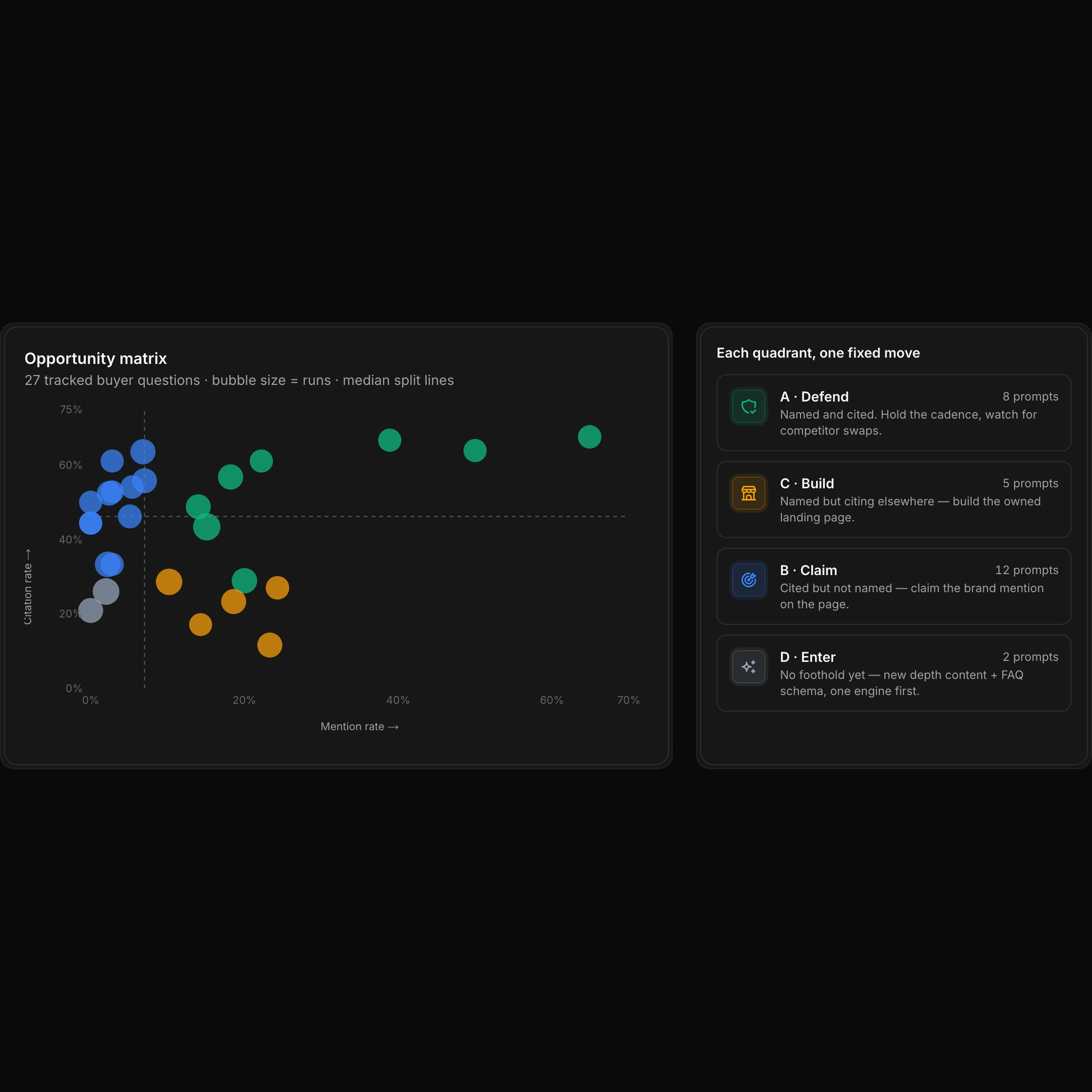
Score every prompt on two booleans - brand named, own domain cited - and every AI answer lands in one of four quadrants: stronghold, conversion gap, source gap, or whitespace. Each quadrant has one fixed move.
Gan Liu
Input-Side Grounding vs Output-Side Verification: Where GEO Fits in the Ontology and RAG Stack
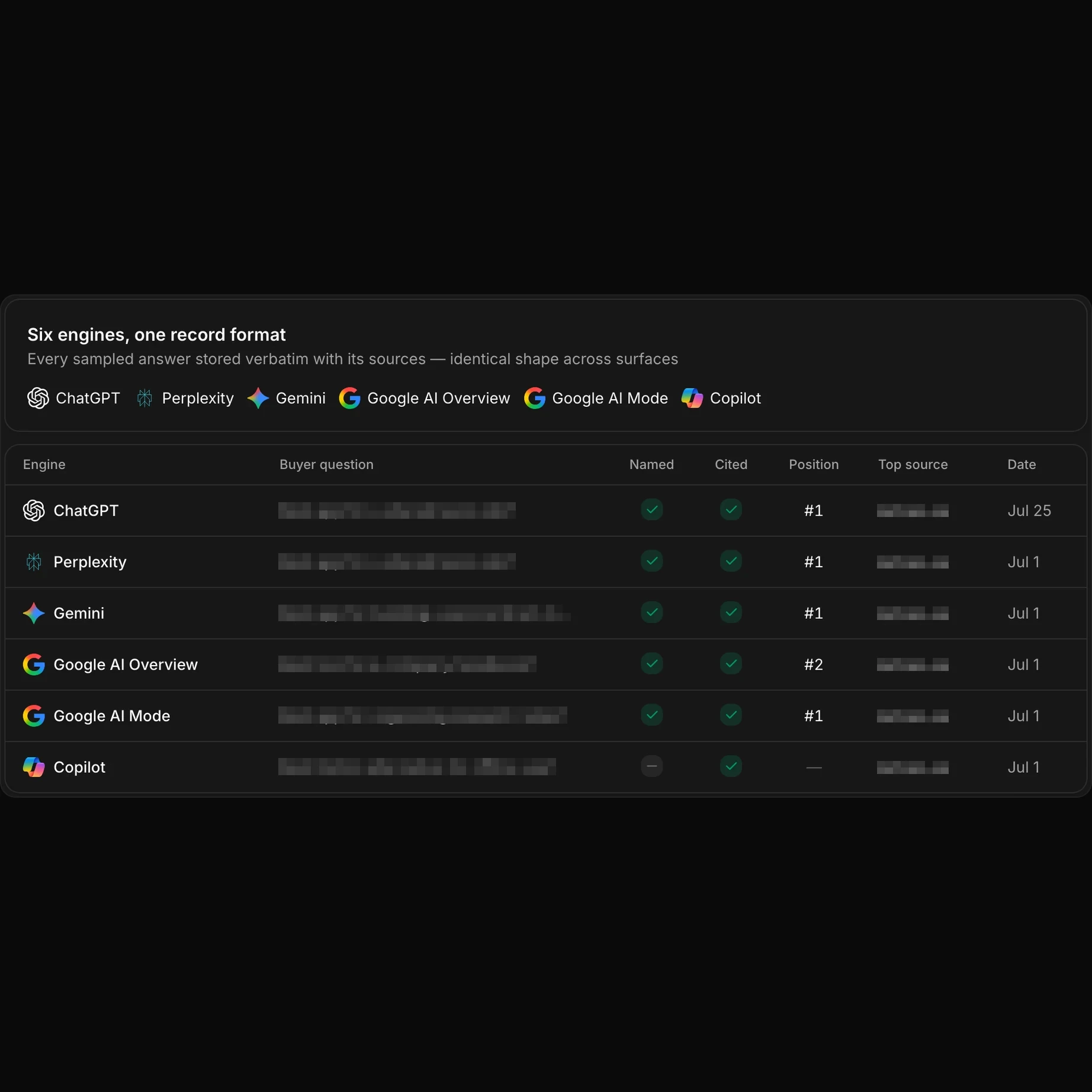
Ontology, RAG, and grounding feed your own AI so it understands your business. GEO verification is the mirror image: checking whether external answer engines named your brand and cited your domain.
Gan Liu
Start with the free audit
Send us one brand. We’ll run it through the engines and send back the answers, citations, and sources — so the first report your client sees is already backed by evidence.
Free audit: ChatGPT, Perplexity and Gemini, run by hand. Paid work covers all six engines.