GEO for Agencies: How to Offer AI Visibility Monitoring as a Service
How SEO, PR, and brand agencies can package AI visibility monitoring as a retainer: a re-runnable evidence report where every mention and citation opens to the exact AI answer it came from.
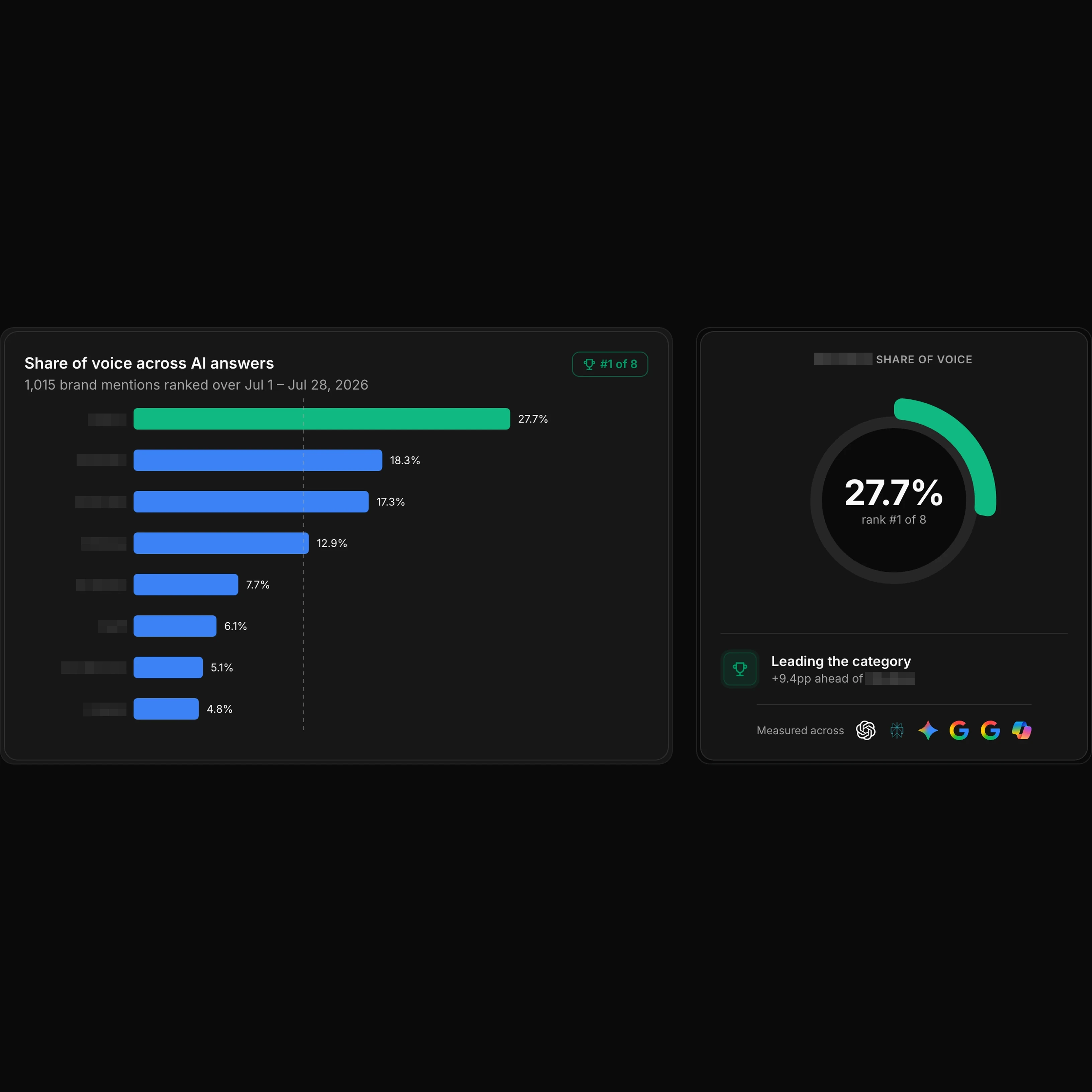
TL;DR: Sell AI visibility monitoring as a retained deliverable built on one artifact - a re-runnable report where every brand mention and every cited source opens to the exact AI answer it came from. Evidence a client can click, not a score they have to trust.
Your clients have started asking a new question: "What does ChatGPT say about us?" A year ago that was curiosity. Now it is a line item. The brand or PR lead has watched a prospect open Perplexity instead of Google, and they want to know whether the answer names them, cites them, or hands the moment to a competitor.
That question is a service you can retain. This is how to package it for SEO, PR, and brand agencies without promising anything you cannot deliver.
What you are actually selling
You are not selling the ability to make an AI "say good things." No vendor can promise that, and any that does is selling a story. You are selling observation you can prove: for a fixed set of client prompts, run across six AI answer engines - ChatGPT, Perplexity, Gemini, Google AI Overview, Google AI Mode, and Microsoft Copilot - you capture the exact answer text, the sources it cited, and the provider metadata (model, country, whether web search was on). Nothing gets flattened into a black-box score; every derived number opens back to a raw answer.
The tooling underneath runs no models of its own. It routes each prompt through a managed AI-scraper provider, normalizes every reply into one record shape, and hands the data back. You are recording what the AI said, not generating it - which is exactly why you can defend every line to a client.
From that raw record you report two independent boolean signals per run:
- Mention - was the client's brand named in the answer?
- Citation - was the client's own domain cited as a source?
Keep them separate. They are different facts, and merging them into one visibility score is exactly the move that makes a deliverable un-defendable in a client meeting. The whole pitch of your service is: evidence, not a score. For why the two signals never merge, read mention vs citation.
The winning artifact: a report where every number opens to a receipt
The deliverable that retains is a re-runnable report: an AI visibility report for clients built on the same prompt set and the same engines, run weekly or monthly and diffed against the client's own past - not against an industry benchmark. A change gets flagged only when it moves beyond sampling noise, and every mention and citation in the report links back to the stored answer it came from. The full method is in the source gap vs conversion gap framework.
When the client asks "why is this number down?", you do not say "the tool recalculated." You open the answer. "Last month Perplexity named you second; this month the same prompt names a competitor and cites their comparison page - here is the sentence." That is the difference between a report a client trusts and a dashboard they cancel.
Two patterns give the report its teeth. Both fall straight out of the two booleans:
- Conversion gap - cited but not named. The AI used your client's content and never said the brand. The reader benefits; the brand stays invisible.
- Source gap - named but the citation points at someone else's domain. The AI says the brand, then sends the reader to a competitor's or aggregator's page as the source.
Both are stories a PR or content lead can act on. Neither requires you to claim the AI described the brand "correctly" - you are not fact-checking the model, only recording whether it named the brand and whose domain it cited.
Package it by agency type
One demand, three angles. Match the deliverable to what each shop already sells.
| Agency type | The headline they buy | Lead metric | Cadence |
|---|---|---|---|
| SEO agency | "Your rankings moved to the answer, not the tenth blue link" | Citation plus source gap - whose domain gets cited | Weekly to monthly |
| PR / comms agency | "What the AI says about your brand this week" | Mention plus the exact answer text as quotable receipts | Weekly, faster around launches |
| Brand / marketing agency | "Where your brand shows up when nobody types your name" | Mention across category prompts plus conversion gap | Monthly retained |
For SEO shops it is a natural extension of rank tracking - swap "position on Google" for "cited as a source in the answer." The simplest first sale is not a new document but two extra sections inside the report the client already receives; that structure is in SEO client reporting. For PR, the exact answer text is the product; a screenshot of Copilot naming the client lands harder than any chart. For brand teams, the category prompts - the ones that never mention the client by name - reveal whether the brand exists in the AI's default answer at all.
How to run it across many clients
The operating model is per-client isolation with shared economics:
- Fix the prompt set per client. Twenty prompts per client is plenty to start - their category questions, their comparison questions, their branded questions.
- Schedule the runs. Cadence goes from weekly down to every 15 minutes, matched to the client's tier. Every run is kept in history, so the diff against last week is always there.
- Render the report in your house style. Compute mention, citation, and the two gaps from the stored records; lay them out as your PDF, your Notion page, your slide. The records come to you in full - the six-engine capture and stored-evidence workflow hands back working files your team can rebuild into any client-facing format.
- Attach the receipts. Every flagged change links to the original stored answer. That link is the retention mechanism.
This is the shape of our agency offering: each client gets an isolated workspace, usage draws from one shared credit pool - so the unit cost falls as your roster grows - and every report line can be re-run and verified. Pausing a client's workspace can be arranged. Full white-label GEO delivery - your brand on the report, our records underneath - is coming soon; today you deliver the evidence under your own narrative, with the records there to back every line. For the section order that deliverable should follow, see white-label GEO reports.
Pricing the retainer
Price the data line, then stack your analysis and margin on top. The math is countable, not vibes:
prompts x engines x runs per month = records per month
A 20-prompt client across 6 engines, run weekly (4 runs a month), is 480 records a month - a fixed, knowable cost of goods before you quote. Add your account-manager time to write the narrative and your margin on top. The full version of that arithmetic - the two cost lines, three packaging shapes, and when to decline the work - is in what to charge for GEO services.
Where this beats the black-box tools
Many AI visibility tools hand the client a single number that moved up or down, with the calculation sealed inside the vendor. When the client asks why, the honest answer is often "we don't know." That is a hard place to defend a retainer from.
Your position is the opposite. Every claim in your report is traceable to the original stored answer, inside a defined sampling window, with a methodology open to inspection. You are not promising the number goes up - moving it is content and positioning work; verifying whether it moved is the service. "Evidence you can open" versus "a number you cannot" is the entire pitch, and it is the one an agency can stand behind in a QBR. For a head-to-head of the platforms agencies actually weigh here, see the honest shortlist of AI visibility tools.
Can agencies use LLM audits for SEO?
Yes - and it is the cleanest way into this service, provided the audit runs real prompts instead of statically scoring a site. An LLM audit worth selling - call it an AEO audit or a GEO audit - takes the questions a client's buyers actually ask, runs them through the answer engines, and records the exact answer, the cited sources, and the two booleans per prompt. Two step-by-step methods make this concrete: the GEO audit checklist for agencies for the full run across a client book, and how to track brand mentions in ChatGPT for the per-engine mechanics. That baseline slots straight into an SEO engagement as a three-step chain: the audit finds the gaps, monitoring watches the same prompts over time, and a re-verify run after each fix shows whether the answer actually moved. The audit is the entry point; the schedule is the retainer.
Start with one client - or your own agency
Prove the artifact before you sell it. Request the free, human-run audit on one client: send a URL and an email, and we hand-run ChatGPT, Perplexity, and Gemini - three engines free; paid work covers all six. No card, no account. You get back real answers you can drop straight into a mock report - the exact deliverable you will retain, in miniature. Then talk to us about running it across your client book.
Related blogs
Related Post
Expand your knowledge with these hand-picked posts.
The GEO Audit Checklist for Agencies in 2026: From First Audit to Retainer
A repeatable GEO audit you can run across a whole client book - how to scope prompts with the client, run six engines, sort answers into quadrants, and turn the one-off audit into a monitored retainer with a report the client can check.
Gan Liu
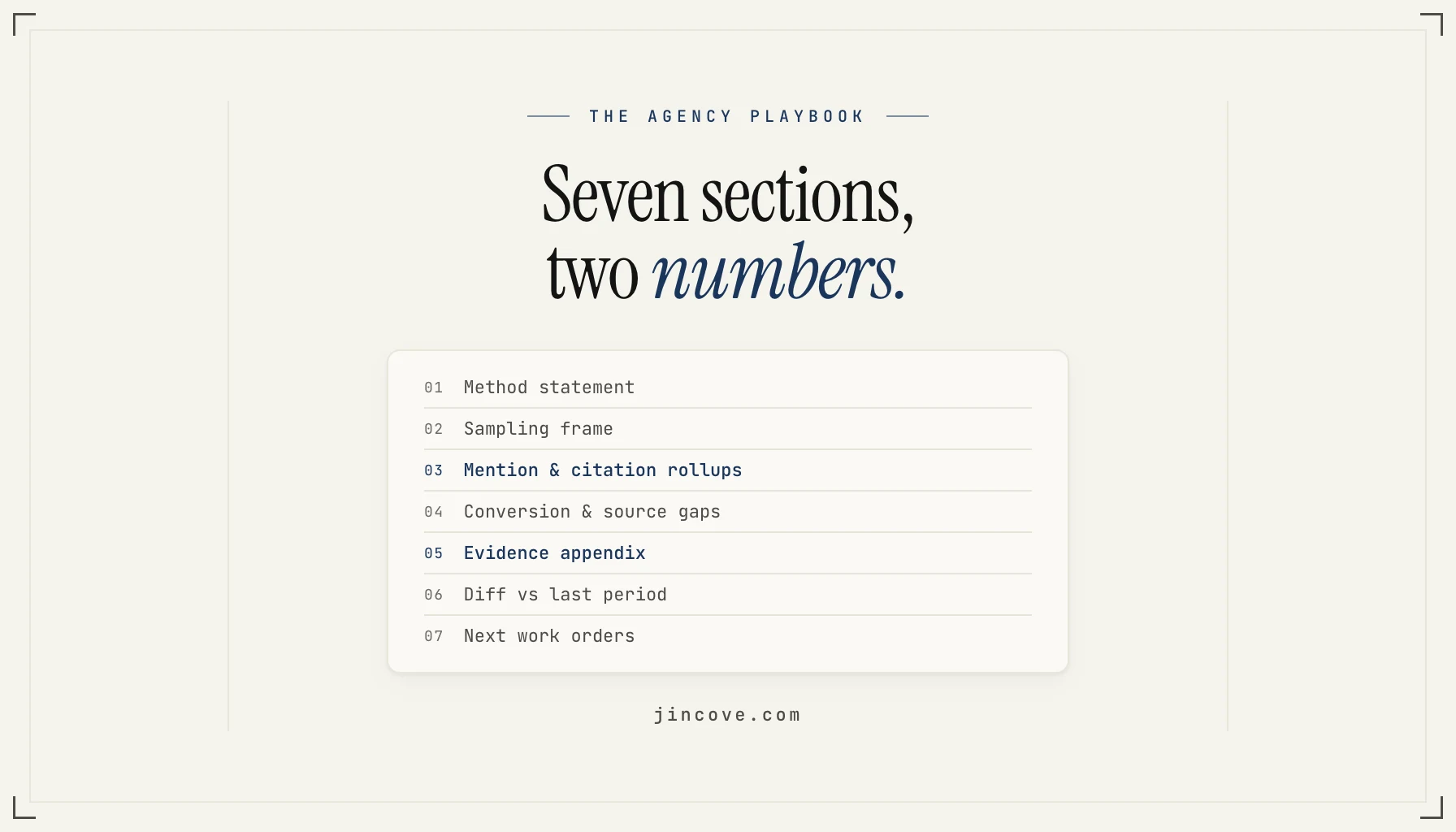
White-Label GEO Reports: The Agency Structure
Build a white-label GEO report that survives the client asking how you know. Here is the section order, the two numbers that matter, and what to leave out.
Gan Liu
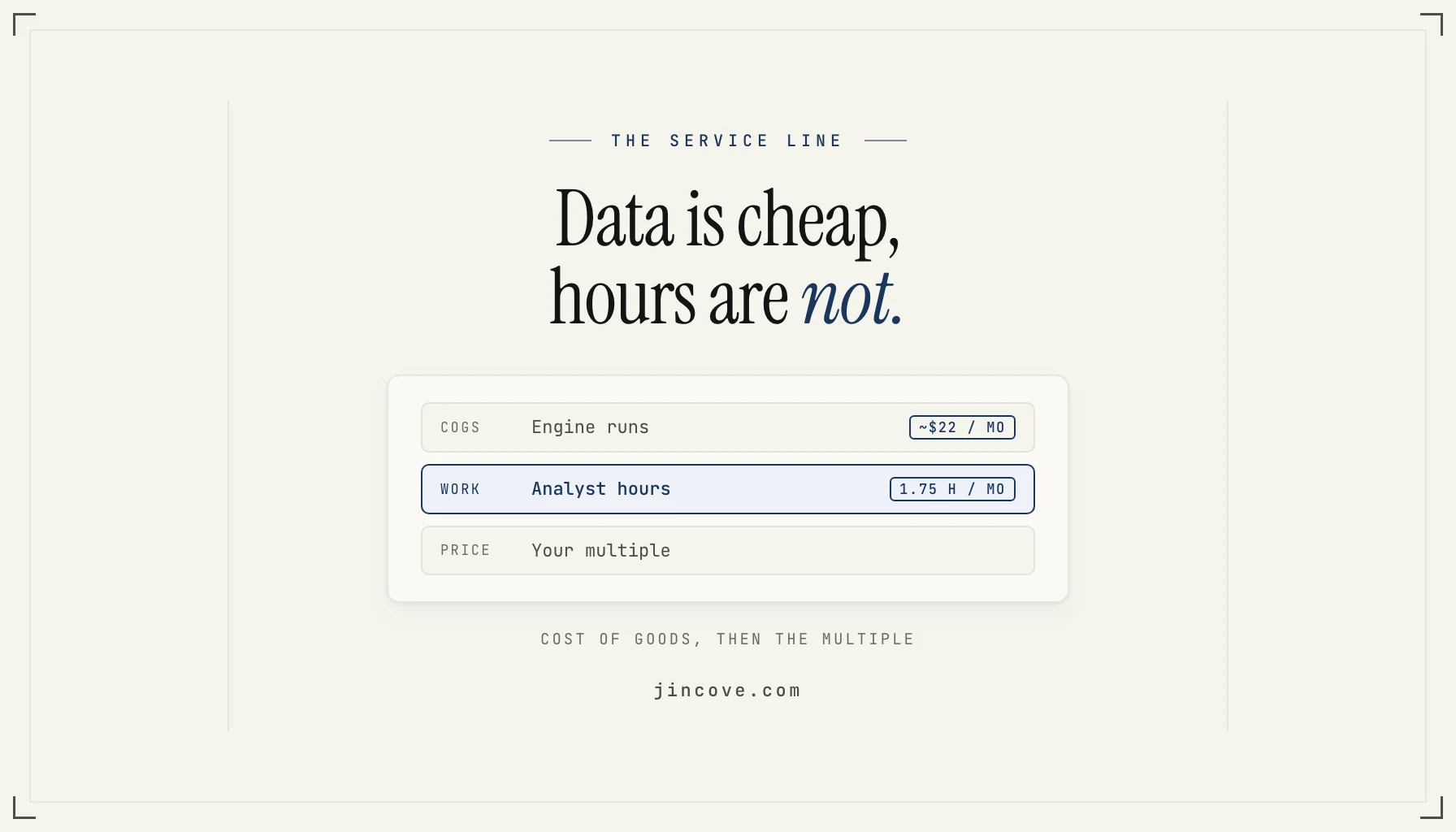
What to Charge for GEO Services: Pricing and Packaging for Agencies
How to price and package GEO as an agency service line - the two real cost lines, three packaging shapes with the arithmetic behind them, what the client actually receives, and the four situations where you should decline the engagement.
Gan Liu
Start with the free audit
Send us one brand. We’ll run it through the engines and send back the answers, citations, and sources — so the first report your client sees is already backed by evidence.
Free audit: ChatGPT, Perplexity and Gemini, run by hand. Paid work covers all six engines.