Perplexity SEO Tracker: How to Check Visibility
Perplexity numbers every source it uses, so cited is easy to see and mentioned is easy to miss. Here is the manual tracking method, and where it breaks.
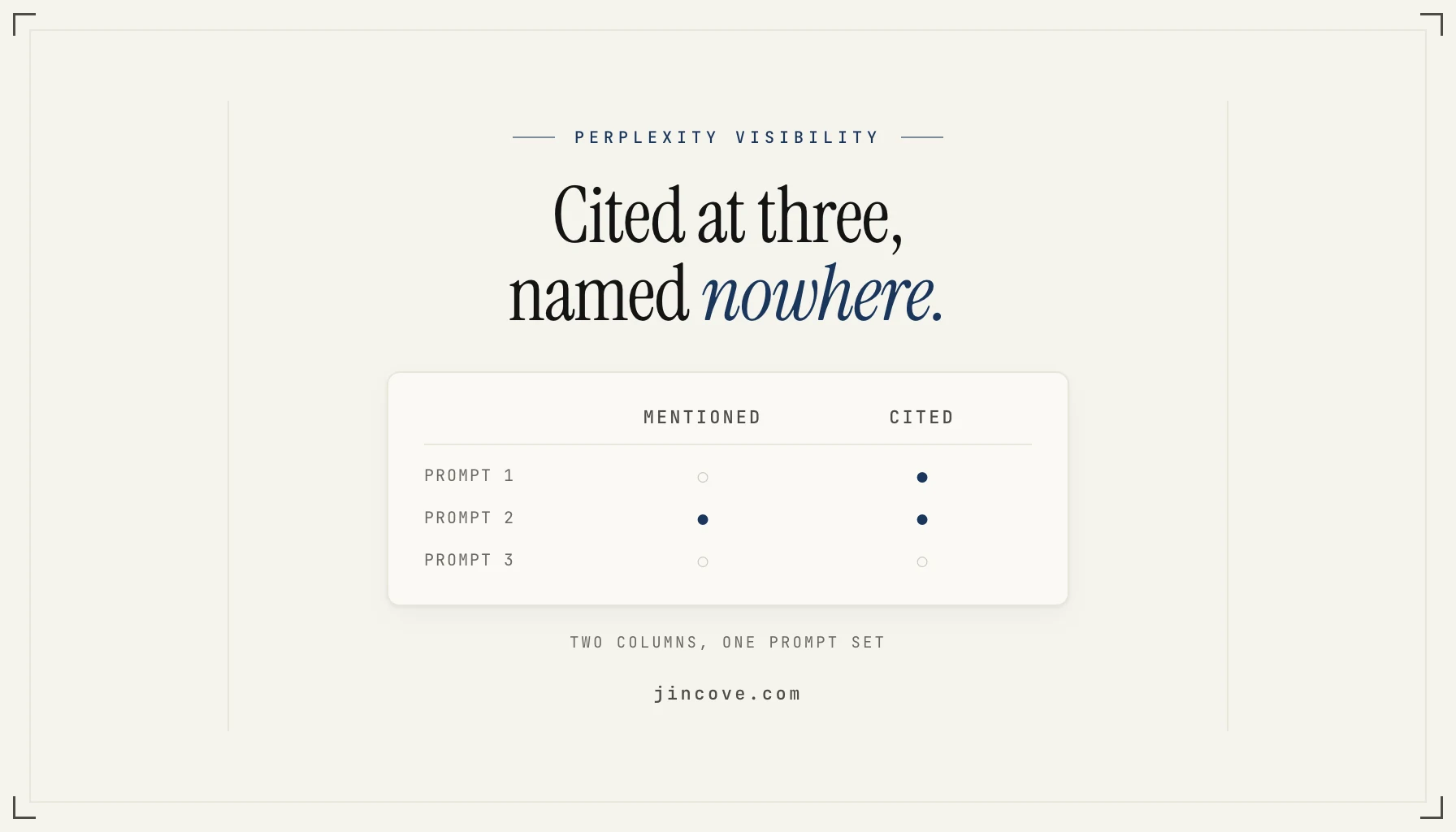
TL;DR: Perplexity is the easiest engine to check and the easiest one to misread. It searches the web on nearly every query and prints numbered citation markers with a matching source list, so the cited boolean is visible on screen without tooling. That same design pulls the two signals apart more often than ChatGPT does: your page can sit at footnote 3 while your brand name never appears in the sentence it supports. Track mentioned and cited as two columns, re-run one fixed prompt set on a fixed cadence, and state the sampling limits before a client finds them.
Most people looking for a Perplexity SEO checker want one number that says how they are doing. That number does not exist in a defensible form: the tools selling it average two facts that fail for different reasons and get fixed by different work. What does exist is a repeatable manual method, cheaper to run on Perplexity than anywhere else, because the evidence you would otherwise infer is printed under the answer.
This is the Perplexity-specific companion to the general method: how to track brand mentions in ChatGPT covers the prompt-set design and recording discipline both engines share, and tracking brand mentions in Perplexity for a client roster covers the agency workflow around it. Below is what changes when the engine is Perplexity.
Perplexity is not ChatGPT with a different logo
ChatGPT can answer from what the model already carries. Retrieval fires on some queries and not others, and when it does not fire there is no source list at all. That leaves a real ambiguity in your sheet: a blank citation column can mean the engine chose not to cite you, or that it never went to the web. Different diagnoses, different fixes, identical on screen.
Perplexity is retrieval-first by default. In normal use it searches, then writes an answer over what it found, carrying numbered inline markers that map to a listed set of source URLs. You need no theory about the internals: the answer text and the source list are two separate artifacts on the same page, and you read both directly.
Two consequences follow, and they are why a Perplexity tracker and a ChatGPT tracker are not the same instrument.
Cited becomes cheap and unambiguous. You read a printed list rather than inferring behaviour. Domain in the list, cited is yes. Not there, cited is no. Two analysts have nothing to disagree about, which is the property you want in a number a client will question.
Mentioned and cited separate more visibly. The prose is a synthesis written across several retrieved pages, so a brand name is not carried into a sentence just because that brand's page was a source. You will regularly see an answer that cites your domain at footnote 2, names two competitors, and never names you. That is a conversion gap, and Perplexity is where you meet it most often - and the worst case for a blended score, because a rising citation count reads as a win until someone asks what the reader actually saw.
The two booleans, restated for this engine
Every sampled answer gives two independent yes-or-no facts, and they belong in two columns.
- Mentioned - does the brand name appear in the answer text a reader sees.
- Cited - does the brand's own domain appear in the numbered source list under that answer.
The full split, including the reverse case where you are named while a competitor is cited, is set out in mention vs citation. Every convenience pushes the other way: one percentage is easier to slide, and it is the one output you cannot defend when it moves.
How to track Perplexity visibility by hand
Six steps, no software. Running them once by hand is the only way to know whether a tool you buy later measures the same thing.
- Build a fixed prompt set of 20 to 50 buyer questions. Category discovery, comparisons, buying criteria, problem-first phrasing, brand-direct lookups, written the way a person types into Perplexity rather than as a keyword export. How you know you did it right: count how many contain the brand name. More than a fifth and the set is flattering, not diagnostic.
- Run every prompt in a fresh thread. Perplexity threads carry follow-up context, so a set run down one thread is contaminated by question five. Prefer a logged-out session or clean browser profile over an account that has researched this client for weeks. How you know you did it right: run one prompt twice in two clean threads. Wording should differ while the named brands stay similar.
- Record mentioned and cited as two booleans, before any judgement. Read the answer text for the brand name, then the source list for the domain. No quality rating, no sentiment score - those do not reproduce next month and you end up defending a feeling. How you know you did it right: hide your columns and have a colleague re-derive them from the stored answer.
- Copy the domains out of the numbered source list, not the link titles. Titles are unstable and do not tell you who owns the page. Record the bare domain for every numbered source, in order, tracking parameters stripped. How you know you did it right: your source column reads as domains you can group and count without opening anything.
- Repeat the set from at least one other region. Retrieval is location-sensitive, and a brand can be present in one market and absent in another for reasons unrelated to its content. Keep each region in its own rows rather than averaging. How you know you did it right: your sheet has a region column, and you never compare across it.
- Re-run weekly and diff against your own history. The baseline is the client's previous runs, never an industry average. Compare booleans first, prose second, and flag a change only when it survives the following week. How you know you did it right: most of last week's flags are still flagged. If they reverse on their own, you are catching noise.
Steps 1 and 3 carry most of the work. For a starting prompt set and a matching two-boolean scoring sheet, our free prompt set generator builds both in the browser, covering Perplexity alongside ChatGPT and Gemini.
What each engine actually lets you observe
Engine coverage is sold as a count. What matters more is that these four surfaces are observable in different ways, so a method that works on one can quietly produce garbage on another.
| Engine | Citation visibility | Sampling stability | Hardest thing to observe |
|---|---|---|---|
| ChatGPT | Only when web search fires. Many answers carry no source list at all. | Moderate. Memory, custom instructions and model choice all move the answer. | Whether a missing source list means no citation or no retrieval. |
| Perplexity | High. Numbered markers in the text plus a listed set of source URLs on nearly every answer. | Moderate. Rewording a prompt changes which pages get retrieved. | That a cited domain never got its brand named in the prose. |
| Google AI Overviews | Partial. Links attach to the block rather than to each sentence. | Low to moderate. The block does not render for every query or every user. | Absence. No overview shown is not the same result as losing. |
| Google AI Mode | Present, but the source set grows as the session continues. | Low. Heavily dependent on follow-ups and session state. | Where one answer ends, when the surface keeps expanding. |
Perplexity is the cheapest engine to instrument and the likeliest to hand you a conversion gap. AI Mode is the most expensive to define, because you must decide what counts as one observation before counting anything.
A worked read of one answer
Illustrative, not a client result. The numbers are invented to show the shape of the output.
Take a fictional invoicing tool, Harborline. Twenty-five prompts, clean threads, one region. Its domain appears in the source list on eleven answers. The brand is named in the answer text on four.
As one score that looks healthy. As two columns it says something specific: on seven answers Perplexity used Harborline's own pages to build an answer recommending someone else. Six of those seven cite the same comparison page, which states its conclusions inside a table rather than in prose, so no sentence carries the brand name for the engine to lift.
The work order falls straight out of the split. That page is already trusted enough to be retrieved repeatedly, so its verdicts need to be named sentences, not table cells. The three category-discovery prompts where Harborline is neither named nor cited need entry content first. Neither instruction is derivable from a percentage.
Where this method breaks down
This is the most defensible approach available, which is not the same as reliable. Four limits, and they belong in the first client report, not the last.
Single samples are noisy. Generative answers are stochastic and retrieval is not deterministic. One run of one prompt tells you what happened once, and anything reported from a single sample can reverse next week with nothing changed on the client's site.
Answers drift for reasons you cannot see. Index refreshes, model updates, and a competitor's new page all move the result. A drop between two weekly runs may reflect something that happened at Perplexity rather than anything about the brand, and you usually cannot tell which.
Login state and personalization contaminate results. An account with a long history of researching this client carries that context forward. Clean threads and a logged-out session reduce it, nothing removes it, and no browser-based method reproduces what a stranger in another country sees.
Mode and model selection change the answer. Perplexity exposes different search modes and, on paid tiers, a model picker, and the options on offer change over time. Two people running one prompt under different settings can get materially different source lists and each conclude the other erred. Record mode and model with every run and hold them fixed, or the trend is measuring your settings.
A fifth limit is operational: the same set across six engines, weekly, for eight clients is over a thousand runs a week, and one skipped week erases the trend line you sold.
Two traps specific to Perplexity
Counting citations instead of scoring them. A count rises when an engine simply gets chattier about sources. Only the paired booleans say whether a reader learned the brand's name.
Comparing your Perplexity number against your ChatGPT number. Different instruments. Perplexity shows sources on nearly every answer, so its citation rate starts higher by construction. Trend each engine against its own history, never across engines.
See it on your own brand first
Request a free, human-run audit: send one client URL and an email, and we hand-run ChatGPT, Perplexity and Gemini on a real prompt set, then reply with the exact answers, every cited source, and whether each named the brand or only cited it - within two business days, no card, no account. It is the fastest way to see the two-boolean method on Perplexity for a brand you care about.
Related blogs
Related Post
Expand your knowledge with these hand-picked posts.

How to Track Brand Mentions in ChatGPT in 2026: The Agency Method
ChatGPT has no Search Console - no impressions, no analytics, no export. Here is the method agencies use to track brand mentions across ChatGPT and the other answer engines without trusting a black-box score, and why "citations" and "mentions" are two different numbers.
Gan Liu

Best AI Visibility Tools for Agencies in 2026: An Honest Shortlist
Most "best GEO tool" roundups rank on engine count. Agencies buy on a different axis - client roster, white-label, and evidence you can hand a client. Here is the honest shortlist, what each tool is actually best at, and the three questions that decide it.
Gan Liu
How to Track Brand Mentions in Perplexity in 2026: The Agency Method
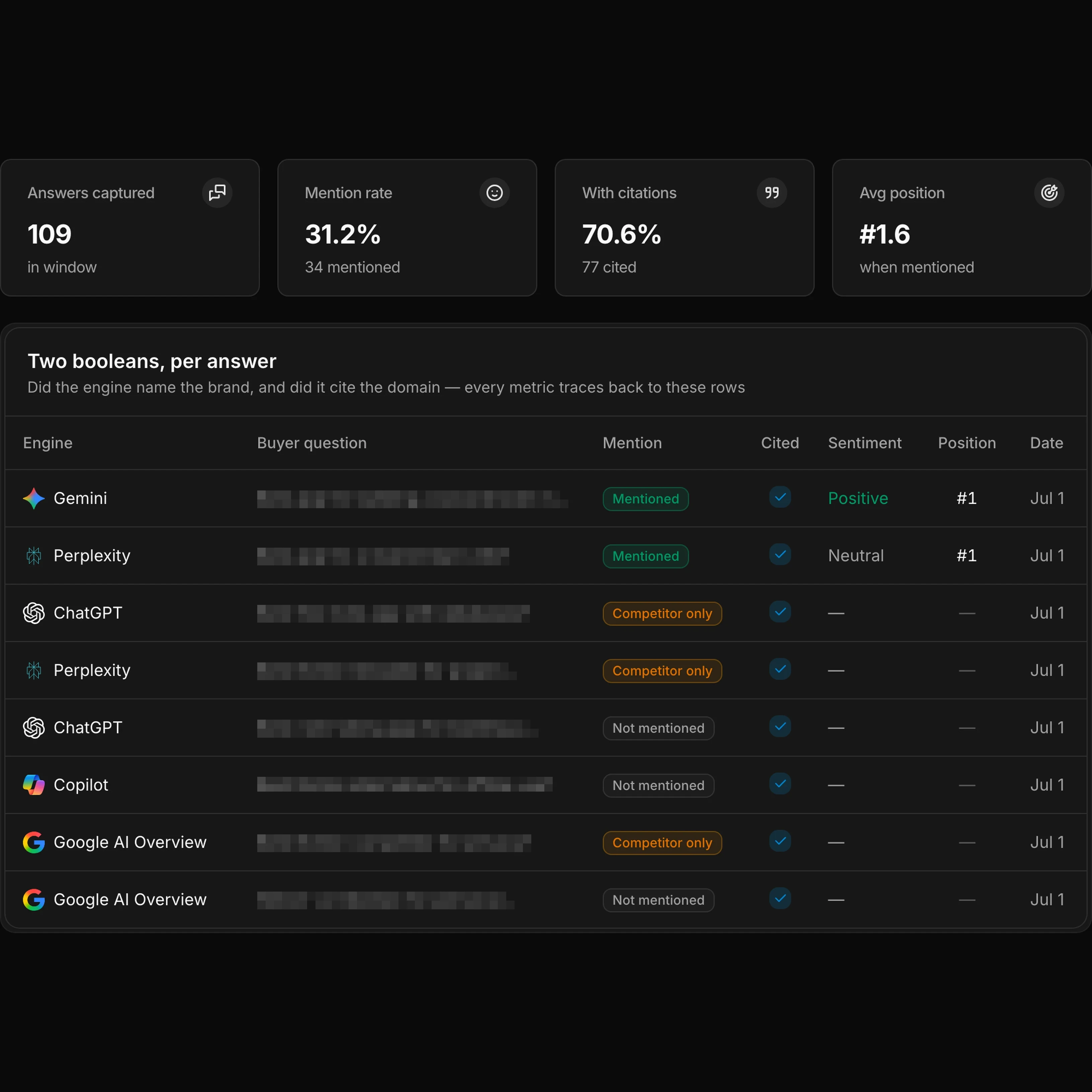
Perplexity shows numbered citations and a Sources list under every answer. The agency method for reading brand mention vs citation off it - no black-box score.
Gan Liu
Start with the free audit
Send us one brand. We’ll run it through the engines and send back the answers, citations, and sources — so the first report your client sees is already backed by evidence.
Free audit: ChatGPT, Perplexity and Gemini, run by hand. Paid work covers all six engines.