SEO Client Reporting When AI Answers Eat Clicks
A client SEO report built on rankings and organic sessions alone cannot explain the quarter. Here is the section order that does, and the two numbers to add.
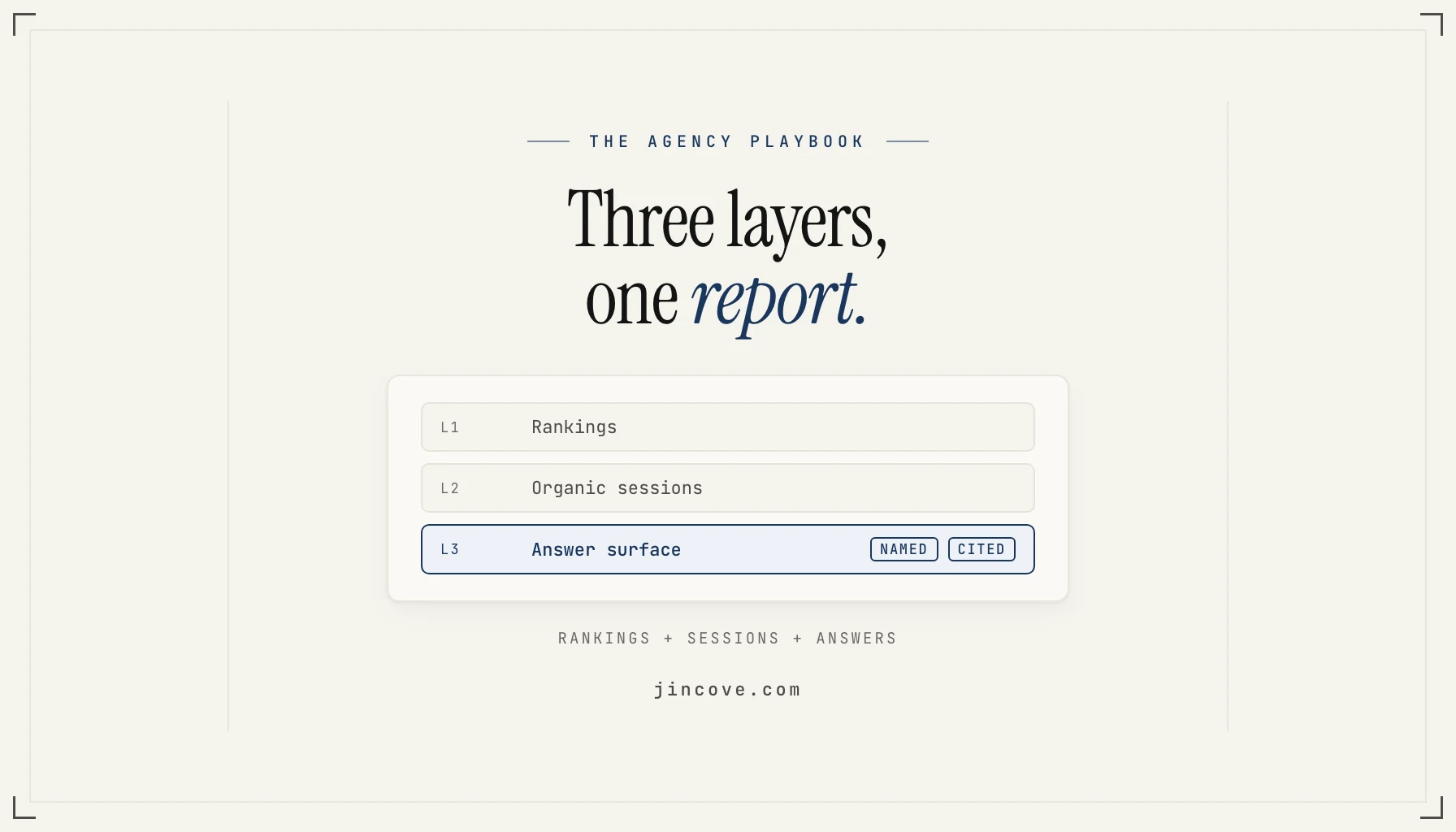
TL;DR: A client SEO report needs a third layer in 2026. Rankings and organic sessions describe the blue-link surface only, and a growing share of the question gets resolved inside an AI answer before anyone clicks anything. Add two boolean columns per tracked prompt - was the brand named, was the client's own domain cited - put your sampling frame on page one, and park the raw answers in an appendix. Six sections, in order, below.
There is a meeting most SEO agencies have had at least once by now. The rank tracker says position 3, held all quarter, no volatility. Search Console says clicks on that page are down nineteen percent over the same window. The client, who is not stupid, asks the obvious question: if we did not move, why did the traffic move?
A report built out of a rank tracker and a Search Console export has no row that answers that. Not because those tools broke. Because the query landed on a surface they do not measure.
Three things are now happening in the same quarter, and only one of them shows up in a traditional SEO client report. The buyer sees the page listed and clicks it - that one is measured. The buyer sees the answer above the listing, gets what they needed, and never clicks - that one shows as an impression with no click, which looks like a CTR problem and is not. And the buyer never opens Google at all, asks ChatGPT or Perplexity instead, and reads an answer that either names your client or does not - that one leaves no trace anywhere in your client's Search Console, because it never touched Google Search.
The fix is not a better estimate. It is a second data source, sampled directly from the answer engines, recorded rather than modeled, and reported next to the numbers you already send.
Why rankings-only client reports stopped explaining the quarter
The gap shows up in three recognizable shapes, and it helps to name them in front of the client before they name them for you.
Rank flat, clicks down. The page still ranks. The answer above it resolved the question. Nothing in a rank tracker can distinguish this from seasonality, so a rankings-only report defaults to blaming seasonality, and the client learns over two or three quarters that your explanations are guesses.
Traffic flat, pipeline worse. Sessions hold, but sales says prospects arrive already anchored on a competitor. Somewhere in the research path an assistant listed three vendors and your client was not one of them. Session count cannot see this. It is a naming problem, not a traffic problem.
Total silence. A whole class of buyer question - the comparison questions, the "is X worth it" questions, the "best tool for Y" questions - increasingly gets asked inside an assistant. Whatever happened there is not missing from your report because the number is low. It is missing because there is no row for it.
None of these are failures of Search Console. Search Console reports what happened on Google Search surfaces, accurately. The problem is that a growing part of the client's demand no longer resolves there, and a report whose only inputs are a rank tracker and a Search Console export is silent about the part that moved.
What to add: two booleans, not a third score
The temptation is to buy a tool that prints an AI visibility score and paste that number into slide four. Resist it. A single blended score is the fastest way to lose the next meeting, because when the client asks what moved it, the honest answer is that a vendor recalculated something.
Add two facts instead, recorded per prompt, per engine, per run date:
- Mentioned - did the answer name the client's brand?
- Cited - did the answer cite the client's own domain as a source?
Two booleans. Countable, checkable, and independent. Keeping them apart is what makes the report survive scrutiny, because the interesting findings live in the cases where they disagree. Cited but not mentioned is a conversion gap: the engine used your client's page and handed the credit to the assistant. Mentioned but the citation points elsewhere is a source gap: the brand gets named, and the reader gets sent to a competitor's page for the detail. Both are actionable. Neither survives being averaged into one number.
The client report structure you can copy
Six sections, in this order. Each one exists to pre-empt a specific sentence the client would otherwise say out loud.
1. Method and sampling frame. Before any chart: which engines were queried, how many prompts, on which dates, and one plain sentence saying the answers were recorded, not generated or estimated. State the multiplication so the client can do it themselves - twenty prompts across six engines run weekly is a number they can verify on a napkin. The sentence you are pre-empting is "is this the whole internet, or a sample?" It is a sample. Say so first and every later number gets read as honest rather than inflated.
2. Traditional SEO layer. Keep it. Rankings for the tracked set, organic sessions, top movers, conversions if you have them wired. Nothing here changes. The mistake agencies make when they add AI reporting is quietly demoting the SEO layer, which reads to the client as changing the subject after a bad quarter. The sentence you are pre-empting is "are you moving the goalposts?"
3. AI visibility layer. The two booleans, rolled up per engine and in total, for this period. Two counts and two percentages. No blended index, no composite. Show the engines separately - a client whose buyers live in Perplexity does not care about a Copilot average. The sentence you are pre-empting is "what am I actually looking at?"
4. Conversion gap and source gap. The two derived patterns, each with a count and two or three named examples pulled from real answers. This is the only section where you are allowed to interpret, and it stays grounded because every example carries the prompt it came from and the engine that produced it. The sentence you are pre-empting is "so what do I do about it?"
5. What changed, and the work order for next period. Two short lists. What we changed since the last report, and what changed in the answers after we changed it. Then three to five specific items for the next cycle, each attached to a gap from section four. Vague next steps are how a retainer starts feeling optional. The sentence you are pre-empting is "what am I paying for next month?"
6. Evidence appendix. The raw answers behind every claim above, with the engine, the date, and the sources each answer cited. Nobody reads the whole appendix. That is fine. Its job is to exist, so that the one line the client decides to spot-check resolves in under a minute. The sentence you are pre-empting is the one that ends retainers: "how do you know?"
Section by section: what the client asks, what you hand over
| Report section | What the client asks | Evidence you produce |
|---|---|---|
| 1. Method and sampling frame | Is this everything, or a sample? | Prompt count, engine list, run dates, and the sentence saying answers were recorded not modeled |
| 2. Traditional SEO layer | Did our rankings actually move? | Rank deltas for the tracked set plus the Search Console clicks and impressions for the same period |
| 3. AI visibility layer | What am I looking at, and per engine? | Mentioned count and cited count, per engine and in total, with the denominator printed next to each |
| 4. Conversion gap and source gap | So what do I do about it? | Named examples: the prompt, the engine, the verbatim sentence, and whose domain got cited instead |
| 5. Changes and next work order | What am I paying for next month? | What we shipped, what moved in the answers after, and three to five scoped items tied to section four |
| 6. Evidence appendix | How do you know? | Stored answer text, engine, timestamp, and the cited source list for every claim made above |
What to leave out
Four things make an otherwise sound report look like it was generated rather than run.
Percentages with no denominator. "Visibility up 12 percent" out of what, across how many prompts, on which dates. If the denominator is not on the page, the percentage is decoration.
A single visibility score. One number that blends naming, citation, position, and sentiment cannot be traced back to anything. The first time a client asks what moved it, you will discover you cannot say.
Category exposure counted as a brand win. If a category prompt returns an answer that names six vendors including your client, that is a data point, not a victory. Reporting it as share of voice without the competitive context is the client-report equivalent of ranking for your own brand name and calling it growth. If you do put the rate in the report, put it in the way AI share of voice defines it - prompt set, engine set and sampling window declared beside the number, or it is not comparable to the next report.
Undated screenshots. An answer without a timestamp, an engine label, and the prompt that produced it is unreproducible. It also ages badly - the same prompt run four weeks later may return something completely different, and if the client tries it themselves and gets a different answer, an undated screenshot looks like a fabrication rather than a sample.
What this report cannot prove
Be direct about this in the method statement, because the client will find out either way and it is much better coming from you.
AI answers are sampled, not enumerated. The same prompt, the same engine, and the same day can return different answers, and results drift with model updates, with the country the query resolves in, and with whether web search was enabled for that run. A single run is a sample of one. Treat a change as real only when it persists across run dates, and say in the report which changes cleared that bar and which are still noise.
What you can prove is narrow and worth paying for: what a given engine said, to a given prompt, on a given date, and whose domain it cited. And after your client ships a change, whether the answer to that same prompt is different now. That is an observation service with a receipt behind every line.
What you cannot promise, and should never write into a scope of work, is that an AI will say good things about the client. Nobody controls model output. Any vendor implying otherwise is selling a story, and the moment a client repeats that promise to their CMO, it becomes your problem. The honest pitch is smaller and much easier to renew: we will show you what the engines are saying, we will show you what changed after each fix, and you will be able to check every line yourself.
If you are packaging this as a retained offer rather than retrofitting an existing report, the commercial framing is in GEO for agencies, and the standalone deliverable version - your logo, our records underneath - is in white-label GEO reports.
Try it on one client report
Take the client whose rankings held and whose clicks did not. Request a free, human-run audit for that one domain: send a URL and an email, and we hand-run ChatGPT, Perplexity, and Gemini against their real buyer questions - three engines free, no card, no account. You get back actual answers with their sources, which is enough to build section three and section six of your next report and see whether the AI layer explains the gap the rankings could not.
If it does, running it across the whole client book is a scheduling problem rather than a research problem. Per-client workspaces on one shared credit pool, six engines on every plan - see pricing.
Related blogs
Related Post
Expand your knowledge with these hand-picked posts.
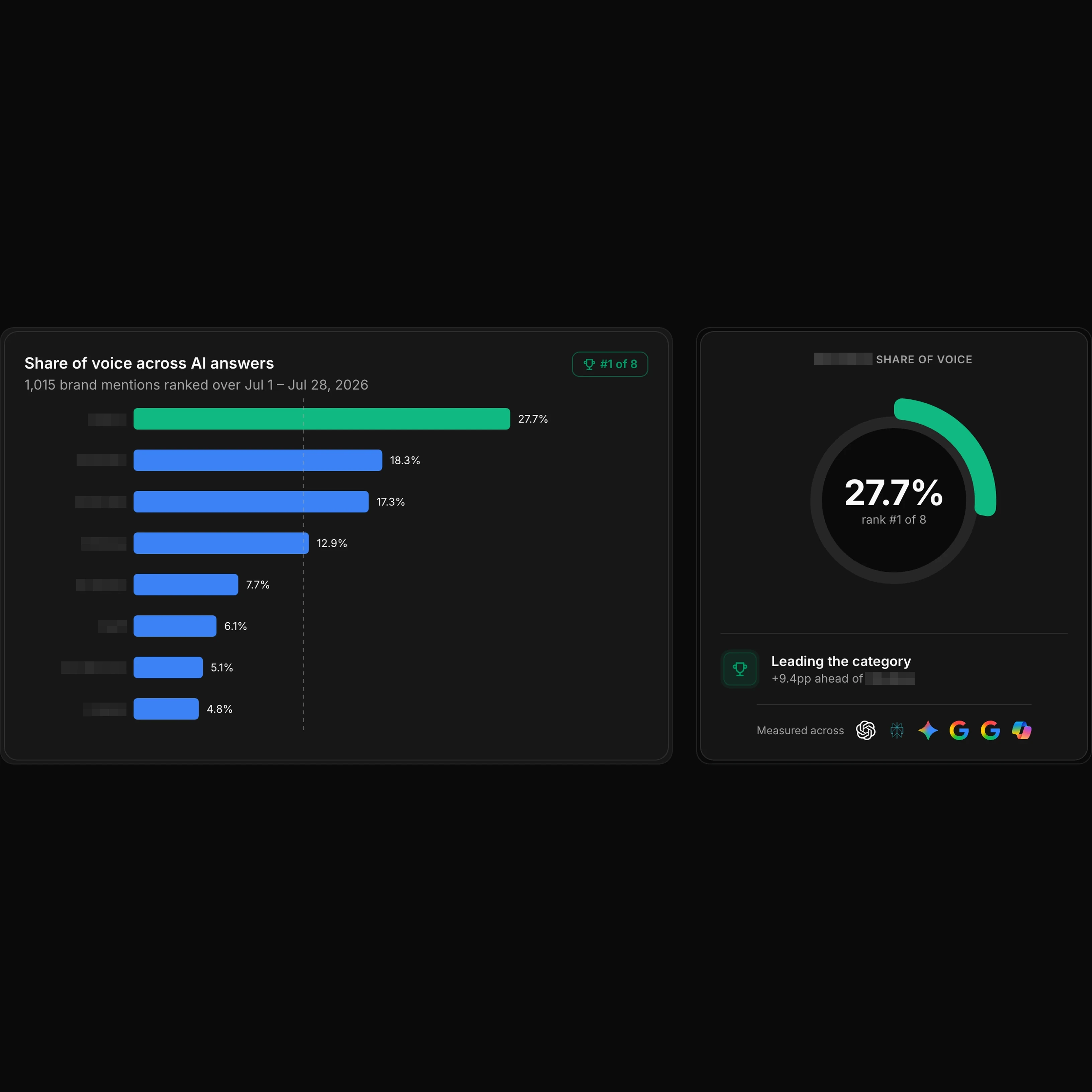
GEO for Agencies: How to Offer AI Visibility Monitoring as a Service
How SEO, PR, and brand agencies can package AI visibility monitoring as a retainer: a re-runnable evidence report where every mention and citation opens to the exact AI answer it came from.
Gan Liu
The GEO Audit Checklist for Agencies in 2026: From First Audit to Retainer
A repeatable GEO audit you can run across a whole client book - how to scope prompts with the client, run six engines, sort answers into quadrants, and turn the one-off audit into a monitored retainer with a report the client can check.
Gan Liu
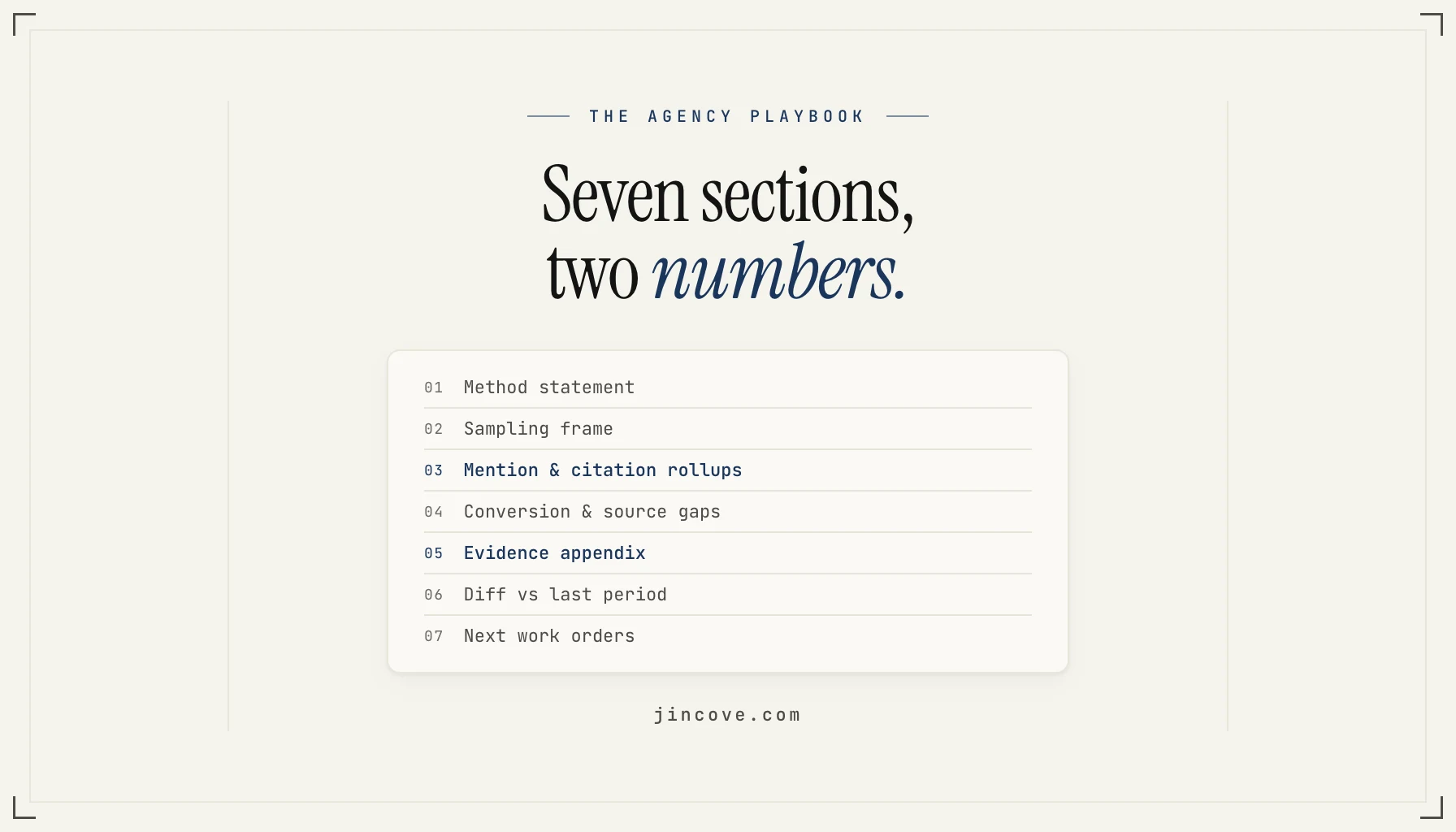
White-Label GEO Reports: The Agency Structure
Build a white-label GEO report that survives the client asking how you know. Here is the section order, the two numbers that matter, and what to leave out.
Gan Liu
Start with the free audit
Send us one brand. We’ll run it through the engines and send back the answers, citations, and sources — so the first report your client sees is already backed by evidence.
Free audit: ChatGPT, Perplexity and Gemini, run by hand. Paid work covers all six engines.