How to Track Brand Mentions in Perplexity in 2026: The Agency Method
Perplexity shows numbered citations and a Sources list under every answer. The agency method for reading brand mention vs citation off it - no black-box score.
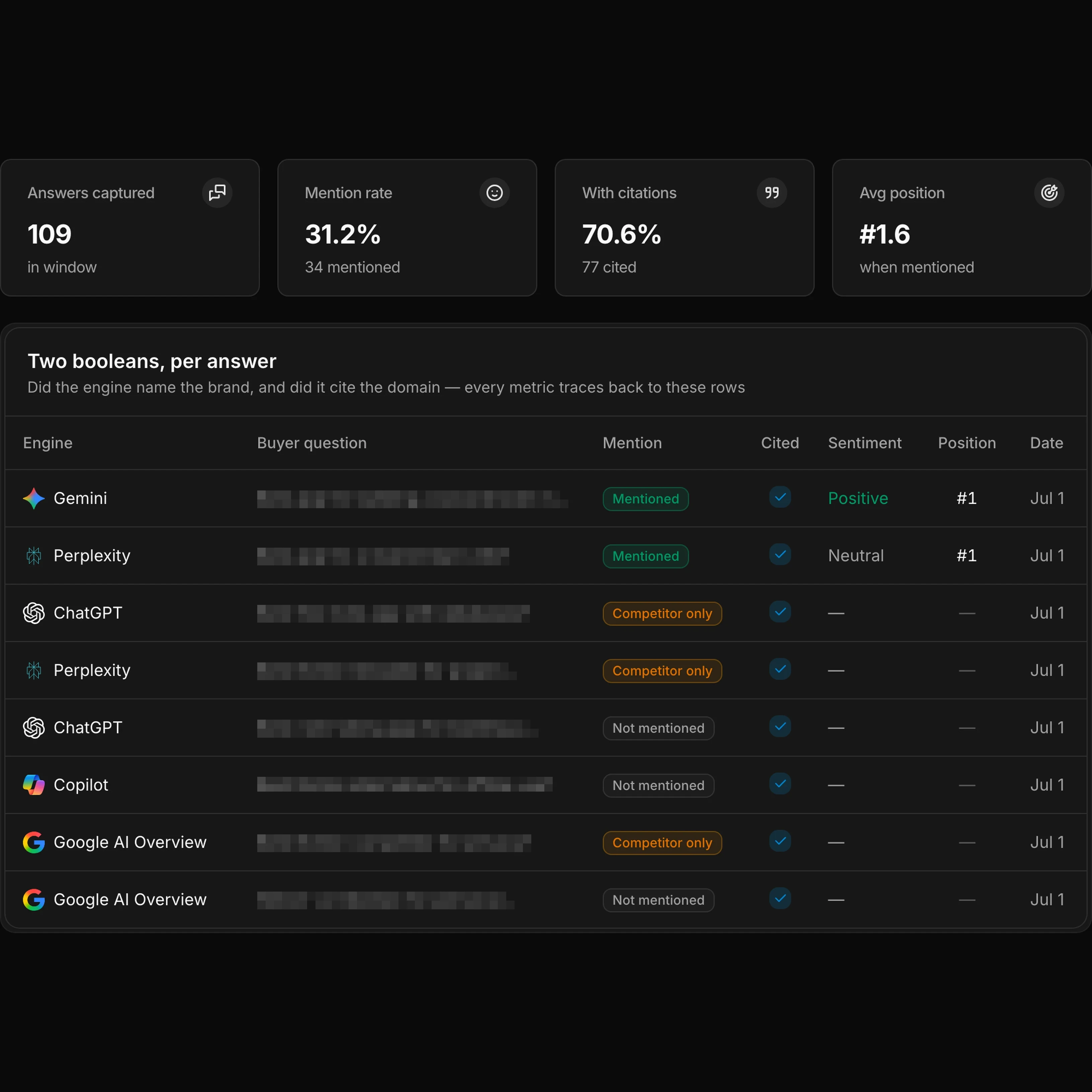
TL;DR: Perplexity is the easiest engine to read the two booleans off, because it shows its work - numbered [1][2] chips inline and a Sources list under every answer. That makes the citation boolean unusually legible here, which is exactly why the conversion gap (your domain cited, your brand never named in the prose) is the pattern to watch on this engine. Run your own prompt set, record mention and citation separately per answer, and store the verbatim text plus the exact cited URLs behind every number. Never one merged "visibility score."
Buyers now ask Perplexity for recommendations the way they'd ask a research assistant, and it answers with a paragraph of prose stitched from sources it names inline. If your client's domain is one of those sources but the brand name never lands in the sentence a reader actually reads, the client shaped the answer and got no credit for it. That failure is invisible unless you measure it.
Perplexity ships with no Search Console - no impressions, no query report, no export. But of the six engines, it hands you the most raw material to build the measurement yourself, because it displays its citations by design. You just have to read them the right way.
Why a single "visibility score" fails here too
Most trackers hand you one number: "62% visibility." It feels like progress and tells you nothing. Sixty-two percent of what - named, cited, or both, blurred together? You cannot act on it, and you cannot defend it when a client asks what changed.
On Perplexity the merge is especially wasteful. This is the one engine that literally prints its sources under every answer, so a tool that flattens "named" and "cited" into a single percentage is throwing away the clearest signal any engine gives you. The fix is to stop merging signals and read the two facts Perplexity puts right in front of you.
Reading the two booleans off a Perplexity answer
Every answer gives you two independent facts. On Perplexity you read each from a different part of the screen:
- Mention - is the brand named in the answer prose the reader reads? Yes or no. Read the answer body, not the sources.
- Citation - is the brand's own domain in the numbered Sources list (and the inline [n] chip that resolves to it)? Yes or no. Read the Sources list.
Perplexity makes the citation boolean close to a glance: every claim carries a [1][2] chip and a Sources list sits under the answer with the domains spelled out. The mention boolean still requires reading the prose - a chip next to a sentence tells you a source was used, not that the brand was named.
That gap is the trap on this engine. The inline chip proves citation, never mention. Reading the chip and calling it a mention is the single most common error people make on Perplexity, and it hides the exact pattern this engine surfaces best: a domain sitting in Sources while the prose never says the name. Your content answered the question; the brand vanished. For the distinction in full, see mention vs citation.
Two things that move the Perplexity answer
Record these as part of every run, because they change what comes back:
- Mode and model. Free default search versus Pro search, plus the model selector Pro users get. Same prompt, different model, different sources and different prose. Note which one you ran.
- Query fan-out and follow-ups. Perplexity decomposes a question into sub-queries and retrieves sources for each, then a follow-up question re-grounds on a fresh retrieval. The answer you capture is one path through that fan-out, so note the exact prompt and whether it was a first turn or a follow-up.
Country and locale move it too. Treat all of this as run metadata, not trivia.
The method
- Build a prompt set. 20-50 real buyer questions in the client's category - the things prospects actually ask, not brand-name lookups. Question-shaped queries surface the truth; brand lookups flatter everyone.
- Run each in Perplexity deliberately. Note the mode (free vs Pro), the model if you set one, the country, and whether it was a fresh thread or a follow-up. These are part of the run.
- Capture the verbatim answer and the full Sources list. Copy the exact prose and every cited URL - the numbered list expanded, not a summary. A screenshot of the answer with its chips is worth keeping.
- Mark the two booleans. Named in prose (Y/N) read from the body; own domain in Sources (Y/N) read from the list.
- Store the raw answer behind the number. This is the step trackers skip and the step that makes your report survive scrutiny. A month later, "you moved out of the conversion gap on this prompt" only means something if you can reopen both answers and their Source lists.
- Diff against your own history, on a schedule. The baseline is the client's past runs, not an invented target. Flag a change only when it moves beyond run-to-run noise - and fan-out makes some variance normal, so set the threshold with that in mind.
A worked example: one Perplexity answer, two booleans
Say the client is a product-analytics SaaS and the buyer question is "what's the best product analytics tool for a Series A startup?" You run it in Perplexity Pro, US, first turn, and capture the verbatim answer plus the Sources list. Now you read the two booleans against the client:
| What you read in the stored answer | Where you read it | Boolean |
|---|---|---|
| Prose says "…teams often start with Acme" | Answer body | Mentioned = Yes |
| A [3] chip resolves to acme.com in the Sources list | Sources list | Cited = Yes |
Both Yes is a stronghold - defend it. Change one fact and the quadrant flips. If acme.com sits in the Sources list but the prose never says "Acme," that is a conversion gap - the pattern Perplexity exposes more plainly than any other engine, because you can see your own URL cited while your name is missing from the sentence. If the prose names Acme but every source resolves to a review directory or a competitor's comparison page, that is a source gap - the reader hears the name and clicks through to someone else. Same prompt, same engine, completely different fix, which is exactly why one merged percentage is useless and the two booleans are not.
Do it across all six engines, not just Perplexity
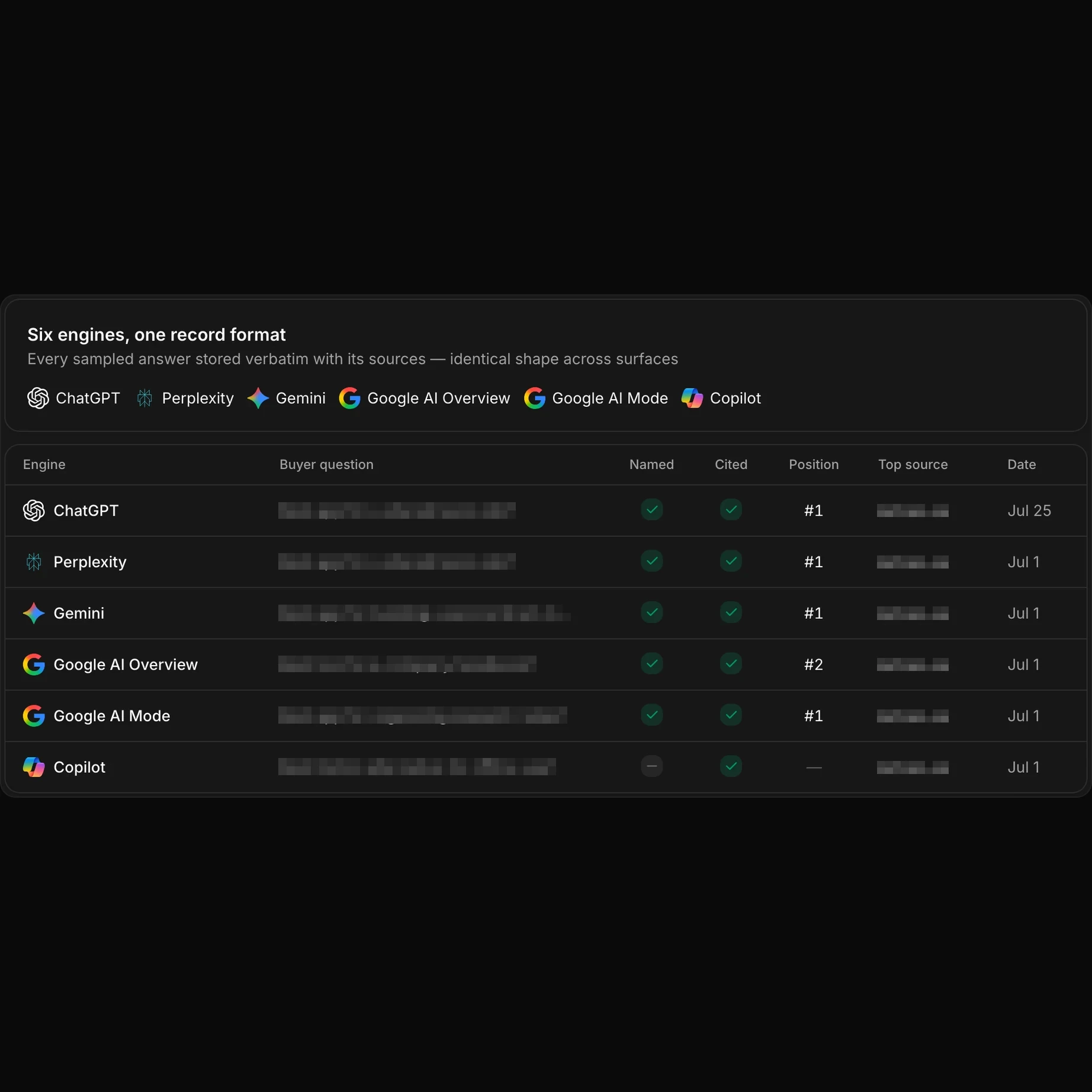
Perplexity is the friendliest surface to audit because it displays its sources - but buyers also land in ChatGPT, Gemini, Google AI Overviews, Google AI Mode, and Copilot, where citations are less legible and the same brand can be a stronghold in one and whitespace in another. The ChatGPT method is the sibling guide for an engine that mostly hides its sources, and the source gap vs conversion gap framework turns the raw booleans into a fixed move per quadrant across all six.
Make it a client-provable habit
Running this by hand once is an audit. Running it on a schedule, per client, with every answer stored, is a monitored service - and the thing that renews a retainer, because you can show proof of movement instead of asserting it. If you want the tracker-intent version of this method - what a Perplexity SEO tracker can and cannot measure, and the manual check to run before buying one - see Perplexity visibility tracking. Jincove runs exactly this method across the six engines with evidence behind every number: the verbatim answer, every cited source, and screenshots, where each number opens back to the stored raw answer.
One honest boundary holds on Perplexity as on every engine: nobody controls what it says, and no tool can promise it will name your client. Jincove proves what the engine said and what moved after your fix. It does not make the engine say anything, and it does not fact-check the model's prose. See exactly what it captures per answer on the features page.
See it on your own brand first
Request a free, human-run audit: send one URL and an email, and we hand-run Perplexity, ChatGPT, and Gemini and reply with the exact answers, the cited sources, and whether each named or only cited the brand. No card, no account. It is the fastest way to see the two-boolean method on a brand you care about - starting with the one engine that shows its work.
Related blogs
Related Post
Expand your knowledge with these hand-picked posts.
How to Track Brand Mentions in ChatGPT in 2026: The Agency Method
ChatGPT has no Search Console - no impressions, no analytics, no export. Here is the method agencies use to track brand mentions across ChatGPT and the other answer engines without trusting a black-box score, and why "citations" and "mentions" are two different numbers.
Gan Liu
Best AI Visibility Tools for Agencies in 2026: An Honest Shortlist
Most "best GEO tool" roundups rank on engine count. Agencies buy on a different axis - client roster, white-label, and evidence you can hand a client. Here is the honest shortlist, what each tool is actually best at, and the three questions that decide it.
Gan Liu
How to Track Brand Mentions in Gemini in 2026: The Agency Method
Gemini sometimes grounds on Google Search and shows sources, sometimes answers from the model alone. Here is the agency method for tracking brand mentions in Gemini with two booleans and stored evidence.
Gan Liu
Start with the free audit
Send us one brand. We’ll run it through the engines and send back the answers, citations, and sources — so the first report your client sees is already backed by evidence.
Free audit: ChatGPT, Perplexity and Gemini, run by hand. Paid work covers all six engines.