What to Charge for GEO Services: Pricing and Packaging for Agencies
How to price and package GEO as an agency service line - the two real cost lines, three packaging shapes with the arithmetic behind them, what the client actually receives, and the four situations where you should decline the engagement.
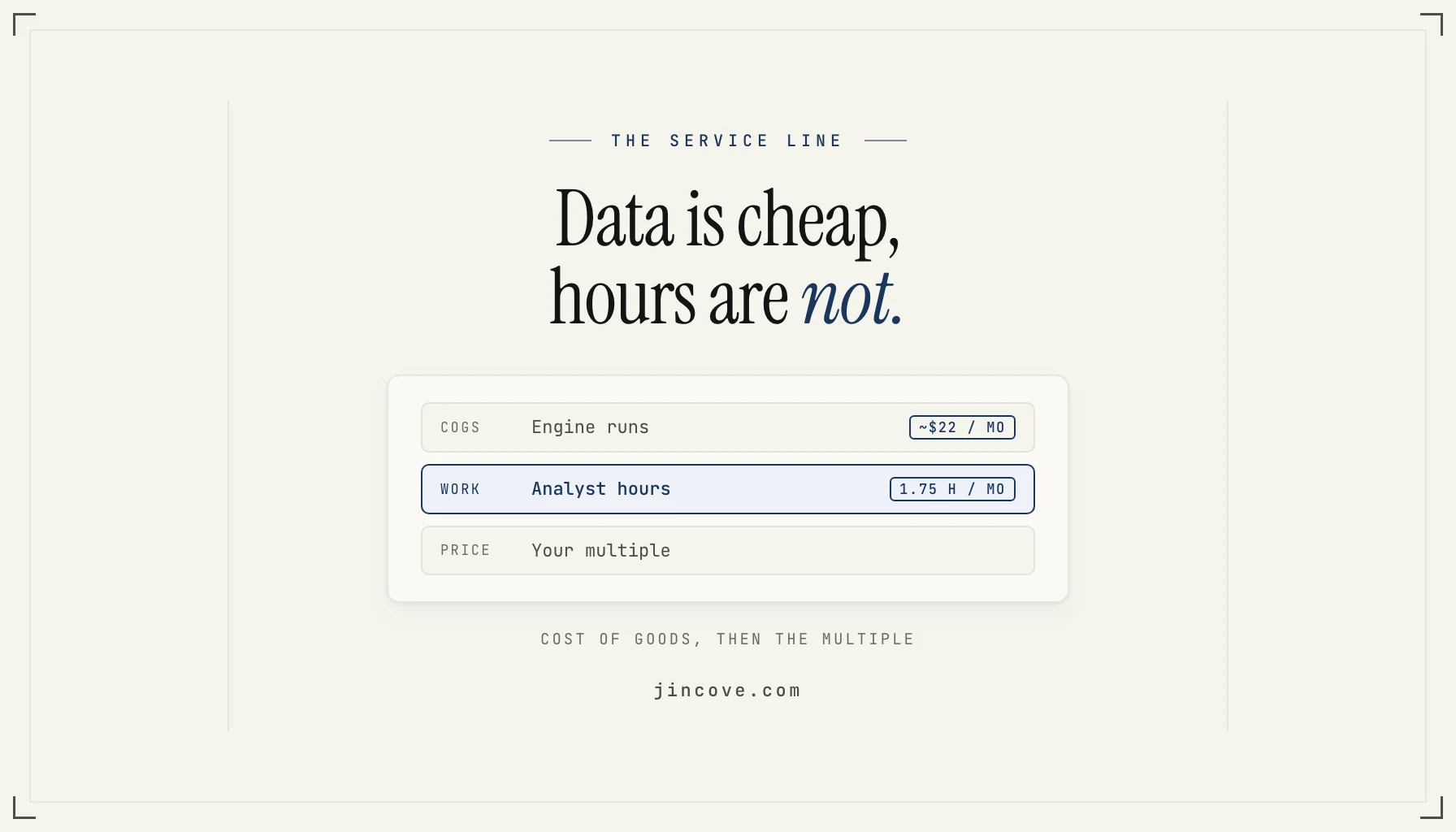
TL;DR: The data behind a GEO engagement costs almost nothing - roughly $10 in engine runs for a full first audit, and around $20 a month per client to keep it monitored. Ninety percent of your cost is analyst time, so price on hours and package on cadence, not on a per-prompt markup. Three shapes work: a one-off audit, a monthly monitoring retainer, and a project priced to a launch window. And there are four situations where the right move is to decline the engagement, all of which cost more to discover in month three than in the first call.
We already published the argument for whether an agency should offer this at all - GEO for agencies covers what you are selling and to whom. This page assumes you decided yes and answers the next question, which is the one people actually get stuck on: what do you charge, what goes in the box, and when do you say no.
Start from cost of goods, not from someone else's rate card
The instinct is to look at what other agencies charge and land somewhere in the middle. That fails here for a specific reason: GEO service pricing in 2026 has no settled anchor, so the "middle" is an average of guesses. Worse, the two shops you benchmark against may be selling different things under the same words - one is running a monthly automated report, the other is doing content work against the findings.
Build the number from the bottom instead. There are exactly two cost lines, and they are wildly asymmetric.
| Cost line | What drives it | Order of magnitude, per client per month |
|---|---|---|
| Engine runs (the data) | prompts x engines x runs per month, plus per-answer analysis | Tens of dollars |
| Analyst time (the work) | scoping the prompt set, reading answers, writing the narrative, QA | Hundreds to low thousands |
That asymmetry is the whole pricing insight. If you price per prompt or per engine, you are marking up the cheap line and giving away the expensive one. Agencies that do this discover the problem when a client asks for "a few more prompts" and the retainer quietly turns into unpaid analysis.
The data line, worked out
The arithmetic is countable before you quote. One run is one prompt on one engine, delivered.
prompts x engines x runs per month = runs per month
A first audit of 30 prompts across 6 engines is 180 runs. If you also want the per-answer analysis - named versus only cited, plus the gap lists - that is roughly triple the run count in billable units on a usage-based platform. Call it 540 units. At the $15 to $20 per thousand that our own rate card works out to, a complete first audit costs you somewhere between $8 and $11 in data.
Monthly monitoring is smaller, because you re-run a tighter set. Twenty prompts across 6 engines, weekly, is 480 runs a month, about 1,440 units with analysis, roughly $22 a month per client. Ten clients is around $220 a month of data cost against a service line that should be billing five figures.
Read that again before you set a price: the data is a rounding error. Any pricing model that treats engine runs as the scarce resource is mispriced against its own cost structure. It also means the tool underneath is not the decision - what matters is whether it stores evidence you can hand a client, which is question 3 of the 12 questions to ask an AI visibility provider.
The analyst line, which is the real product
Here is where the hours actually go. Use your own loaded hourly cost - not a rate card number, the fully loaded internal cost of the person doing the work.
| Task | First audit | Per month thereafter |
|---|---|---|
| Scoping the prompt set with the client | 1.0 - 1.5 h | 0.25 h |
| Reading answers, tagging named vs cited | 1.0 - 2.0 h | 0.5 h |
| Competitor citation review | 0.5 - 1.0 h | 0.25 h |
| Writing the narrative and the work order | 1.0 - 1.5 h | 0.5 h |
| QA and delivery | 0.5 h | 0.25 h |
| Total | 4 - 6.5 h | 1.75 h |
Two notes on these. The scoping hour is the one juniors skip and the one that decides everything downstream - a prompt set built from the client's product vocabulary instead of their buyer's vocabulary produces a report that is technically accurate and commercially useless. And the reading hour does not disappear as you add clients. It compresses, because your analyst learns the pattern, but it never automates away, because the judgment call - is this mention favourable, is that citation a competitor or an aggregator - is the thing the client is paying a human for. The step-by-step version of the audit is in the GEO audit checklist.
Three ways to package it
| Shape | What it is | Bill on | Best when |
|---|---|---|---|
| One-off audit | A single baseline: declared prompt set, all engines, gap analysis, work order | Fixed fee, delivery-cost multiple | New logo, or you are pitching and need proof the problem is real |
| Monitoring retainer | Same prompt set re-run on a cadence, diffed against the client's own history | Monthly fee per client | The client already believes the problem and wants to watch it move |
| Project | Baseline, a fix window, and a re-measure - scoped to a launch, migration or rebrand | Fixed project fee over 6 - 10 weeks | There is a date the client cares about and a budget attached to it |
The retainer is the one worth building toward, for an unglamorous reason: the audit's value is the delta, and there is no delta on run one. A first audit tells the client where they stand. The second one is where the service starts being worth money, because now you can say what moved and open the answer that moved.
The project shape is the underrated one. Clients who will not sign an open-ended monthly line will sign a scoped engagement around an event they already have budget for. A rebrand is the easiest sell in the category - the client genuinely does not know whether the assistants have learned the new name yet, and that is a question with a measurable answer.
Where price bands come from, and what they are not
Take the arithmetic above and apply the multiple your agency already uses on delivery cost - most shops sit somewhere between 3x and 4x loaded cost for advisory work. That produces bands, and the bands are only as good as your own hourly number.
To be explicit about what follows: these are derived from the cost model on this page at common agency margins. They are not a survey of what other agencies charge, and they are not our rate card. If your loaded hourly cost differs, so do your bands.
- One-off audit: roughly 4 to 6.5 hours of analyst time plus about $10 of data. Applying a 3x to 4x multiple puts this in the low four figures for most agencies.
- Monitoring retainer: roughly 1.75 hours plus about $22 of data per client per month. Same multiple, and the answer is a few hundred to low four figures per client per month, depending on how much narrative and how many stakeholder calls you include.
- Project: the audit, plus the re-measure, plus whatever fix work you are doing - price the fix work the way you already price content and PR, and treat the measurement as an add-on line rather than the whole engagement.
One structural warning. Do not discount the retainer to win the logo and plan to raise it later. The number you set in month one is the number the client benchmarks every future conversation against, and GEO is a category where your cost per client falls as your roster grows - so a low anchor set at one client becomes structurally underpriced at ten.
What the client is actually buying
Price defends itself when the box is specific. Every engagement, in either shape, should deliver these eight things. If one is missing, the client is paying for a dashboard.
- The scope contract. The exact prompt set, the exact engine set, the geography and the window. Written down, agreed, and unchanged between runs - because changing the sample invalidates the comparison.
- A named-versus-cited matrix, one row per prompt per engine. Two booleans, never merged into a score. Why they never merge is in mention vs citation.
- The stored answers, openable. Every cell in that matrix opens to the verbatim text the engine produced and the sources it listed.
- A competitor citation list - whose domains the engines are actually citing on the client's own category prompts. This is usually the single most-read page of the deliverable.
- Source-gap and conversion-gap lists, which turn the matrix into two piles of actionable work rather than one number. The framework is in source gap vs conversion gap.
- A prioritized work order - three to five fixes, ranked, each tied to the specific answer that motivated it.
- The re-run schedule and the rule for what counts as movement versus sampling noise.
- One executive page the client's boss can read without you in the room. If you white-label the report, the structure to follow is in white-label GEO reports.
How to quote without promising a ranking
The contract language matters more here than in SEO, because the temptation is worse. Nobody controls what a model says. Commit to inputs and delivery, never to outcomes:
- Commit to: the declared sampling frame, the cadence, the evidence stored per answer, the number of fixes recommended, and the turnaround on each report.
- Never commit to: a visibility score target, a number of mentions, appearing in a given engine's answer, or "being recommended by ChatGPT."
If a prospect pushes for an outcome guarantee, that is not a negotiation to win. It is the clearest signal in the whole sales process that the engagement will end badly, which brings us to the last section.
When not to take the engagement
Four situations. All four are cheap to detect in the first call and expensive to discover in month three.
The category has no AI answer volume. Some categories simply are not where buyers ask assistants - highly local trades, spot-priced commodities, categories where the purchase runs through a procurement portal. Run a handful of the client's real buying questions through two engines by hand before you quote. If the answers are generic and name nobody, there is no visibility to win and you would be selling a monthly report about an empty room.
The client will not change content. Every deliverable in the list above terminates in a work order. If the client has no content function, no budget for one, and no intention of shipping the fixes, you are selling a subscription to bad news. Ask directly in the scoping call: who ships the recommendations, and by when.
The client expects a guarantee. "Can you get us recommended by ChatGPT" is a reasonable thing for a client to want and an impossible thing to sell. If the expectation survives one honest correction, decline. The engagement will be judged against a promise you never made.
The brand name is ambiguous. A brand that shares a word with a common noun or a bigger company produces false positives that swamp the signal, and every report turns into an argument about whether a mention counted. It is workable with disambiguating context in the prompt set and stricter matching, but it is more expensive - so either price for the extra hours or pass.
Price it once, then prove it
The fastest way to set your own bands is to run the whole thing once, end to end, and count your actual hours instead of estimating them. Request a free, human-run audit on one real client URL: we hand-run ChatGPT, Perplexity and Gemini and reply within two business days with the exact answers, the sources, and the gaps - use it as the baseline for your first paid engagement, and time yourself writing the narrative on top of it. Then check the data line against our pricing and build your bands from your own numbers rather than someone else's.
Related blogs
Related Post
Expand your knowledge with these hand-picked posts.
GEO for Agencies: How to Offer AI Visibility Monitoring as a Service
How SEO, PR, and brand agencies can package AI visibility monitoring as a retainer: a re-runnable evidence report where every mention and citation opens to the exact AI answer it came from.
Gan Liu
The GEO Audit Checklist for Agencies in 2026: From First Audit to Retainer
A repeatable GEO audit you can run across a whole client book - how to scope prompts with the client, run six engines, sort answers into quadrants, and turn the one-off audit into a monitored retainer with a report the client can check.
Gan Liu
White-Label GEO Reports: The Agency Structure
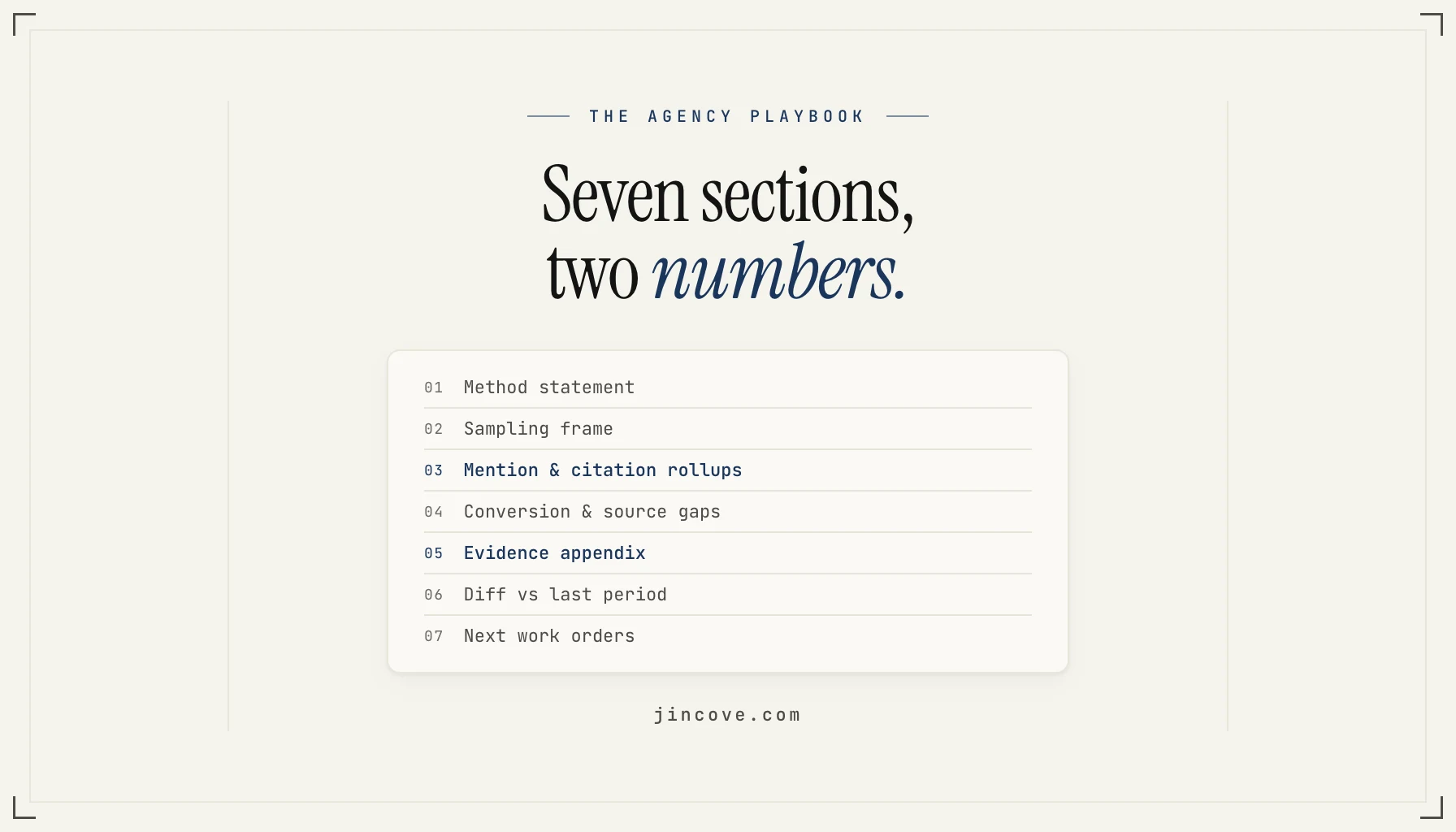
Build a white-label GEO report that survives the client asking how you know. Here is the section order, the two numbers that matter, and what to leave out.
Gan Liu
Start with the free audit
Send us one brand. We’ll run it through the engines and send back the answers, citations, and sources — so the first report your client sees is already backed by evidence.
Free audit: ChatGPT, Perplexity and Gemini, run by hand. Paid work covers all six engines.