Best Google AI Mode Tracking Tools: 6 Compared
Six Google AI Mode tracking tools compared on whether AI Mode is a named surface, single-turn versus multi-turn sampling, stored evidence and 2026-09 pricing.
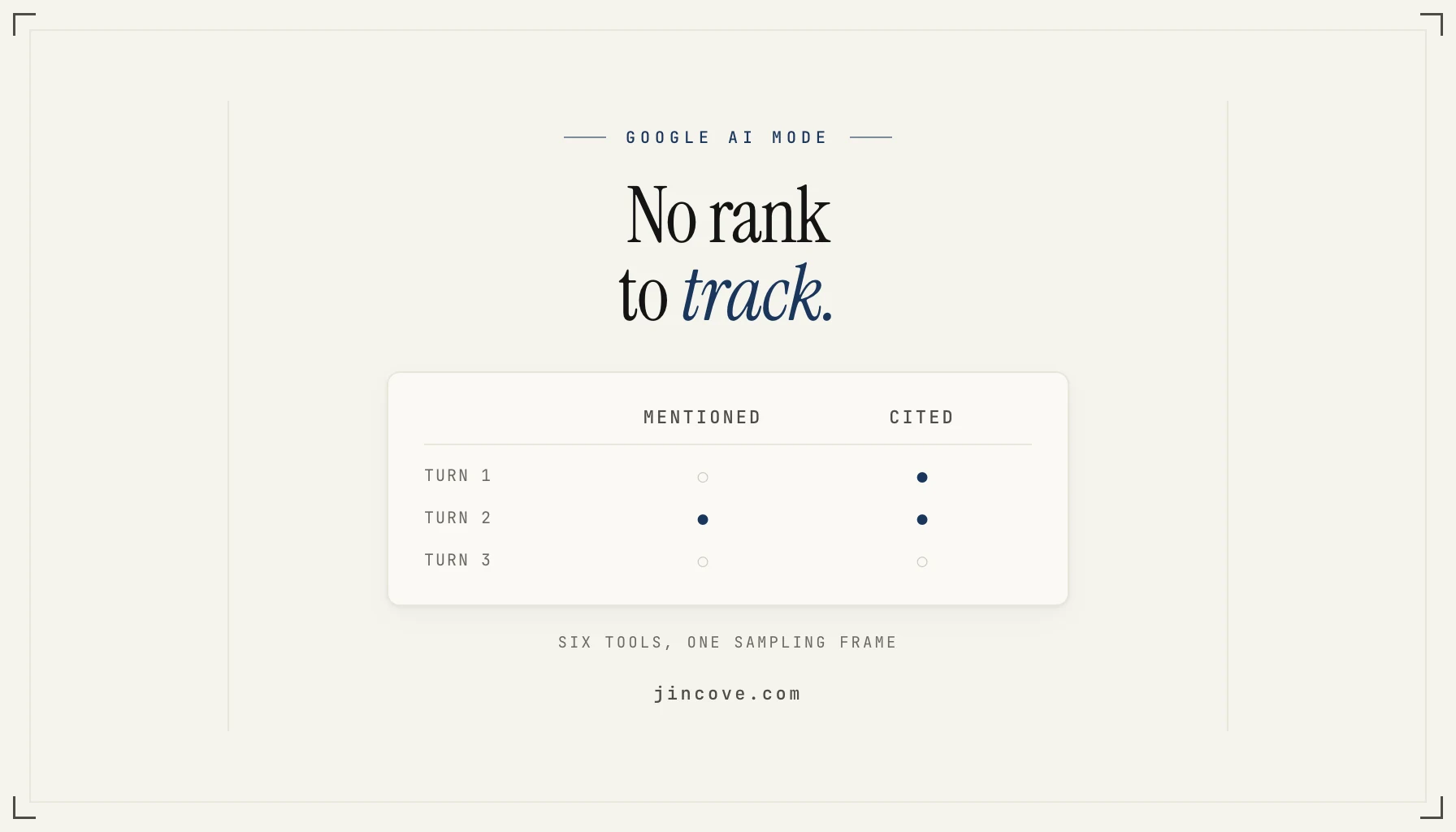
TL;DR: There is no rank in Google AI Mode, so a Google AI Mode tracking tool sold as a rank tracker is measuring something else and usually not saying what. AI Mode fans one question out into several simultaneous sub-searches and synthesises one conversational answer, which means the only defensible measurements are whether the brand was named, whether its domain was cited, and on which conversational turn. Otterly.AI is the cheapest published entry that lists AI Mode as a tracked surface. Rankability suits teams whose reporting is still keyword-shaped. Profound and Scrunch AI are built for in-house brand teams rather than agency rosters. Ask every vendor one question before you buy: do you sample turn one only, and do you say so in the report.
Search for Google AI Mode tracking tools and you get lists ranked on engine count and price. Both matter less here than in any other engine, because AI Mode breaks the thing those lists assume exists. Below is what actually differs between these products, after the part that explains why the usual comparison fails.
If you are not yet sure what the surface is, start with what Google AI Mode is. For the keyword-attached summary panel, which is a different surface with different tooling, see best Google AI Overview trackers. For the manual method rather than the software, see how to track brand mentions in Google AI Mode. For the whole category, see the AI visibility tool shortlist for agencies.
Why AI Mode breaks normal tracking
Three properties of the surface, and what each one does to a measurement.
Query fan-out means there is no result set to rank in. AI Mode decomposes one question into multiple related sub-searches, runs them at once, and writes a single answer over the combined material. There is no ordered list of ten things. A tool reporting your "position in AI Mode" has either invented a position or is quietly reporting the classic SERP underneath. Ask which. The honest units are two booleans per sampled answer - was the brand named in the text, was its domain in the citations - which is the same pair we use everywhere and describe in mention vs citation.
It is conversational, so turn one is not the answer. People open AI Mode precisely for the questions they intend to follow up on. The shortlist that matters often forms on turn two or three, after the user narrows by budget, region or use case. Nearly every tracker samples the first turn, because it is cheap and reproducible, and nearly none of them state that in the report. A first-turn-only dataset is not wrong, it is a defined slice, and the vendors that name the slice are the ones worth trusting.
It is drifting into AI Overviews, not away from them. Google has been wiring the two together in the interface, so a reader can start in an Overview and continue into an AI Mode conversation. Search Console reports them in one generative bucket rather than separately. If your client asks how much traffic came from AI Mode specifically, the honest answer is that nobody can currently split it cleanly, and any tool implying otherwise is modelling, not measuring.
How we picked, and where we are biased
Jincove is our own product. It is on this list, at the bottom, with a paragraph on who should not buy it. Rubric first, so you can re-run it against anything we left out.
- Is AI Mode a named tracked surface, or is "Google" one entry that may mean AI Overviews.
- Single-turn or multi-turn, and does the vendor say which in writing.
- Does it keep named and cited apart, rather than averaging them into one visibility score.
- Is the answer text stored, so a claim can be opened and read rather than defended from a chart.
- What does it cost at ten clients, not one.
Every figure below is what the vendor publicly listed when we checked, marked (2026-09). Where nothing is published the cell says "not publicly listed" rather than a number inferred from a review site. We ran no controlled bake-off, so nothing here claims one tool samples more accurately than another.
The six Google AI Mode tracking tools compared
| Tool | AI Mode as a named surface (2026-09) | Turn depth documented | Named and cited kept apart | Multi-client | Pricing signal (2026-09) |
|---|---|---|---|---|---|
| Otterly.AI | Listed among its tracked AI surfaces | Not publicly documented | Not documented as separate fields | Flat prompt quota, no per-client partition | Published: $29 / $189 / $489 per month by tracked prompts |
| Rankability | Listed inside its AI search analysis, beside a classic rank tracker | Not publicly documented | Mention tracking and citation tracking are named separately | Positioned for agencies; credit-based | Published credit tiers; review sites quote different ladders, so confirm on the vendor page |
| Peec AI | Base plan is capped at three engines; further surfaces are paid add-ons | Not publicly documented | Charts are the primary output | Agency plans capped by project count | Brand plans about $95-495; agency about $245-795 |
| Profound | Above the entry tier - the $99 plan is ChatGPT only | Not publicly documented | Dashboards and aggregate metrics | Enterprise contract only | $99 entry, about $399 for three engines, Enterprise quoted |
| Scrunch AI | Not broken out publicly by tier - get it named in the quote | Not publicly listed | Share-of-AI metrics rather than two separate booleans | Multi-client workspace; agency pricing via an unpublished partner program | Published: Starter $300 and Growth $500 per month; Enterprise quoted |
| Jincove | One of six engines, every plan | Sampling frame stated in every report | Two independent booleans on every sampled answer | Per-client workspaces on one shared credit pool | Studio $249 and Agency $749 per month, usage-based on top |
Otterly.AI
In one line: the cheapest published entry that names AI Mode as a surface rather than folding it into "Google".
Who it fits. One brand, a short prompt list, a weekly signal. As of 2026-09 Otterly publicly lists $29, $189 and $489 per month, separated mainly by tracked prompt count, with the core surfaces included at every tier. At the bottom tier it is genuinely cheap for a recurring check.
Who it does not fit. Anyone past their second client, and anyone who needs the conversation rather than the opening answer. A flat prompt quota does not partition across a roster.
Verdict: a smoke alarm for one brand, not a client deliverable. Long version: Jincove vs Otterly.
Rankability
In one line: a Google AI Mode tracking tool attached to the keyword rank tracker an SEO team already runs.
Who it fits. Teams whose client reporting is still built around keywords and who want one fewer system. Rankability names mention tracking and citation tracking as separate capabilities, which is more than most of this field does, and unlimited clients on published tiers is friendly to an agency roster.
Who it does not fit. Buyers who want the evidence record itself; the public material describes scores and analysis layers rather than a stored verbatim answer you can drop into an appendix. Pricing is published in credit tiers, but third-party reviews quote different ladders, so confirm the current one directly rather than trusting a roundup - including this one.
Verdict: the strongest fit when a Google AI Mode tracking tool is meant to be one more column in an existing rank report.
Peec AI
In one line: a clean tracking dashboard with a real agency tier and a capped engine list.
Who it fits. Mid-market teams and small agencies wanting trend charts across several brands.
Who it does not fit. Buyers who assume every Google surface is included. As of 2026-09 Peec lists brand plans in roughly the $95 to $495 per month range and agency plans in roughly $245 to $795, credit-based and capped by project count, with three engines in the base and further surfaces as paid add-ons. Get AI Mode named in the quote, not implied by the word Google.
Verdict: good value when charts are the deliverable. Long version: Jincove vs Peec AI.
Profound
In one line: the most polished AI-search analytics product, priced and shaped for large in-house teams.
Who it fits. A brand team with an analytics function and one name to watch.
Who it does not fit. Anyone shopping specifically for AI Mode on a budget. As of 2026-09 the listed $99 entry tier is ChatGPT only, and the plan most teams use sits near $399 for three engines. Multi-client work means a quoted Enterprise contract - a procurement cycle, not a line item on next month's retainer.
Verdict: best-in-class if you are the brand, awkward if you bill on someone else's behalf.
Scrunch AI
In one line: an AI-search visibility platform for mid-market and enterprise brand teams, acquired by Sitecore in mid-2026.
Who it fits. In-house teams that want brand monitoring plus AI-crawler analytics and site audits. As of 2026-09 Scrunch publishes self-serve tiers - Starter at $300 per month and Growth at $500, each capping custom prompts and seats - with the Data API, SSO and real scale behind a custom Enterprise quote.
Who it does not fit. Agencies costing a per-client engagement: agency terms run through a partner program whose pricing is not published, and the self-serve prompt and seat caps do not partition across a roster. Engine coverage by tier is not broken out publicly either, so get AI Mode named in the quote before you buy.
Verdict: a credible enterprise product; confirm the surface and the agency price before proposing it on a retainer. Long version: Jincove vs Scrunch AI.
Jincove, and who should skip it
In one line: a usage-based GEO platform whose unit is the client roster, with the raw answer stored behind every number.
Who it fits. Agencies running AI visibility as a billable line across several clients. Google AI Mode is one of six engines in every plan, credits come from a shared pool so unit cost falls as the roster grows, and each sampled answer carries two independent booleans - named and cited - alongside the stored text, the sources and the sampling frame that produced it.
Who it does not fit. A single brand watching only itself pays for roster machinery it never uses. Teams who want AI Mode welded to keyword rank positions should buy a rank tracker with an AI module, because we are not one. Teams wanting one headline visibility number will find our reports deliberately uncomfortable, because we do not produce one. White-label reporting is coming soon rather than shipped, so if rebranded client PDFs are a hard requirement this quarter, take that at face value.
Verdict: buy it for the roster and the evidence trail, not for the dashboard. See pricing.
How to track brand visibility in AI Mode by hand
Do this before you buy anything, because it is the only way to know what the tools are approximating.
- Write ten buyer questions, phrased the way a person types them, not the way a keyword tool prints them. AI Mode is used for comparison and reasoning questions, so favour "which x is best for y" over single nouns.
- Open AI Mode logged out, in a clean browser profile, from the region the client sells into. Account history and personalisation contaminate results, and nothing removes that entirely.
- Record two booleans per answer. Was the brand named in the text. Was the brand's domain in the cited sources. Keep them in separate columns forever; merging them deletes the only signal you would act on.
- Ask one follow-up per question, the obvious narrowing move a real buyer would make, and record the same two booleans for turn two. This is the column no cheap tool gives you.
- Save the answer text. Paste it into the sheet. In month three, when someone asks how you know, the text is the answer and the chart is not.
- Repeat weekly on the same prompt set. Change the prompt set and you have started a new series, so note the date you changed it.
An hour a week for one brand. That is the crossover point: at roughly three clients, or the moment a missed re-run costs a retainer rather than an afternoon, tooling pays for itself. Our AI visibility checker generates a starting prompt set and a scoring sheet free in the browser, with nothing leaving the page.
Three questions that decide it
Is AI Mode the job, or one column of the job? The same buyer who opens AI Mode also sees AI Overviews without asking and may check ChatGPT afterwards. A single-surface subscription usually becomes two within a quarter.
Does the vendor state its sampling frame? Turn depth, region, logged-in state, cadence. A tool that publishes its frame can be defended in a client meeting. A tool that does not is asking you to defend it for them.
Does the report leave the tool? If a client reads it, the stored answer is the load-bearing feature and the dashboard is decoration.
Questions buyers ask
Is there such a thing as an AI Mode rank tracker?
Not in the sense the phrase implies. Ranking requires an ordered list of results, and AI Mode returns one synthesised answer built from several simultaneous sub-searches. Tools using the phrase are doing one of two things: reporting your position in the classic search results that sit behind the same query, which is a real number about a different surface, or scoring how prominently your brand appears in the answer text, which is a proprietary metric with no external definition. Both can be useful. Neither is a rank, and a client who later learns that will trust the rest of your report less.
Can I use Search Console to measure AI Mode?
Partly, and it is the best free data you have. Search Console reports impressions in Google's generative AI features and counts clicks on external links there, for your own property. What it does not do is split AI Mode from AI Overviews - they arrive in one generative bucket - so you cannot attribute a change to one surface. Use it for your own true exposure and a third-party sampler for competitive share and the named-versus-cited split. Check the current documentation before relying on any of this; the reporting has changed more than once.
Why do two Google AI Mode tracking tools show different numbers for the same brand?
Because they sampled different conversations. The prompt set differs, the region and logged-in state differ, turn depth differs, and the definition of a mention differs - some count any occurrence of the brand string, some only a recommendation. Conversational surfaces vary more between runs than keyword-attached ones, so two honest tools can disagree without either being wrong. Never mix two vendors' figures into one client chart; pick one method, document it, and compare only against your own history.
How often should AI Mode monitoring run?
Weekly, and never with gaps. Daily runs mostly buy variance, because generative answers move day to day for reasons that have nothing to do with the brand - model updates, index refreshes, time of day. Monthly is too slow to attribute anything, since you will have shipped four other things by the time you see the change. An unbroken weekly line is a trend; a line with two gaps is an anecdote.
See the evidence on one of your own clients
Before subscribing to any Google AI Mode tracking tool on this page, look at the output. Request a free, human-run audit: send one client URL and an email, and we hand-run the answer engines and reply with the exact answers, the sources, and whether each named the brand or only cited it - two business days, no card, no account. If the evidence is useful, the same method runs on a schedule across all six engines.
Related blogs
Related Post
Expand your knowledge with these hand-picked posts.
How to Track Brand Mentions in ChatGPT in 2026: The Agency Method
ChatGPT has no Search Console - no impressions, no analytics, no export. Here is the method agencies use to track brand mentions across ChatGPT and the other answer engines without trusting a black-box score, and why "citations" and "mentions" are two different numbers.
Gan Liu
Best AI Visibility Tools for Agencies in 2026: An Honest Shortlist
Most "best GEO tool" roundups rank on engine count. Agencies buy on a different axis - client roster, white-label, and evidence you can hand a client. Here is the honest shortlist, what each tool is actually best at, and the three questions that decide it.
Gan Liu
How to Track Brand Mentions in Perplexity in 2026: The Agency Method
Perplexity shows numbered citations and a Sources list under every answer. The agency method for reading brand mention vs citation off it - no black-box score.
Gan Liu
Start with the free audit
Send us one brand. We’ll run it through the engines and send back the answers, citations, and sources — so the first report your client sees is already backed by evidence.
Free audit: ChatGPT, Perplexity and Gemini, run by hand. Paid work covers all six engines.