Best Google AI Overview Trackers: 7 Compared
Seven Google AI Overview trackers compared on trigger coverage, the cited-versus-named split, stored evidence and 2026-09 pricing, plus what is free in GSC.
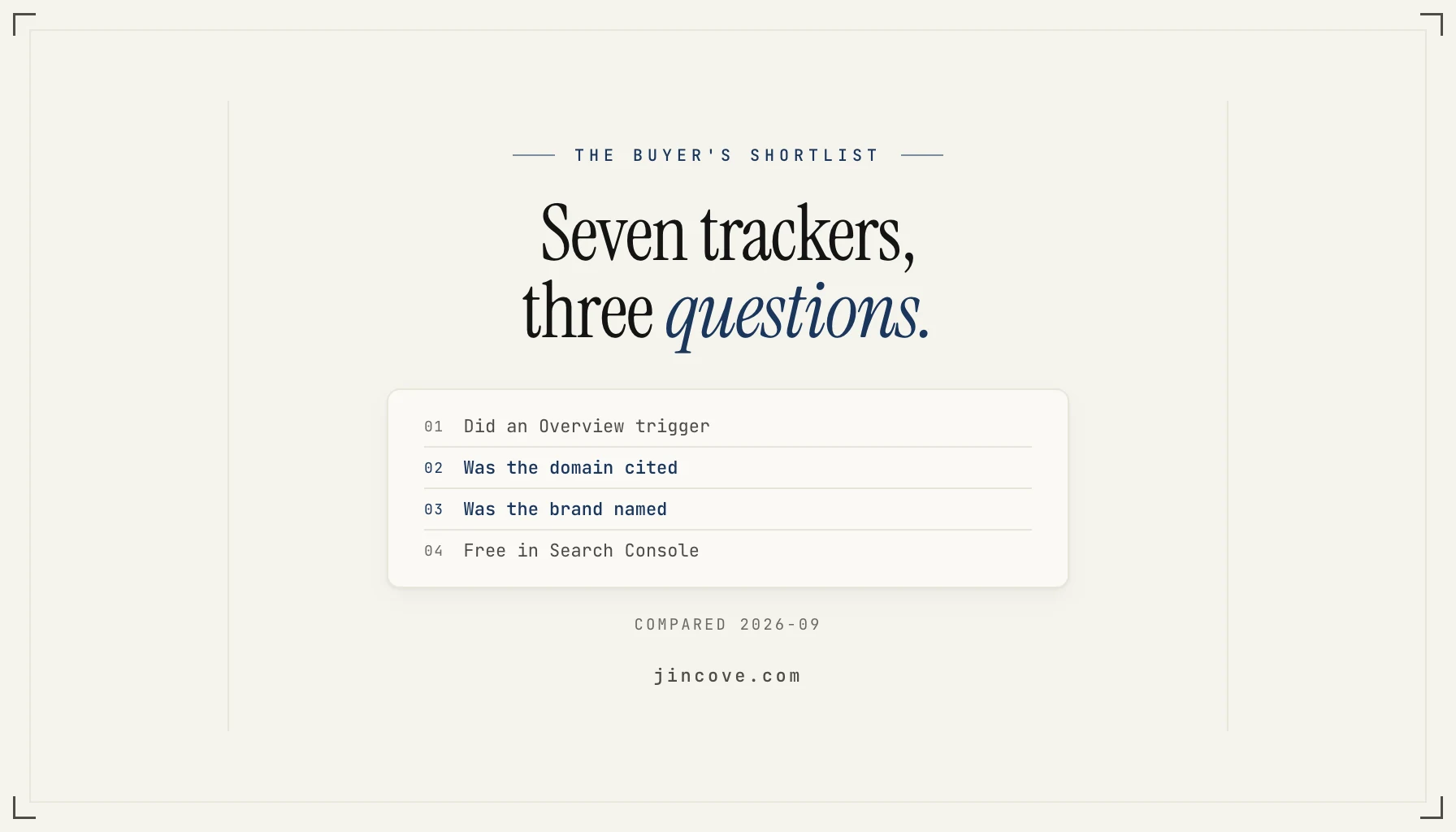
TL;DR: Before you shop for a Google AI Overview tracker, note that Search Console already reports impressions inside Google's generative AI features for free - it just cannot separate AI Overviews from AI Mode. Tools exist to fill that gap. Otterly.AI is the cheapest published entry at $29/mo (2026-09) and lists AI Overviews in every plan. Rankability fits best if you want AI Overview tracking bolted onto a keyword rank tracker you already run. Profound and Scrunch AI are built for in-house brand teams rather than agency rosters. The feature separating a usable tool from a dashboard is whether you can open a number and read the exact Overview text with its source list.
"AI Overview tracking" gets sold as one product and is actually three measurements stacked on top of each other. Most roundups compare price and engine count and never mention this, which is why buyers end up with a number they cannot explain to a client. So the shortlist below comes after the definition, not before it.
This page is about one Google surface. For the conversational tab, which behaves differently enough to need its own instrument, see best Google AI Mode tracking tools and the plain explanation of what Google AI Mode is. For the whole category rather than one surface, see the AI visibility tool shortlist for agencies. For the manual method rather than the software, see how to track brand mentions in Google AI Overviews.
Three different things get called AI Overview tracking
An AI Overview is attached to a keyword. That single fact makes it unlike ChatGPT or Perplexity monitoring, and it splits the measurement into three questions that fail independently.
Does an Overview trigger at all? Google does not show one for every query, and trigger rates move with core updates, query class and region. A keyword that had an Overview in March may not have one in September. This is a SERP-feature presence question - the one classic rank trackers were already built to answer.
Is your domain in the source list? If an Overview fires, it carries a set of linked sources. Your domain is either in that set or it is not. This is the cited boolean, and it is cheap to read because the links are printed.
Is your brand named in the answer text? Entirely separate. Google can summarise your page, link it as source three, and never write your brand name in the sentence a reader actually absorbs. That is a conversion gap, and it is invisible to any tool that only checks the link list.
Most products merge questions one and two into a single "AI Overview visibility" percentage. That number rises when Google shows more Overviews in your category and falls when trigger rates drop, neither of which is a thing you did. Ask a vendor which of the three they measure and whether you can see them apart. The answer sorts the field faster than any feature grid.
How we picked, and where we are biased
Jincove is our own product. It is on this list, at the bottom, with a paragraph on who should not buy it. Here is the rubric first so you can re-run it against anything we left out.
- Does it separate the three measurements above, or roll them into one score you cannot decompose.
- Does it store the Overview text. Not a screenshot of a chart - the answer as generated, with its source URLs, so a claim you make to a client can be opened and checked.
- Does it handle keyword scale. AI Overview tracking is keyword-shaped, so cost tends to scale with tracked keywords rather than tracked prompts. Those two pricing units are not comparable and vendors rarely say which one they use.
- What does it cost at ten clients, not one.
- Does it cover more than this one surface. An AI Overview number alone is partial. The same buyer sees AI Mode, ChatGPT and Perplexity too.
Every figure below is what the vendor publicly listed when we checked, marked (2026-09). Where nothing is published, the cell says "not publicly listed" rather than a number lifted from a review site. We ran no controlled bake-off, so nothing here claims one tool is more accurate than another.
The seven Google AI Overview trackers compared
| Tool | AI Overview coverage (2026-09) | Named and cited kept apart | Overview text stored | Multi-client | Pricing signal (2026-09) |
|---|---|---|---|---|---|
| Otterly.AI | Listed as a tracked surface in every plan | Not documented as separate fields | Not documented as a client-facing evidence record | Flat prompt quota, no per-client partition | Published: $29 / $189 / $489 per month by tracked prompts |
| Rankability | Listed inside its AI search analysis alongside a classic rank tracker | Mention tracking and citation tracking are named separately | Not publicly documented in detail | Positioned for agencies; credit-based | Published credit tiers; review sites quote different ladders, so confirm on the vendor page |
| Peec AI | Base plan is capped at three engines; further surfaces are paid add-ons | Charts are the primary output | Tracking charts are the primary output | Agency plans capped by project count | Brand plans about $95-495; agency about $245-795 |
| Profound | Above the entry tier - the $99 plan is ChatGPT only | Dashboards and aggregate metrics | Dashboards and aggregate metrics | Enterprise contract only | $99 entry, about $399 for three engines, Enterprise quoted |
| Scrunch AI | Not broken out publicly by tier - get it named in the quote | Share-of-AI metrics rather than two separate booleans | Tracked responses; screenshots not documented | Multi-client workspace; agency pricing via an unpublished partner program | Published: Starter $300 and Growth $500 per month; Enterprise quoted |
| Siftly | Not publicly listed | Not publicly listed | Not publicly listed | Not publicly listed | Unverified - trial it yourself before shortlisting |
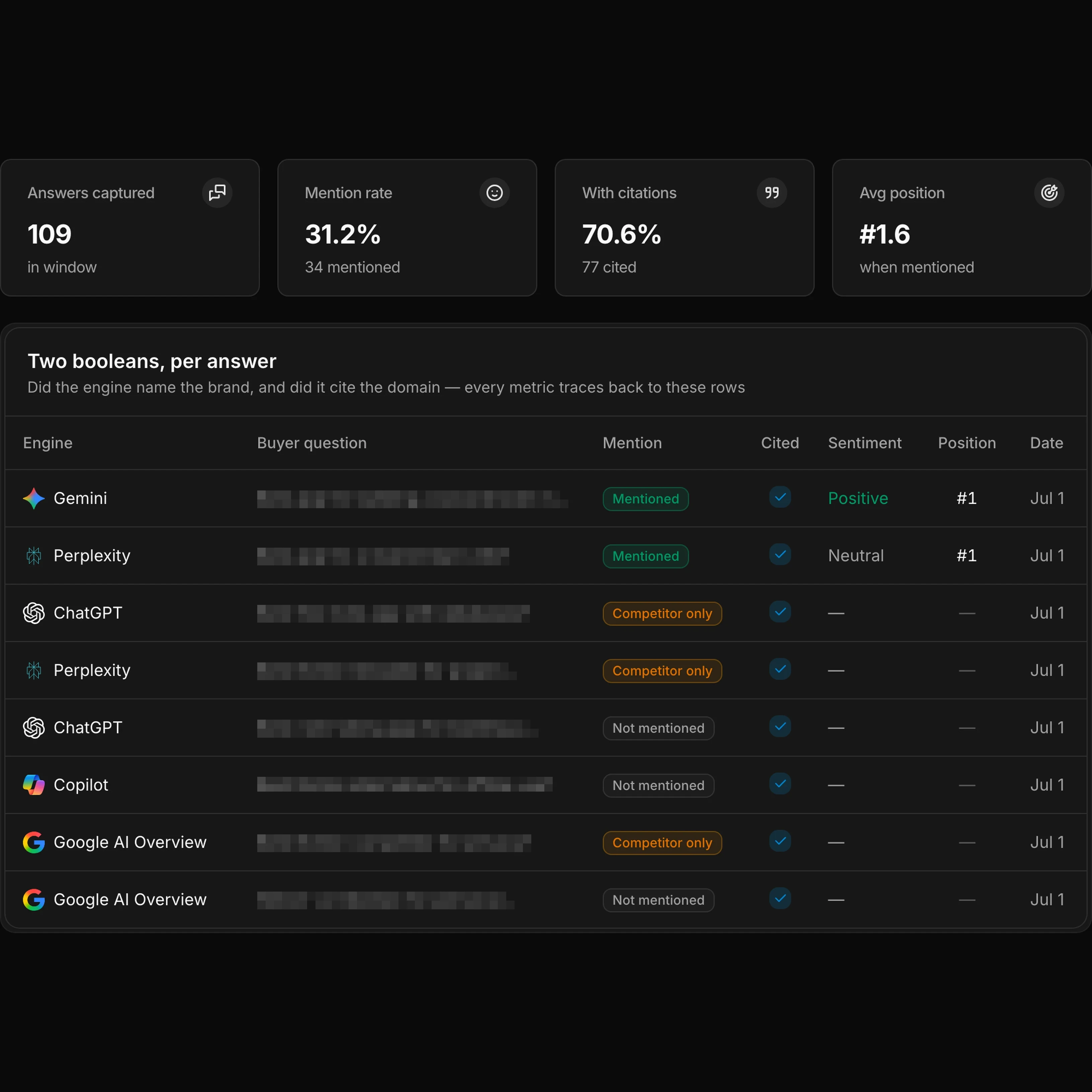
| Jincove | One of six engines, every plan | Two independent booleans on every sampled answer | Verbatim answer, sources and screenshot behind every number | Per-client workspaces on one shared credit pool | Studio $249 and Agency $749 per month, usage-based on top |
Otterly.AI
In one line: the cheapest published way to see whether Overviews in your category link to you.
Who it fits. One brand, a short keyword list, a weekly signal. As of 2026-09 Otterly publicly lists $29, $189 and $489 per month, separated mainly by tracked prompt count, with AI Overviews included at every tier rather than gated behind an upgrade.
Who it does not fit. Anyone past their second client. A flat prompt quota does not partition across a roster, and the output is a signal rather than an artefact you hand a client with your logo on it.
Verdict: the right first purchase, and the wrong second one. Long version: Jincove vs Otterly.
Rankability
In one line: a Google AI Overview tracker attached to the keyword rank tracker an SEO team already lives in.
Who it fits. Teams whose reporting is still keyword-shaped. Because AI Overviews trigger per keyword, having presence, position and AI mention in one place removes a monthly join you would otherwise do by hand. Rankability names mention tracking and citation tracking as distinct capabilities, which is more than most of this field does.
Who it does not fit. Buyers who need the evidence record itself; as of 2026-09 the public material describes scores rather than a stored verbatim answer you can put in an appendix. Pricing is published in credit tiers, but third-party reviews quote different ladders, so confirm it directly rather than trusting a roundup - including this one.
Verdict: the strongest fit if a Google AI Overview tracker is meant to be one more column in an existing rank report.
Peec AI
In one line: a clean tracking dashboard with a real agency tier and a capped engine list.
Who it fits. Mid-market teams and small agencies wanting trend charts across several brands.
Who it does not fit. Buyers who assume every surface is included. As of 2026-09 Peec lists brand plans in roughly the $95 to $495 per month range and agency plans in roughly $245 to $795, credit-based and capped by project count, with three engines in the base and further surfaces as paid add-ons. Confirm AI Overviews sit inside the tier you are quoted, not beside it.
Verdict: good value when charts are the deliverable.
Profound
In one line: the most polished AI-search analytics product, priced and shaped for large in-house teams.
Who it fits. A brand team with an analytics function and one name to watch.
Who it does not fit. Anyone shopping specifically for AI Overviews on a budget. As of 2026-09 the listed $99 entry tier is ChatGPT only, and the plan most teams use sits near $399 for three engines. Multi-client work means a quoted Enterprise contract - a procurement cycle, not a line item on next month's retainer.
Verdict: best-in-class if you are the brand, awkward if you bill on someone else's behalf. Long version: Jincove vs Profound.
Scrunch AI
In one line: an AI-search visibility platform for mid-market and enterprise brand teams, acquired by Sitecore in mid-2026.
Who it fits. In-house teams that want brand monitoring plus AI-crawler analytics and site audits. As of 2026-09 Scrunch publishes self-serve tiers - Starter at $300 per month and Growth at $500, each capping custom prompts and seats - with the Data API, SSO and real scale behind a custom Enterprise quote.
Who it does not fit. Agencies costing a per-client engagement: agency terms run through a partner program whose pricing is not published, and the self-serve prompt and seat caps do not partition across a roster. Engine coverage by tier is not broken out publicly either, so get AI Overviews named in the quote before you buy.
Verdict: a credible enterprise product; confirm the surface and the agency price before proposing it on a retainer. Long version: Jincove vs Scrunch AI.
Siftly
In one line: a visible name on this query that publishes very little we could verify.
Who it fits. Unknown from public material. It appears consistently in results for AI visibility tracking, so a free trial is the only honest way to evaluate it.
Who it does not fit. Anyone writing a procurement case this week. If pricing, surface list and retention behaviour are not on a public page, you reconstruct them from a sales call.
Verdict: trial it directly before it enters a shortlist. We will update this entry when there is a public page to cite.
Jincove, and who should skip it
In one line: a usage-based GEO platform whose unit is the client roster, with the raw answer stored behind every number.
Who it fits. Agencies running AI visibility as a billable line across several clients. Google AI Overviews is one of six engines in every plan, credits come from a shared pool so unit cost falls as the roster grows, and each sampled answer carries two independent booleans - named and cited - plus the stored text and sources a client can check line by line.
Who it does not fit. A single brand watching only itself pays for roster machinery it never uses; Otterly costs less and does that job. Teams wanting AI Overviews welded to keyword rank positions should buy a rank tracker with an AI module, because we are not one. Teams wanting one headline visibility number will find our reports deliberately uncomfortable, because we do not produce one. White-label reporting is coming soon rather than shipped.
Verdict: buy it for the roster and the evidence trail, not for the dashboard. See pricing.
What Search Console already gives you, free
Skipping this section costs people money, so it goes before the decision questions rather than in a footnote.
Google reports impressions inside its generative AI features in Search Console, and a click on an external link in those features counts as a click. That is first-party data about your own property, and no third-party sampler matches it for coverage, because it is a census rather than an estimate.
Two limits decide whether you still need a tool. It does not split AI Overviews from AI Mode - they arrive as one generative bucket - and the detail is impressions-first, so you cannot cleanly attribute traffic to one surface. It also says nothing about competitors, and nothing about whether the answer named your brand rather than merely linking you.
The honest division of labour: Search Console for your own exposure, a tracker for competitive share and the named-versus-cited split. If a vendor's pitch only reproduces what Search Console already shows you about your own site, you are paying for a prettier view of free data. Check the current documentation before deciding - this area has changed twice in a year.
Three questions that decide it
Is AI Overview coverage the job, or one column of it? If your client's buyers also use ChatGPT and Perplexity, a single-surface tool creates a second subscription within a quarter. Buy the matrix, or accept the partial view deliberately.
Does the report leave the tool? If it goes to a client, the stored answer matters most and the dashboard is decoration. If it stays internal, the reverse holds and you should buy the cheapest thing that alerts you.
Is your reporting keyword-shaped or prompt-shaped? AI Overviews trigger on keywords, so a keyword-native tool joins an existing SEO report with no extra work. Prompt-native tools fit a buyer-question report. Mixing units mid-quarter is how a client chart stops reconciling.
Questions buyers ask
Can you track Google AI Overviews for free?
Partly, and it is worth doing before you buy. Search Console covers your own exposure. For the rest, run a manual pass: take twenty commercial keywords, search each in a logged-out browser, and record three columns - did an Overview appear, was your domain in the source list, was the brand named in the text. Twenty keywords takes about half an hour and yields a baseline no sales call can talk you out of. Our AI visibility checker generates a starting prompt set and a scoring sheet in the browser, free, with nothing leaving the page.
Why do two Google AI Overview trackers report different numbers for the same site?
Because they are not measuring the same thing. Differences come from the keyword set, the region and device, whether the check ran in a real browser session or through a data provider, the time of day, and how the tool defines presence - some count any occurrence of the brand string, some only a linked citation. None of that is cheating, but vendor figures are not comparable across tools. Pick one method, document it, compare only against your own history.
Do AI Overviews and AI Mode need separate tracking?
Yes, and assuming otherwise is the expensive mistake in this category. AI Overviews attach to a keyword and appear above classic results. AI Mode is a conversational destination that decomposes one question into several simultaneous sub-searches, so there is no fixed result set to hold a position in. A tool built for keyword-attached SERP features reports AI Mode badly, and a prompt-based tool reports AI Overview trigger rates badly. Read what Google AI Mode is before assuming one number covers both.
How often should AI Overview tracking run?
Weekly for most retainers. Overviews are steadier week to week than chat answers, because they are anchored to a keyword and a retrieval set rather than regenerated conversationally, so daily runs mostly buy noise. Cadence matters more than frequency: an unbroken weekly line is a trend, a line with two gaps is an anecdote, and the gap always lands in the month a client asks what they are paying for.
See the evidence on one of your own clients
Before subscribing to any Google AI Overview tracker on this page, look at the output. Request a free, human-run audit: send one client URL and an email, and we hand-run the answer engines and reply with the exact answers, the sources, and whether each named the brand or only cited it - two business days, no card, no account. If the evidence is useful, the same method runs on a schedule across all six engines.
Related blogs
Related Post
Expand your knowledge with these hand-picked posts.

How to Track Brand Mentions in ChatGPT in 2026: The Agency Method
ChatGPT has no Search Console - no impressions, no analytics, no export. Here is the method agencies use to track brand mentions across ChatGPT and the other answer engines without trusting a black-box score, and why "citations" and "mentions" are two different numbers.
Gan Liu

Best AI Visibility Tools for Agencies in 2026: An Honest Shortlist
Most "best GEO tool" roundups rank on engine count. Agencies buy on a different axis - client roster, white-label, and evidence you can hand a client. Here is the honest shortlist, what each tool is actually best at, and the three questions that decide it.
Gan Liu
How to Track Brand Mentions in Perplexity in 2026: The Agency Method
Perplexity shows numbered citations and a Sources list under every answer. The agency method for reading brand mention vs citation off it - no black-box score.
Gan Liu
Start with the free audit
Send us one brand. We’ll run it through the engines and send back the answers, citations, and sources — so the first report your client sees is already backed by evidence.
Free audit: ChatGPT, Perplexity and Gemini, run by hand. Paid work covers all six engines.