How to Track Brand Mentions in Google AI Mode in 2026
Google AI Mode fans one question into many sub-searches, so the brand it names depends on the whole cluster. Track mentions and citations without a black-box score.
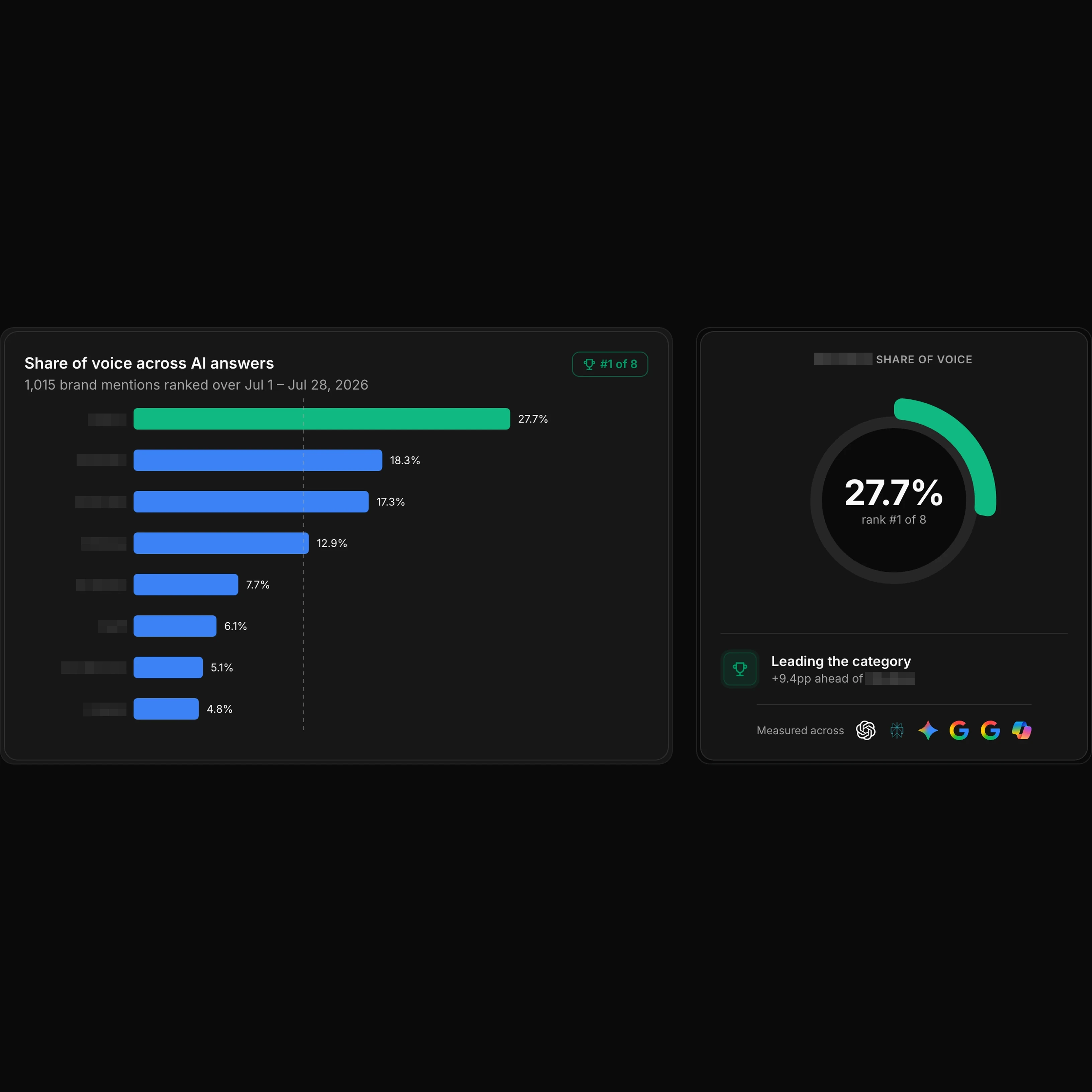
TL;DR: Google AI Mode is a conversational, generative search surface - distinct from AI Overviews - and it fans one question out into many sub-searches, so the brand that surfaces depends on the whole neighborhood of related questions, not the literal words typed. Track it the way you track any engine: run a prompt set, read two independent booleans per answer - was the brand named, was its domain cited - and store the raw answer behind every number. Skip the single "visibility score." Expect more run-to-run drift here than on most surfaces, and diff against your own history so a real change is not mistaken for fan-out noise.
Buyers now open Google, switch to AI Mode, and hold a back-and-forth instead of scanning ten blue links. The answer they read is generated, pulled from a spread of pages, and different from what the same words return in classic search or in an AI Overview. If your client is absent from that answer - or named while the sources point elsewhere - they lose the buyer before a single click. And AI Mode ships with no Search Console for any of this: no impressions, no query report, no export. You build the measurement yourself.
Why a single "visibility score" fails - and fails harder here
Most trackers hand you one number: "58% visibility." It merges two different signals and cannot be checked, so you can neither act on it nor defend it to a client. That problem is worse in AI Mode because of how the surface works. AI Mode leans on heavy query fan-out: one visible question expands into several related sub-searches, each retrieves its own set of pages, and the model synthesizes them into a single answer. The brand that ends up named depends on that whole cluster of sub-queries, not the phrase you typed.
Two consequences follow. First, a single literal query is a poor probe - testing one phrasing tells you little about a surface that samples a neighborhood of questions. Second, the answer drifts more from run to run, because a different fan-out on a different day pulls a different mix of sources. A merged score hides both problems behind a number that looks stable while the thing underneath moves.
AI Mode is not AI Overviews
Keep the two Google surfaces separate. They behave differently, and you measure them as different engines.
| Google AI Mode | Google AI Overviews | |
|---|---|---|
| Surface | A dedicated conversational tab you enter and keep talking to | A generated summary above classic results on some queries |
| Interaction | Multi-turn; follow-ups carry context | Single-shot; tied to the one query |
| Fan-out | Heavy - one question expands into many sub-searches | Present but lighter; anchored closer to the entered query |
| Measurement note | Higher run-to-run drift; needs a cluster prompt set | Steadier, but still diff against your own history |
Because they diverge, a brand can be a stronghold in one and whitespace in the other. Track each on its own.
The two booleans, read off AI Mode
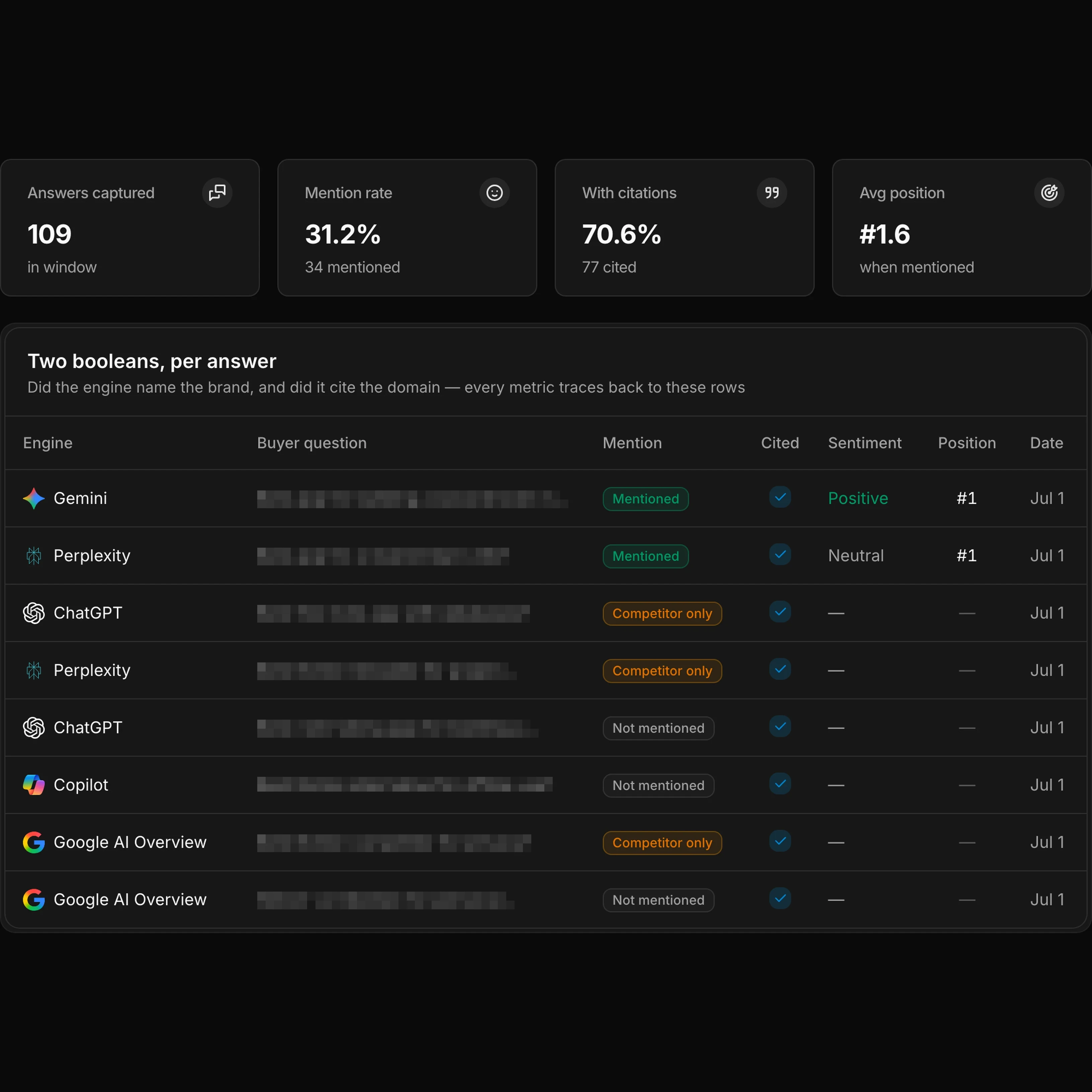
Every AI Mode answer gives you two independent facts. Never merge them:
- Mention - is the brand named in the answer text the reader sees? Yes or no.
- Citation - is the brand's own domain among the sources AI Mode shows for that answer? Yes or no.
These fail for different reasons and get fixed with different work, which is exactly why mention and citation stay separate. From the two booleans you derive the gaps: a conversion gap is cited-but-not-named (the answer paraphrases your page and drops your name), and a source gap is named-but-cited-elsewhere (the answer says your name and then points the reader at a competitor or a review directory). One merged percentage erases the distinction; two booleans preserve it.
The method
- Build a cluster prompt set, not a phrase list. Because AI Mode fans out, one wording under-samples the surface. Take each buyer question and cover its neighborhood - the comparison, the "best X for Y," the "alternatives to," the objection. Aim for 20-50 real, question-shaped prompts across the category, not brand-name lookups.
- Run each prompt in AI Mode deliberately. Fresh session, and record the run conditions - model surface, country, whether you are signed in - because they change the answer. Read the first generated answer to the buyer question, the same way every time, so runs stay comparable.
- Capture the verbatim answer and its sources. Copy the exact text and the cited URLs, not a summary. The artifact is the evidence.
- Mark the two booleans: brand named (Y/N), own domain cited (Y/N).
- Store the raw answer behind the number. This is the step trackers skip and the step that lets your report survive scrutiny. "You moved out of the source gap on this prompt" only means something if you can reopen both answers.
- Diff against your own history over a sampling window. The baseline is the client's past runs, not an invented target. Because fan-out makes AI Mode noisier, flag a change only when it moves beyond run-to-run drift - a wider sampling window earns its keep here.
The discipline is the same as the ChatGPT method: record the verbatim answer, the exact cited URLs, and the metadata, so a month later you can reopen this precise answer and prove which way it moved. On AI Mode you simply expect the raw record to wobble more, and you let the history - not a single run - tell you whether something real changed.
Track all six engines, not just AI Mode
AI Mode is one surface. The same buyer also lands in ChatGPT, Perplexity, Gemini, Google AI Overviews, and Copilot, and the same brand can be named on one and invisible on another. Run the same prompt set across all six, sort every answer into a quadrant with the source gap vs conversion gap framework, and you get a work order instead of a number. That cross-engine reading - the exact answer, every cited source, screenshots, and history you can diff - is what Jincove's features are built to capture, one isolated workspace per client. And if you are shopping for software to run it, the Google AI Mode tracking tools comparison scores six products on exactly these criteria.
Two honest boundaries hold across every engine, AI Mode included. Nobody controls what these models say - Jincove proves what they said and what moved after a fix; it does not promise to make an engine name your client, and it does not fact-check the model's prose. Measurement, not influence. Evidence, not a verdict.
See it on your own brand first
Want to see the two-boolean read on a brand you care about? Request a free GEO audit: send one URL and an email, and we hand-run the engines and reply with the exact answers, the cited sources, and whether each one named your brand or only cited it - no card, no account. It is the fastest way to see, on your own domain, what AI Mode is actually saying.
Related blogs
Related Post
Expand your knowledge with these hand-picked posts.
How to Track Brand Mentions in ChatGPT in 2026: The Agency Method
ChatGPT has no Search Console - no impressions, no analytics, no export. Here is the method agencies use to track brand mentions across ChatGPT and the other answer engines without trusting a black-box score, and why "citations" and "mentions" are two different numbers.
Gan Liu
Best AI Visibility Tools for Agencies in 2026: An Honest Shortlist
Most "best GEO tool" roundups rank on engine count. Agencies buy on a different axis - client roster, white-label, and evidence you can hand a client. Here is the honest shortlist, what each tool is actually best at, and the three questions that decide it.
Gan Liu
How to Track Brand Mentions in Perplexity in 2026: The Agency Method
Perplexity shows numbered citations and a Sources list under every answer. The agency method for reading brand mention vs citation off it - no black-box score.
Gan Liu
Start with the free audit
Send us one brand. We’ll run it through the engines and send back the answers, citations, and sources — so the first report your client sees is already backed by evidence.
Free audit: ChatGPT, Perplexity and Gemini, run by hand. Paid work covers all six engines.