How to Track Brand Visibility in Google AI Overviews in 2026
Google AI Overviews only appear for some queries. Track them with three booleans: did an Overview trigger, did it name your brand, did it cite your domain.
TL;DR: Google AI Overviews only appear for some queries, so tracking them needs a boolean the other engines don't have - did an Overview even trigger for this query? Then the usual two: was your brand named in the Overview text, and was your own domain among its small set of cited links. Store the raw Overview behind every number, and diff against your own history, because the same query can show the Overview on one run and hide it on the next.
Google AI Overviews sit at the very top of a results page - above the blue links - for the queries Google decides deserve one. For those queries, the Overview is the first and sometimes the only thing a buyer reads. But it does not appear for every query, and it does not appear reliably for the same query twice. That conditional behavior is what makes tracking this surface different from tracking ChatGPT, and it is why the usual two-boolean method needs a third boolean bolted on the front.
Why a single "visibility score" fails on this surface
Most trackers hand you one number for AI Overviews: "48% visibility." On a surface that only appears sometimes, that number is even emptier than usual. Forty-eight percent of what - the queries where an Overview appeared, or all queries including the ones where it never rendered? Named in the text, or just cited in a link chip? A merged score buries three different facts that fail for three different reasons, and you cannot reopen it to check. On AI Overviews you have to keep the facts apart, or you are measuring nothing.
The third boolean: did an Overview even appear?
On ChatGPT or Perplexity you always get an answer to read. On Google AI Overviews you do not. Google shows an Overview only for queries it judges will benefit from one, and that judgment shifts with location, device, sign-in state, freshness of results, and Google's own model updates. The same buyer question can surface an Overview this morning and just blue links this afternoon.
So the first thing you record for this engine is not mention or citation - it is whether the surface existed at all:
- Triggered - did an AI Overview render at the top of the results page? Yes or no.
If it did not trigger, there is no Overview text to read and no Overview links to check - the query fell through to classic organic results, which is a different and older game. Trigger rate itself becomes a number you diff against your own history: an Overview that used to appear for a high-intent query and now doesn't is a real change, and only visible if you were recording the boolean all along.
One more wrinkle worth naming: AI Overviews build their answer through query fan-out - a single question is expanded into several sub-queries, each retrieved separately, then synthesized. That is part of why the brand named in an Overview can differ from what the literal query implies, and why your prompt set should cover the whole cluster of buyer questions, not one phrasing.
The two booleans, read off the Overview itself
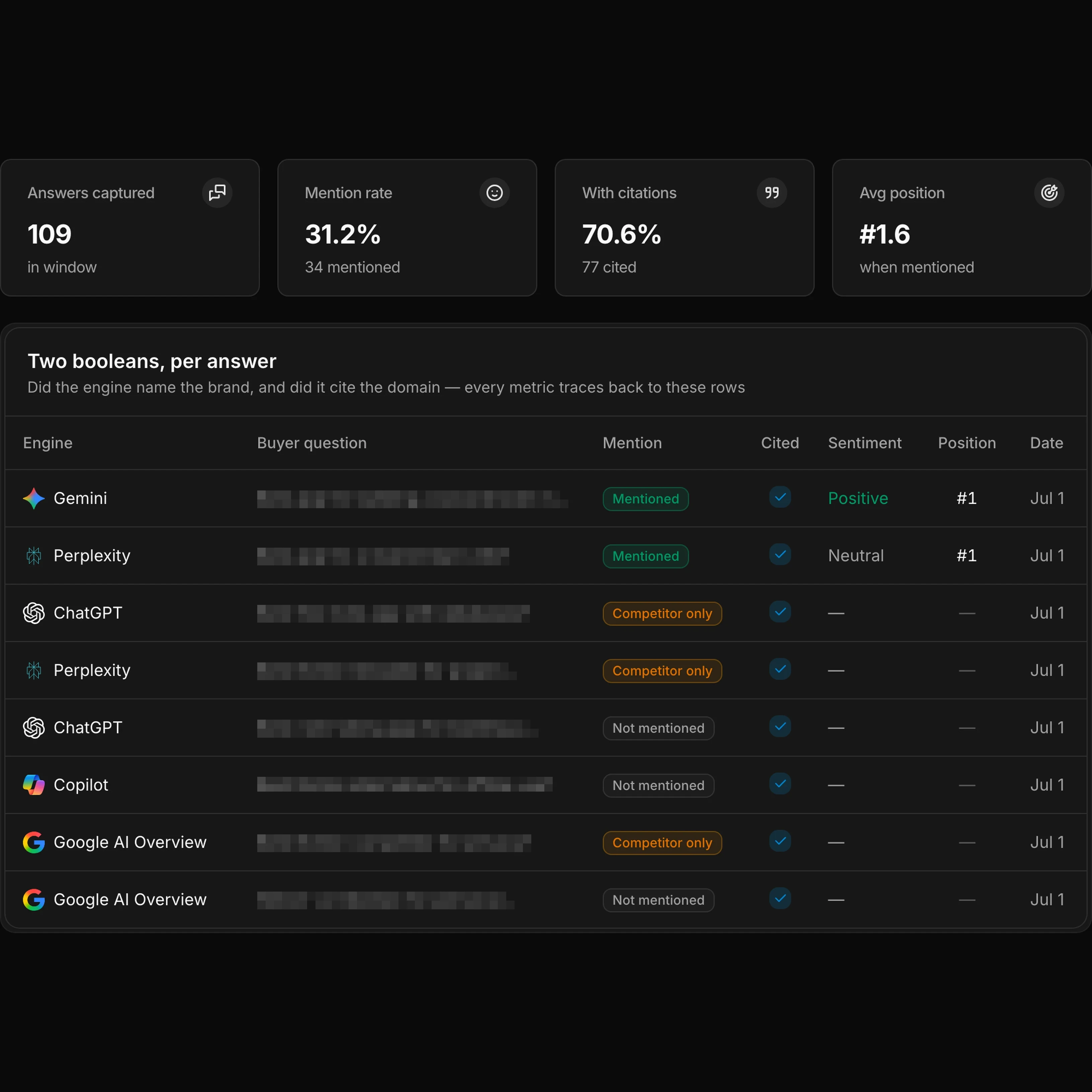
When an Overview does trigger, you read the same two independent facts you read on every engine:
- Mention - is your brand named in the Overview text the reader sees? Yes or no.
- Citation - is your own domain one of the Overview's cited links (the small link set beside or beneath it)? Yes or no.
AI Overviews cite a deliberately small set of links, so citation here is a tighter contest than a page of ten blue results. Being one of three cited links is a very different position from ranking sixth organically.
| Boolean | What you read on the results page | What it tells you |
|---|---|---|
| Triggered | Did an AI Overview render above the blue links? | Whether this surface exists for the query at all |
| Mention | Is the brand named in the Overview text? | Whether the reader sees your name before scrolling |
| Citation | Is your domain among the Overview's cited links? | Whether the reader can click through to you |
From the two read booleans you derive the same gaps as everywhere else. Cited, not named is a conversion gap - the Overview pulled from your page and never said your name. Named, but the links point elsewhere is a source gap - the reader sees your brand and clicks through to a competitor or a review site. Same two derivations, now gated behind "did it trigger."
The method, step by step
- Build a prompt set. 20-50 real buyer questions in the client's category - question-shaped queries, not brand-name lookups. Cover the cluster (comparisons, alternatives, "best X for Y"), because fan-out means the Overview samples the neighborhood, not just your exact wording.
- Run each as a real Google search and fix the conditions: location, country, device, signed-out. These change whether an Overview triggers, so they are part of the run, not trivia.
- Record the trigger boolean first. Did an Overview render? Capture a screenshot of the top of the results page as the artifact - screenshots matter more here because the surface is transient.
- If it triggered, capture the verbatim Overview text and its cited links. Copy the exact wording and every cited URL, not a paraphrase.
- Mark the two read booleans: brand named (Y/N), own domain cited (Y/N).
- Store the raw Overview behind every number, then diff against your own history on a schedule - trigger rate included - and flag a change only when it moves beyond run-to-run noise.
This is the same discipline as the ChatGPT method, with the trigger boolean added and screenshots treated as first-class evidence.
One honesty boundary the method forces: nobody controls whether Google shows an Overview, whether it names a brand, or which links it cites. This tracks and proves what the Overview did on the record, and what moved after your content work - it does not promise to make an Overview appear or say anything, and it does not fact-check the Overview's prose. Evidence of what happened, not a lever on what happens.
Track all six engines, not just AI Overviews
AI Overviews are one surface. The same buyer also lands in ChatGPT, Perplexity, Gemini, Google AI Mode, and Copilot, and the same brand can be a stronghold in one and whitespace in another. Run the same prompt set across all six, then sort every triggered answer into a quadrant - the source gap vs conversion gap framework turns the raw booleans into fixed moves. Jincove's features run this method across the six engines with the raw Overview, its screenshot, and its cited links stored behind every number, so any figure opens back to the answer it came from. If you are evaluating software for this surface instead, the Google AI Overview trackers comparison scores seven products on the cited-versus-named split.
See it on your own brand first
Request a free GEO audit: send one URL and we hand-run the engines and reply with the exact answers, the cited sources, and - for AI Overviews - whether one triggered, whether it named the brand, and where its links pointed. It is the fastest way to see the three-boolean method on a brand you care about. Want your whole book of clients monitored on a schedule? Talk to us.
Related blogs
Related Post
Expand your knowledge with these hand-picked posts.
How to Track Brand Mentions in ChatGPT in 2026: The Agency Method
ChatGPT has no Search Console - no impressions, no analytics, no export. Here is the method agencies use to track brand mentions across ChatGPT and the other answer engines without trusting a black-box score, and why "citations" and "mentions" are two different numbers.
Gan Liu

Best AI Visibility Tools for Agencies in 2026: An Honest Shortlist
Most "best GEO tool" roundups rank on engine count. Agencies buy on a different axis - client roster, white-label, and evidence you can hand a client. Here is the honest shortlist, what each tool is actually best at, and the three questions that decide it.
Gan Liu
How to Track Brand Mentions in Perplexity in 2026: The Agency Method
Perplexity shows numbered citations and a Sources list under every answer. The agency method for reading brand mention vs citation off it - no black-box score.
Gan Liu
Start with the free audit
Send us one brand. We’ll run it through the engines and send back the answers, citations, and sources — so the first report your client sees is already backed by evidence.
Free audit: ChatGPT, Perplexity and Gemini, run by hand. Paid work covers all six engines.